Get Full Government Meeting Transcripts, Videos, & Alerts Forever!
Get email alerts on the Recreation Infrastructure topic
No spam. Unsubscribe anytime.
Planning board keeps pickleball center public hearing open, seeks traffic, noise and historic-impact studies
Summary
After a lengthy public hearing with residents and preservationists, the Wolfeboro Planning Board accepted the New Hampshire Lakes Region Pickleball Club site plan as complete but continued the hearing to May 6 and requested a traffic study, DOT feedback, a noise/historic-impact check and revisions to several plan items.
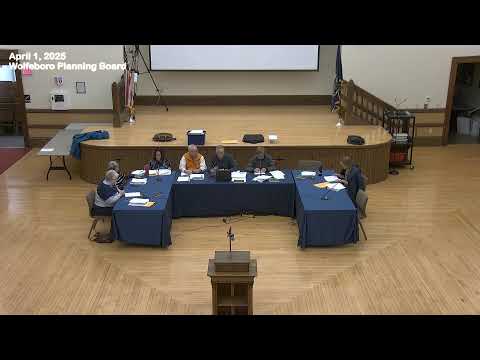
The Wolfeboro Planning Board on April 1 accepted a formal site-plan submission for a proposed 20-court pickleball complex at the Wolfeboro Center parcel but voted to continue the public hearing to May 6 so the applicant can supply additional studies and plan revisions requested by the board and the public.
Paul Bog of Norway Plains Associates presented the Vander Heyden Family Pickleball Center application on behalf of the New Hampshire Lakes Region Pickleball Club and Wolfeboro Center LLC. The proposal calls for a 208-by-24-foot building containing eight indoor courts and 12 outdoor courts, roughly 34 acres of property, and an initial plan for 99 parking spaces that the applicant said would be reduced to about 90 spaces to comply with a 50% rule in the town’s regulations. Access is proposed via a 22-foot-wide driveway; stormwater treatment would use infiltration basins, rain gardens and porous pavement. The applicant told the board that the project will require New Hampshire Department of Transportation driveway approval, New Hampshire Department of Environmental Services (AOT) permitting for alteration of terrain, and an EPA construction stormwater permit.
The board accepted the submittal as complete and opened a public hearing. Dozens of residents and stakeholder groups then spoke, raising three central concerns: traffic and pedestrian safety at the Route 109/Route 28/rail-trail area, potential noise impacts on the nearby Wolfeboro Center Community Church (a property on the National Register of Historic Places), and stormwater/groundwater protection. Maggie Steer of the town Heritage Commission urged the board to watch for potential Section 106 review under the National Historic Preservation Act if any federal permitting (for example, an EPA permit) qualifies as a federal undertaking.
Residents reported past tournaments that drew hundreds of participants at other venues and urged the board to test the applicant’s traffic assumptions. Beth Baldwin, a longtime Wolfeboro resident, told the board she believes tournament traffic should be routed to Route 28 rather than Route 109 and asked the planning board to require an accurate baseline traffic study for summer months and tournament surge conditions. Noreen McDonald, trail ambassador for the Cotton Valley Rail Trail Club, warned that sight-distance and pedestrian crossing safety at Fernald Crossing would be affected by the proposed driveway on Route 109.
“We are extremely concerned regarding the increase in vehicles proposed to use only Route 109 to enter and exit,” McDonald said during public comment.
The applicant, represented by Paul Bog and by Joe (identified on the record as president of the New Hampshire Lakes Region Pickleball Club and appearing by GoToMeeting), said their operations historically ran tournaments without major parking failures and that some play would free up spaces at Foss Field. The applicant also described three underground 30,000-gallon cisterns planned to support fire-protection pumping; initial fills would be trucked in and the cisterns would tie to the site well for topping up, the presenter said.
Town engineering review comments from consultant Tighe & Bond and the planning office highlighted multiple technical items to be revised. The planning board requested — and included in its continuation motion — a specific list of materials and studies the applicant must provide for the May 6 meeting: feedback and any conditions from NHDOT on access and curb cuts (the applicant agreed to submit DOT applications after the meeting), a traffic study that considers existing summer baseline traffic and tournament surge, any Section 106/historic-preservation determinations triggered by federal permits, a noise-impact assessment or mitigation plan (consistent with the ZBA requirement that noise be addressed), responses to Tighe & Bond’s plan review comments, clarification of parking and porous-pavement choices (including snow-and-salt management), correction of an incorrectly labeled Wentworth Watershed Association reference on plan sheets, elimination or clarification of “function room” spaces that the Zoning Board of Adjustment did not approve, and updated site plans showing any other changes (for example, lighting and landscaping adjustments suggested by reviewers).
Chair Doug Breskin moved to continue the public hearing to May 6 and listed the requested deliverables; the motion passed on a voice vote. The board also directed staff to invite input from the Heritage Commission and to track DOT feedback when it arrives.
Why it matters: The proposal would create one of the town’s largest recreational facilities with repeated event activity; the scale and location raise potential safety, noise, historic-preservation and stormwater questions that could affect users of the rail trail, neighbors, and the nearby historic church.
What’s next: The applicant will submit DOT and AOT permit applications, respond to the technical plan-review comments, and return to the planning board on May 6 with a traffic study, noise and historic-impact materials, and revised plan sheets addressing the reviewer comments and the board’s list of requested items.