Get Full Government Meeting Transcripts, Videos, & Alerts Forever!
Get email alerts on the Juvenile Court Findings topic
No spam. Unsubscribe anytime.
Committee moves bill requiring judges to make written findings before committing some juveniles to state facilities
Summary
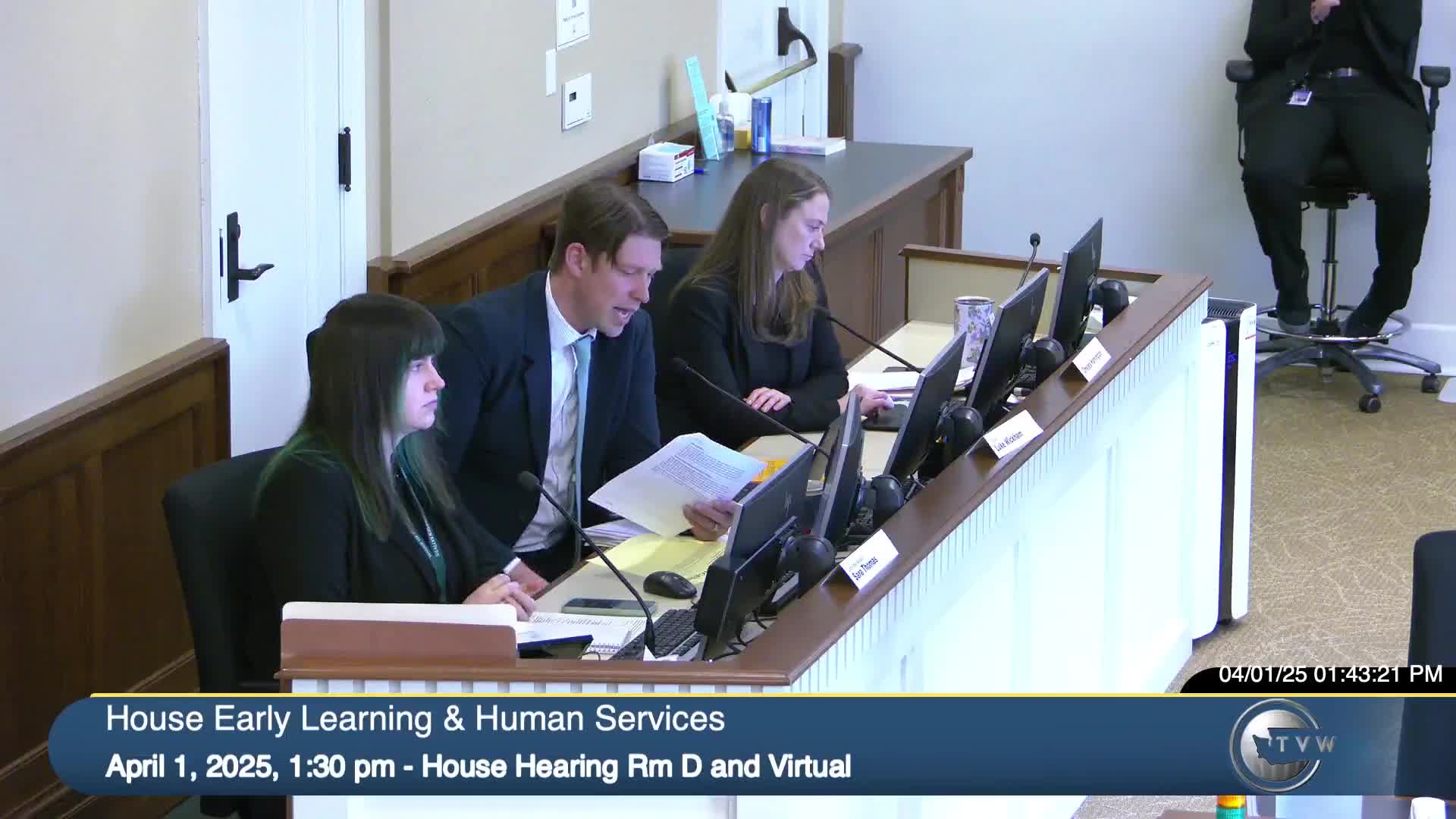
The committee adopted a striking amendment and reported Engrossed Second Substitute Senate Bill 5296 out of committee with a due-pass as amended recommendation.
The Human Services, Youth, & Early Learning Committee adopted a striking amendment and reported Engrossed Second Substitute Senate Bill 5296 out of committee with a due-pass as amended recommendation. The bill requires courts to make a written finding that commitment to a juvenile rehabilitation institution is necessary because a community-based placement would not adequately protect the community before committing certain people to a state juvenile institution, and it revises eligibility for certain dispositional alternatives.
Representative Luke (committee staff) summarized the striking amendment (H-2015.1) as narrowing the set of exclusionary offenses that would preclude the court's required finding and applying that same list to newly expanded disposition alternatives (including the chemical-dependency/mental-health disposition alternative). The striking amendment lists exclusionary offenses that include "a serious violent offense," violent offenses with specified criminal history, "**** of a child in the first or second degree," "**** in the second degree," "hit and run resulting in death," and "child molestation in the first degree"; committee discussion referenced those specific categories as exclusions in the amendment.
The striker also requires DCYF to negotiate contractual agreements with juvenile court administrators for county confinement terms of less than 90 days and states counties are not required to provide custody under existing contracts. The amendment directs DCYF to prioritize setting the release date for juveniles who would serve less than 90 days under state supervision and to consider infractions while in custody.
Representative Goodman, who moved adoption of the striking amendment, said the changes narrow eligibility and provide local jurisdictions assurance that the state will bear the expense for any confinement negotiated under the new terms. Representative Goodman added that the bill provides for a midpoint review of a youth's progress while in a state facility so a court can consider return to local placement. "Confinement in an institution far away from home often exacerbates that behavioral health disorder," Goodman said, arguing the bill seeks a careful balance between rehabilitation and community safety.
The committee adopted the striking amendment and voted to report the bill out with a due-pass as amended; the clerk recorded six ayes and five nays without recommendation.