Get Full Government Meeting Transcripts, Videos, & Alerts Forever!
Get email alerts on the Parking Policy topic
No spam. Unsubscribe anytime.
Bill would let cities allow parking across driveway mouths in some residential neighborhoods
Summary
Substitute House Bill 10-61 would let a city or county, by ordinance or resolution, permit residential property owners to park across the point of ingress or egress of their own driveway if the vehicle does not obstruct a sidewalk, another driveway or the roadway and the driveway is 50 feet or shorter.
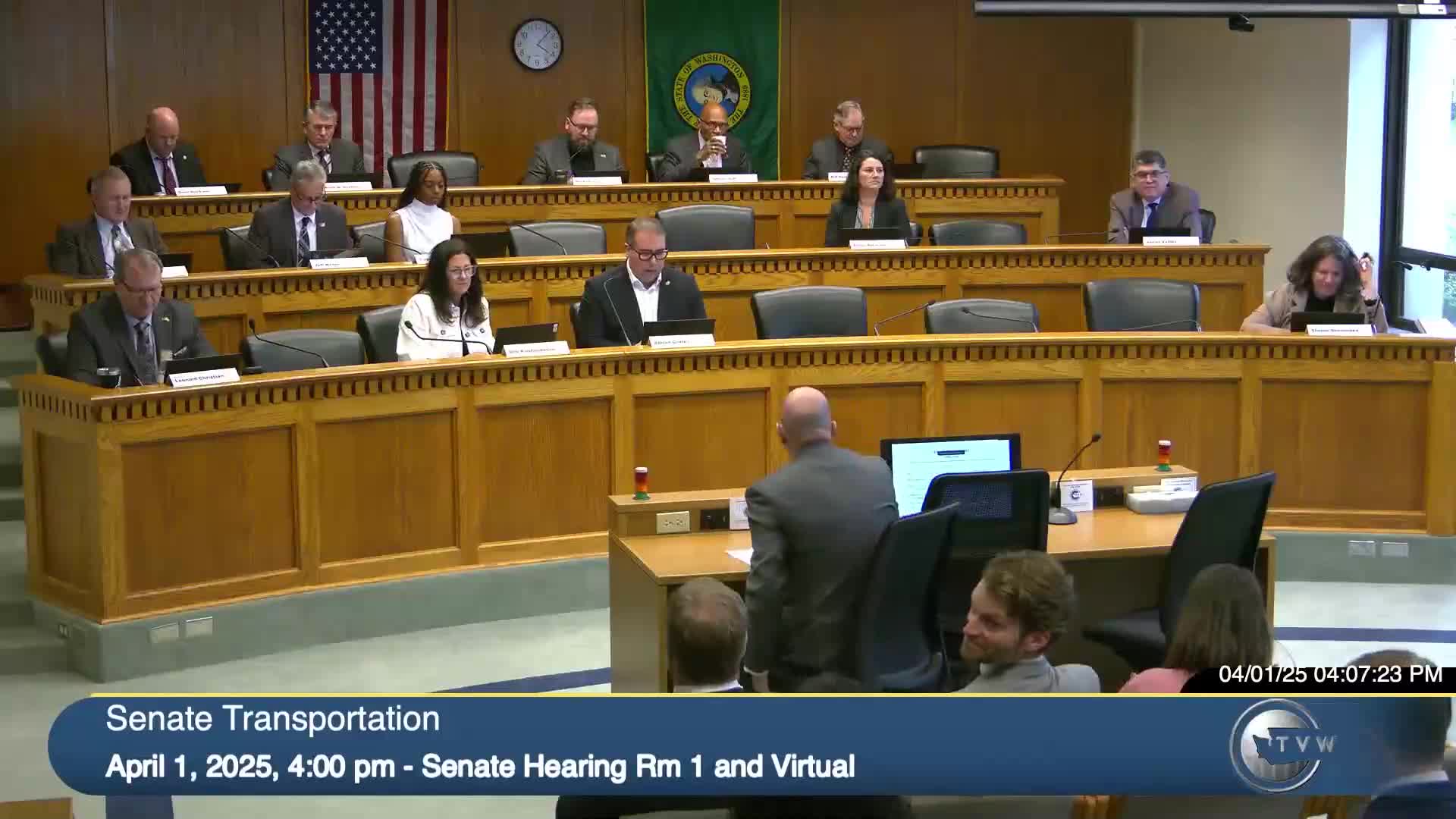
Substitute House Bill 10-61 would authorize a city or county to allow residential property owners to park across the point of ingress or egress of their own driveway so long as the parked vehicle does not obstruct a sidewalk, another driveway or the roadway, and the driveway is no longer than 50 feet, staff and the bill’s prime sponsor told the Senate Transportation Committee.
Brandon Popovac, committee staff, summarized current law that makes it unlawful to park in front of a driveway beyond a curb radius, with narrow exceptions for safety and brief passenger pick-up. He said HB 10-61 would create a local option — municipalities could adopt ordinances or resolutions allowing blocking of the driveway mouth when it would not impede sidewalks, adjacent driveways or the roadway. The fiscal note showed no state fiscal impact.
Representative Jared Lowe, the prime sponsor, said the measure responds to parking shortages as housing density increases — especially in neighborhoods with ADUs or tighter setbacks — and emphasized that the change is permissive for local governments, not mandatory. “We did work with the state fire marshal to make sure if the driveway is not more than 50 feet long that you're not blocking so that they can get a fire hose up there easier,” Lowe said.
Opposition concerns: Randy Haines, fire marshal for the Olympia Fire Department, testified in opposition. He told the committee that street parking can delay fire and emergency medical response and cited national fire-protection standards as reasons for caution. Haines urged collaboration and careful local analysis to avoid compromising emergency access.
Local officials and mayors who testified in favor said the bill would create modest additional on-street capacity in older neighborhoods. Brent Gailey, mayor of Lake Stevens, said a Lake Stevens example would add 11 on-street stalls in a 55-home subdivision — a 22% increase in parking for that neighborhood — and that the measure includes a 50-foot limitation and remains a local option.
Implementation issues flagged in the hearing included enforcement, public awareness, impacts on emergency access on narrow streets and the tension between local traffic needs and life-safety concerns. Committee members asked sponsors to clarify how the bill would work in practice, and Lowe said local decision-making and fire-department input were central to the design.
Ending: The committee heard competing testimony from public safety officials and local officials and stakeholders; no formal action or vote was recorded in the transcript.