Get Full Government Meeting Transcripts, Videos, & Alerts Forever!
Get email alerts on the Land Use Leasing topic
No spam. Unsubscribe anytime.
Bill would let WSDOT consider public benefits when leasing unused highway land
Summary
Substitute House Bill 17-74 would allow the Washington State Department of Transportation to count social, environmental or economic public benefits as part of the consideration when leasing unused highway land.
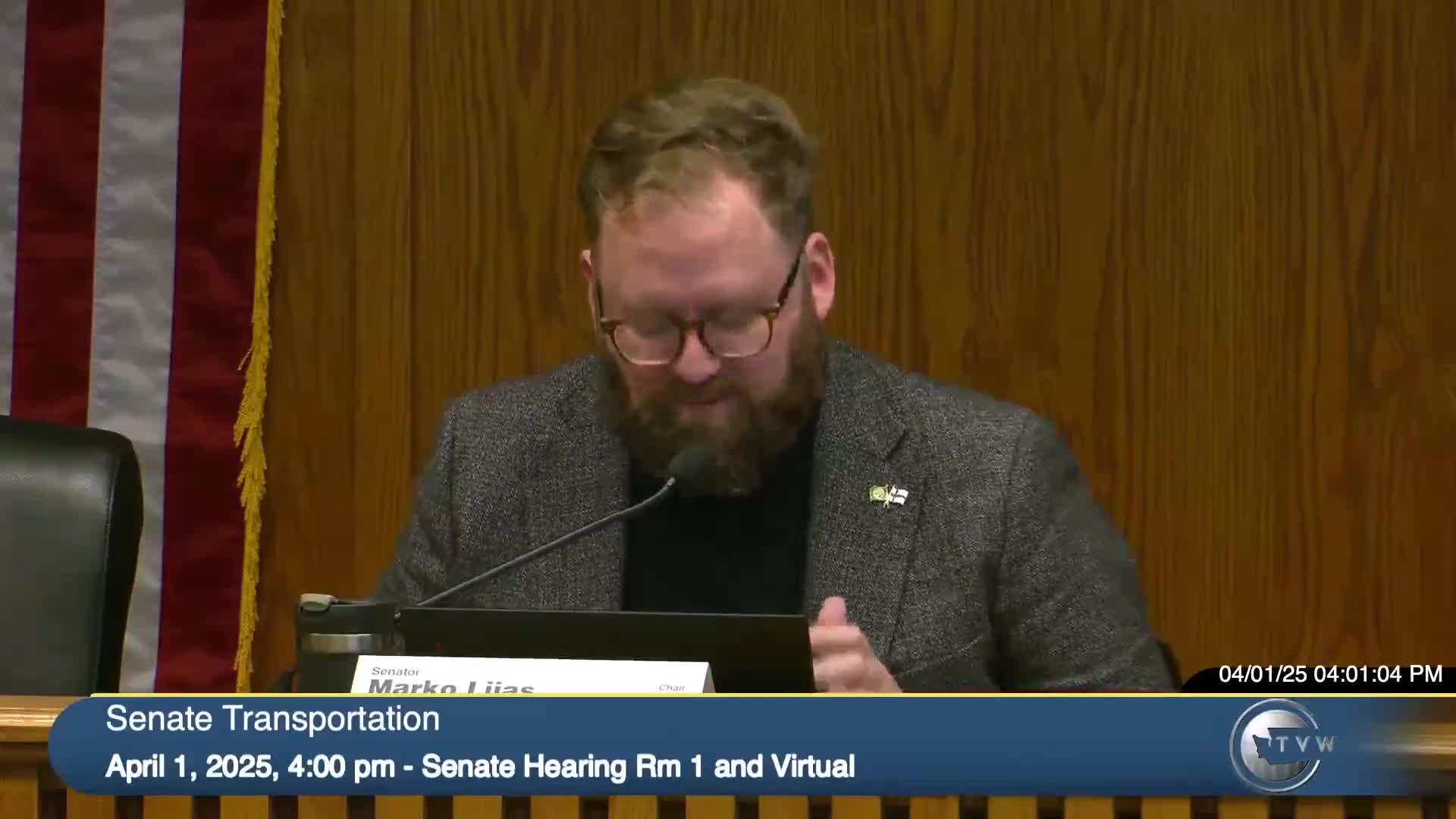
Substitute House Bill 17-74 would allow the Washington State Department of Transportation to count “social, environmental, or economic benefits” provided by a lessee as part of the consideration for leasing unused highway land, according to a staff briefing and testimony before the Senate Transportation Committee on April 1, 2025.
The bill would let WSDOT lease highway land and air space that is not needed for highway purposes under a new methodology that factors community uses such as housing, housing assistance, shelter programs, parks, enhanced public spaces, public recreation and public transportation uses. Kelly Simpson, committee staff, told the panel that under current law DOT generally must receive economic rent or fair market value but federal law already provides an exception when property was acquired with federal funds and a lease provides public benefits.
Why it matters: proponents say the change could move underused parcels into productive public use — from parks to maintenance yards to housing-adjacent services — and reduce state maintenance costs on neglected rights-of-way. Sponsors and community groups emphasized the bill’s potential to provide low- or no-cost stewardship for sites that otherwise remain vacant or deteriorating.
Representative Mandy Fey, the bill’s prime sponsor, said the proposal grew from a “late breaking request” tied to an affordable-housing and community-improvement opportunity in her district and stressed that the language was developed with WSDOT attorneys. “This is a leasing situation; this is not transferring the property — it is simply leasing in certain circumstances,” Fey told the committee.
Community groups and local officials testified in support. Jennifer Saunders, director of the Washington State Historical Society, said HB 17-74 would allow the society to lease and restore Pagnetti Park in Tacoma, which she described as “run down” and subject to encampments. Don (Jerry) Pagnetti, whose father is the park’s namesake, also testified in support, saying a lease would allow a “more willing steward” to maintain and secure the park. Tacoma Mayor Victoria Woodards told the committee the property is state-owned and said the historical society is willing to lease and maintain it.
Nonprofit housing providers told the committee the bill would unlock projects that are currently infeasible under a strict market-value lease requirement. John Grant, chief strategy officer for the Low Income Housing Institute, said a WSDOT gravel lot returned a market rental appraisal of $600,000 per year — an amount “way above and beyond what a nonprofit would be able to lease” — and that the bill would enable use of a $2 million matching grant to move people out of unsafe RV encampments.
Some tribal concerns: Lonnie Greninger, vice chair of the Jamestown S’Klallam Tribe, testified in general support but requested an amendment to explicitly add federally recognized tribes to the list of eligible public entities in section 2 so tribes could be lessees for projects such as bus maintenance facilities.
Fiscal and limits: staff reported a one-time fiscal impact of just under $500,000 to manage the new leases. Simpson said the bill would require lessees to maintain and secure premises and would bar housing or shelter programs directly on highway right-of-way (the transcript indicates restrictions on providing housing or shelter “on the highway right away”).
What the bill does not do: it does not transfer ownership of state property and, as sponsors emphasized, leaves WSDOT’s existing protections in place. Several witnesses asked the committee to clarify implementation details and to consider an effective date or emergency clause if rapid deployment of projects is desired.
Next steps: the committee held the public hearing and collected proponent testimony; no committee action or vote was recorded in the transcript. The committee invited amendments, including the tribal-eligibility language requested by Jamestown S’Klallam.
Ending: Supporters said HB 17-74 would convert neglected state-owned parcels into community assets — from restored parks to facilities supporting transit and housing work — while retaining WSDOT safeguards and a lease framework rather than transfer of land.