Get Full Government Meeting Transcripts, Videos, & Alerts Forever!
Get email alerts on the Nonprofit Funding Grants topic
No spam. Unsubscribe anytime.
Nonprofits tell committee reimbursement grants and delayed contracts hamper BIPOC-led groups; Commerce outlines limits and pilots
Summary
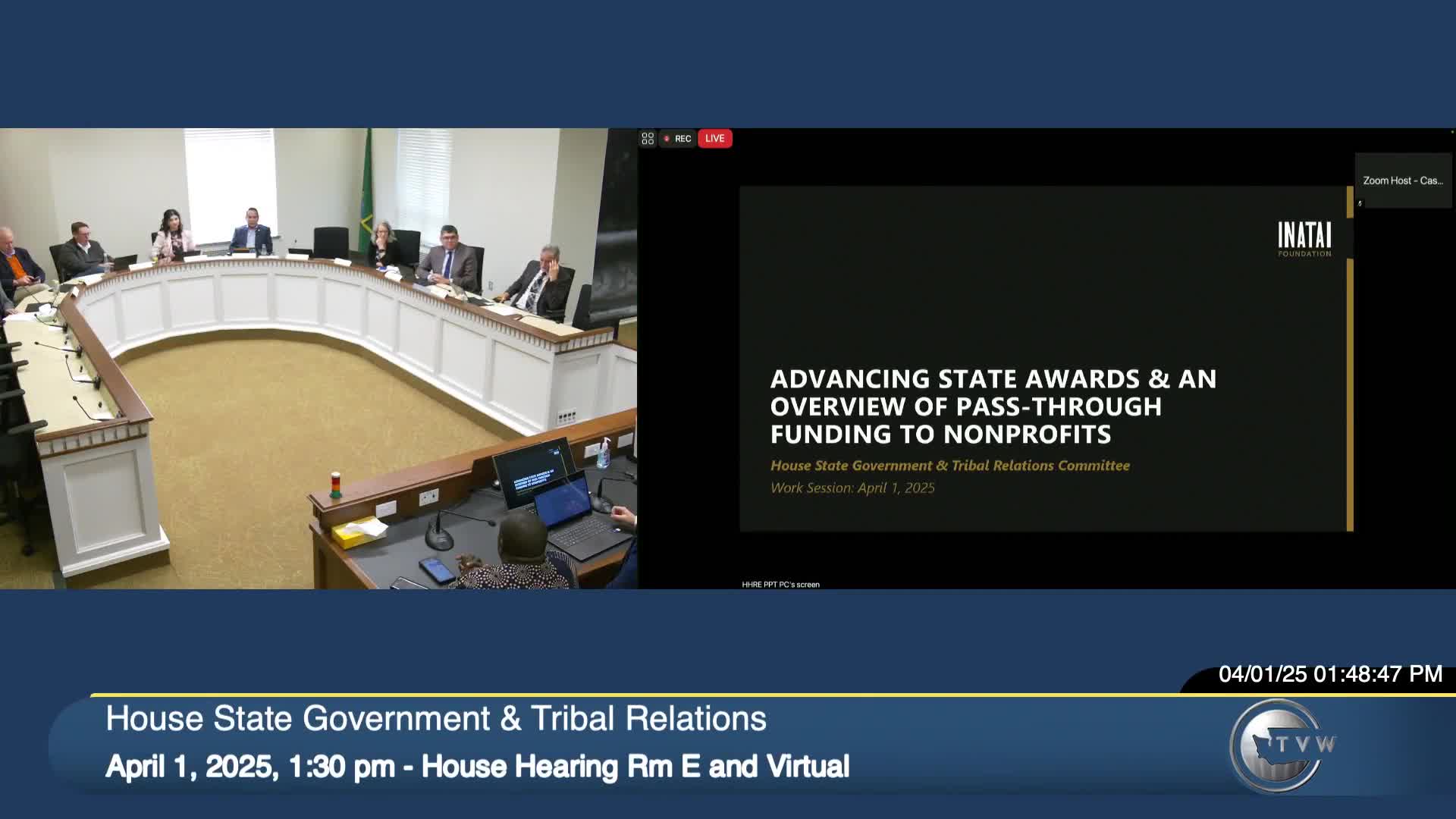
Nonprofit leaders told the House State Government & Tribal Relations Committee that the state’s reimbursement-based grants, delayed contract signatures and tight allowable-cost rules create cash‑flow and implementation barriers—problems that particularly harm small, BIPOC-led organizations.
Nonprofit leaders and funders told the House State Government & Tribal Relations Committee that Washington’s reimbursement-based grants and delayed state contracts create structural barriers for small and culturally specific organizations, limiting their ability to deliver services.
Pausman Jouf, founder and executive director of the Washington West African Center, said many start-up and BIPOC-led groups rely on private philanthropic seed money to implement state-funded projects because Commerce’s grants are often reimbursement-based and restricted. "The reimbursement based grants making system is definitely something that we are concerned about," Jouf said, describing a Sub-Saharan Africa project where large portions of the award remained unspent near the fiscal-year end because allowable costs were too restricted for community needs.
Shavona McKeown, executive director of the Southwest Washington Equity Coalition, said reimbursement contracting forces nonprofits to take on loans or build reserves before applying. "One of the organizations we work with had to take out a significant loan to cover the upfront costs of implementing the award they were granted by Commerce," McKeown said. She said delays of up to six months for reimbursement have jeopardized payroll and programming.
Shawnee Fitzgerald, founder of Women of Wisdom and the Washington African American Chamber of Commerce, urged more upfront funding and regional parity for Eastern Washington organizations, saying delayed payments and upfront cost requirements prevent small businesses and nonprofits from applying for state funding.
Nella (surname not specified), executive director of Encompass and member of the Nonprofit Association of Washington (NAWA), gave a quantitative example: the early childhood ECAP contract the organization runs had a permitted indirect cost rate of 5% while the organization’s actual administrative cost rate is roughly 24%, meaning the contract covered “slightly less than 75% of our actual costs,” she said. Encompass also reported contract signature delays that pushed initial payments months after the July 1 contract start date.
Representatives from the Department of Commerce acknowledged the problems but described statutory and accounting constraints. David Pringle and Kyle Gitchell said Commerce manages more than 200 programs and, in the 2023–25 biennium, executed more than 4,000 new contracts. "A majority of this work is a pass-through contract that goes to a service provider or building something throughout the state," Pringle said. Kyle Gitchell cited the state constitution (Article 8, sections 5 and 7) and RCW 43.88.160 as legal restrictions that limit the agency’s ability to advance funds to private entities.
Officials described several partial responses: partnering with local philanthropic intermediaries (community foundations) that can provide upfront funding; piloting performance-based contracting to release payments at specific milestones; expanding capacity-building and technical assistance for grantees; and exploring CDFI partnerships. Omar Santana Gomez of the Governor’s Office of Equity and Belonging said his office is convening agencies to standardize RFPs and streamline licensing and procurement processes across state agencies.
Philanthropic intermediaries said they are already bridging the gap. Seth Kirby of Greater Tacoma Community Foundation described a partnership with the Office of Financial Management to distribute nearly $2 million in census outreach and a $5 million Community Reinvestment Project partnership with Commerce to distribute funds to Black, Latinx and Indigenous organizations. Zeke Smith of Empire Health Foundation said advancing funds from a foundation endowment enabled dozens of Eastern Washington nonprofits to implement homelessness and community reinvestment work without the delays of reimbursement.
Community presenters asked the committee to require more consultation with culturally specific organizations when drafting RFPs, allow flexible and multiyear general operating grants, and reduce reporting burdens. Commerce and equity office staff said they will continue work with partners and the legislature to identify statutory and process changes.
The committee signaled interest in follow-up briefings and thanked witnesses for a session the chair called "informative and helpful."