Get Full Government Meeting Transcripts, Videos, & Alerts Forever!
Get email alerts on the Voting Rights Incarcerated topic
No spam. Unsubscribe anytime.
Massachusetts hearing spotlights push to restore voting rights for incarcerated people
Summary
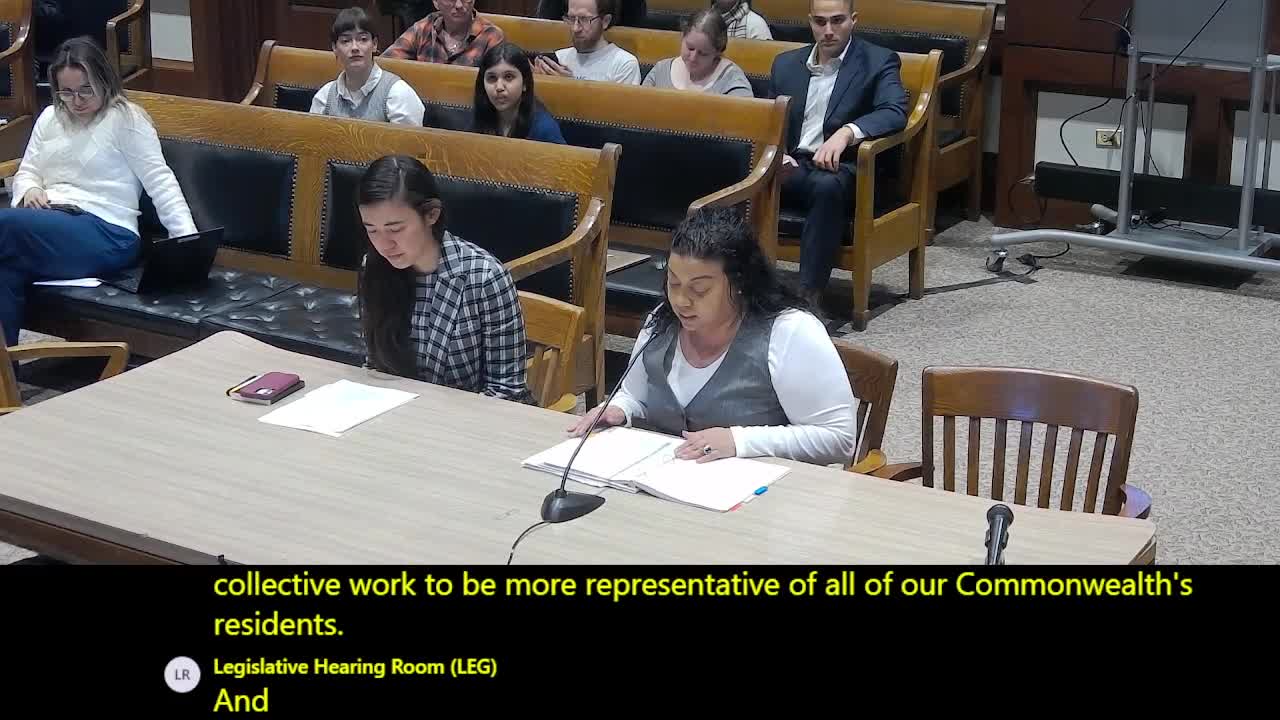
Senator Liz Miranda of the Second Suffolk District and Representative Bridal Eiderhoven urged the Joint Committee on Election Laws to report favorably on S7/H63, a proposed constitutional amendment to restore voting rights to people incarcerated for felony convictions.
Senator Liz Miranda of the Second Suffolk District and Representative Bridal Eiderhoven urged the Joint Committee on Election Laws to send S7/H63 — a proposed legislative amendment to the Massachusetts Constitution to restore voting rights to people incarcerated for felony convictions — out of committee with a favorable report.
The proposal would reinstate a right that supporters said existed in Massachusetts until a constitutional change roughly 25 years ago. "Voting is not a privilege. It is a right," Senator Miranda told the committee, noting that more than 7,000 people in the Commonwealth are currently disenfranchised by felony-based bans and that Black and Latino residents are disproportionately affected.
Supporters — including more than two dozen people who testified remotely from state prisons — framed the change as one that would strengthen civic ties, support rehabilitation and reduce recidivism. "Being able to vote can also be meaningful and have a positive influence when incarcerated," said Maurice Skillman of MCI Norfolk, an African American Coalition Committee advocate. Several speakers said participation behind the wall had increased political education and civic engagement among incarcerated people.
Committee members asked how voting would work in practice. Miranda and Eiderhoven said the proposed constitutional amendment itself would not set detailed rules about registration or domicile. Miranda pointed to prior state work on jail-based voting and said the secretary of state and the Department of Correction had already collaborated on access for some incarcerated people. Representative Eiderhoven added that court decisions such as Dane v. Board of Registrars of Concord have left questions about domicile and voting logistics open to interpretation, and said those practical details would be addressed later in implementing legislation if the amendment were approved.
Advocates and outside groups pressed several themes: racial justice, Massachusetts history and public‑safety benefits. Andrea James, founder of Families for Justice is Healing, argued that felony disenfranchisement has a disparate racial impact and described the 25-year-old amendment that removed the right as a regression. Nicole Porter of The Sentencing Project highlighted research linking civic engagement to reduced recidivism and urged a favorable report from the committee.
Speakers described the current scale and some logistical context: advocates said more than 7,000 Massachusetts residents are disenfranchised by the felony ban, and testimony referenced a current incarcerated population in state facilities under 6,000 (testifiers noted the number varies by facility and jail vs. state prison). Miranda told the committee that, if sent to the ballot and approved by voters, the soonest the public could vote on the amendment would be the February 2028 election cycle.
Several currently incarcerated witnesses described personal experiences of political education and civic organizing behind the walls. "For the first time ever, I felt seen and included by lawmakers," said Corey Al Amin Patterson of MCI Norfolk. Joshua Bridal (also known as Hamza) described voting in a recent election as empowering and said the opportunity to vote encourages responsibility and community investment.
Outside organizations including Common Cause Massachusetts, the ACLU of Massachusetts, Campaign Legal Center, Partners in Democracy and Progressive Massachusetts urged the committee to advance the bills. They pointed to policy work the legislature has already done — notably the Votes Act and jail‑based voting improvements — as precedent for figuring out logistics and access.
Opponents or questions about the proposal were largely procedural during the hearing; Representative Frost asked whether people convicted of the most serious crimes should be allowed to vote while incarcerated, a point witnesses rebutted by arguing that civic participation and rehabilitation are not negated by serious offenses and that disenfranchisement is not an effective tool for remedying harm.
The hearing concluded with the committee accepting written testimony through April 8 and with no immediate vote recorded on the amendment. Committee chairs thanked the Department of Correction for coordinating remote testimony from multiple facilities and closed the hearing.
The bill numbers before the committee are S7 and H63; if enacted into law the amendment would be placed on a statewide ballot for voter approval before taking effect. The committee did not adopt implementing rules at the hearing; proponents said practical questions about registration, ballot delivery and domicile would be addressed in subsequent statutory work or guidance from the secretary of state if the amendment reaches the ballot and voters approve it.