Get email alerts on the Internal Services Facilities Contracts topic
No spam. Unsubscribe anytime.
Clark County Internal Services details staffing, facilities backlog and contracts centralization
Summary
Director Michelle Shuster summarized Internal Services’ staffing, facilities portfolio and budget priorities, noting 61 employees, 56 county sites, major capital spending and a multi‑year project to centralize contracts.
Michelle Shuster, Director of Rental Services for Clark County, outlined the Internal Services Department’s staffing, facilities portfolio, budgets and projects at a county council work session, saying the division employs 61 people and manages maintenance for dozens of county properties.
Shuster said the presentation matters because Internal Services supports county operations across 56 unique sites and more than 258 structures, manages major capital projects and is working to centralize contracts and leases into a single database to improve oversight and reduce fragmentation.
Shuster told councilors the department has 61 positions, including seven two‑year project positions that were recently approved. Facilities management is the largest unit with 39 employees, including electricians, carpenters, HVAC technicians, plumbers, a locksmith and custodial support. Facilities covers maintenance across the county’s portfolio, which Shuster said totals more than 1,800,000 square feet and generates over 17,000 work orders annually.
She described other Internal Services functions: a mailroom and print shop staffed by two cross‑trained employees, a contracts and leasing team that is centralizing agreements, a three‑person records unit that stores roughly 16,000 boxes of retained records, a four‑person procurement/purchasing team and a small financial management group that supports multiple departments. Shuster said the print shop produces about 1,700,000 pages per year and the mailroom processes roughly 800,000 outgoing pieces annually.
On procurement and contracts, Shuster said the county is working with Bonfire (the vendor) to import contract metadata into a centralized system. “They’ll be loading the data, but we’ve gotta get the data into a format first for them, and then they’ll load it,” she said. An Office Assistant (one of two floaters) will help attach contracts and enter new ones; Shuster estimated the import and attachment work will take “probably at least another year” to reach a usable state.
Shuster and councilors discussed staffing tradeoffs between in‑house labor and contracting out. Shuster noted state requirements affect cost and capacity: “If we contract out labor, we have to pay Washington state prevailing wage,” and for capital project work the county may perform 10% or less in house under state rules, with most large projects contracted out. She said Internal Services currently contracts the overwhelming share of major maintenance because it lacks the in‑house capacity for large projects.
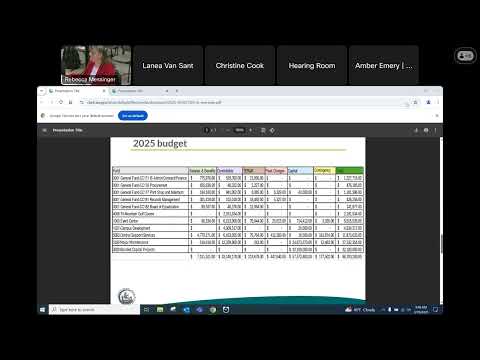
Budget figures in Shuster’s slides show the department manages multiple funds. She said roughly $57,000,000 of the department’s approximately $98,000,000 total is dedicated to capital projects; the major maintenance fund was described as roughly $37,000,000. Shuster also described a bonded capital fund presented as “$30.20 bonded capital,” which she said covers three projects: a jail work center (64‑bed medium security), a district court renovation and an elections remodel. The Tri Mountain Golf Course budget was listed at 2,200,000 and the custodial contract was described as just over $1,000,000 per year.
Shuster characterized the department as largely reactive today and said staff are working with the budget office to build a longer‑range capital and maintenance forecast. She said the county authorized partial funding in February 2019 to perform a facilities condition assessment for larger buildings but that many county properties still lack full condition reports. That assessment work and department requests to deliver six‑ to 20‑year maintenance forecasts remain in progress.
Councilors pressed on efficiency and staffing “sweet‑spot” questions and on how to show public performance. One councilor said keeping skilled staff for small repairs can be cheaper than hiring contractors for routine fixes; another urged publishing success metrics. County staff and councilors said dashboards and newsletters are being used to highlight service performance and that more public data is planned.
No formal action or vote was taken during the presentation. Shuster and councilors acknowledged ongoing constraints: rising supply and construction costs, anticipated retirements and heavy procurement demand that prompted the recent project positions. Shuster thanked council members and said the new procurement/project hire starts next month and will help reduce a backlog of requests.
AI generated
The text on this page is AI generated. Summaries, highlights, analysis, and video transcripts are all produced from the original source material.
AI can make mistakes, so if you spot one, and we will fix it for everyone.
Note: the source content is unaltered by us. Any content source we link to, be it a video, an audio recording, or a document, is presented exactly as its publisher released it. That publisher is usually a government body, sometimes an individual official or another organisation.