Get Full Government Meeting Transcripts, Videos, & Alerts Forever!
Get email alerts on the School Crosswalk Safety topic
No spam. Unsubscribe anytime.
Clark County to restripe school corridor this summer, officials say; community raises congestion and enforcement concerns
Summary
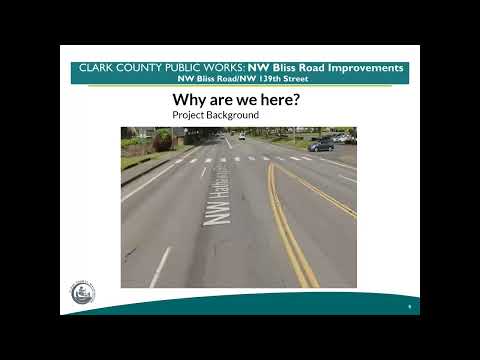
Clark County Public Works presented a restriping and safety plan for a corridor that serves Chinook Elementary School, Skyview High School and nearby Alki Middle School, saying the county will use this summer’s paving work to change striping, add buffered bike lanes and painted pedestrian refuges and to shorten the number of traffic lanes pedestrians must cross.
Clark County Public Works presented a restriping and safety plan for a corridor that serves Chinook Elementary School, Skyview High School and nearby Alki Middle School, saying the county will use this summer’s paving work to change striping, add buffered bike lanes and painted pedestrian refuges and to shorten the number of traffic lanes pedestrians must cross.
County Public Works Director Ken Later introduced the project and told the audience the effort is “really a painting project” tied to the county’s 2025 HMA overlay paving work. Transportation Division Manager Steve Gallup described a past pedestrian fatality from an earlier job that influenced the county’s approach and said, “I never wanna have that happen again.” Traffic engineer Dylan Jennings told residents the project aims to eliminate the “multi lane threat” by reducing the number of through lanes at marked school crossings so pedestrians cross a single traffic lane in each direction rather than two.
The plan described to the public includes: updating Americans with Disabilities Act (ADA) ramps; a two‑week paving window the county hopes to schedule after schools let out (staff cited a June 17 start as the target); painted center islands and tubular markers at crosswalks; dedicated left‑ and right‑turn lanes at certain intersections; neon green high‑visibility bike lane paint with a buffer, and additional signage that cites state law to remind motorists to stop for pedestrians in crosswalks. Staff said the restriping is intended to be reversible and iterative: “It’s just paint,” Later said while adding the county will monitor and change the layout if needed.
Staff emphasized the limits of the current scope: the county did not receive a Safe Routes to School grant that would have funded flashers, concrete refuges and other higher‑cost hardware. Project staff said those elements cost far more—roughly $200,000–$300,000 per flashing beacon—while the paint‑based plan is substantially less expensive but still nontrivial (design and paint amounts were described as “close to a quarter million dollars” for this striping approach). The county said it will continue to seek grants and will apply for the next Safe Routes to School cycle in 2026.
Residents, bus drivers and crossing guards pressed staff on queuing and safety during peak pickup and dropoff. Speakers reported regular “close calls,” bus delays and lines backing up past nearby intersections and private driveways. One crossing guard said incidents happen “regularly.” Multiple residents asked whether the proposed single through lane would make peak congestion worse and how emergency vehicles and buses would be affected; staff replied that the arterial currently carries about 9,000 vehicles per day and that, by federal/state guidance cited by staff, a single lane in each direction can handle far more than the present daily volumes. Staff also cited prior experience and studies from nearby jurisdictions showing repurposed center space can reduce crashes 25–50% while causing only small increases in travel time.
Board members and residents asked whether enforcement (sheriff presence) and signalization would be a better or complementary solution. Staff said signal warrants will be studied where appropriate and that the county and school district will continue coordination; they also encouraged residents to report unsafe driving so enforcement can respond. Staff said they are already coordinating with the school district about on‑campus circulation and that some lot changes there could reduce roadway queuing.
The county said AD A ramp work will start within about a week and be done in roughly one week to meet paving requirements; the paving and restriping are scheduled to begin after the school year ends and to be completed before the next school year. Staff said they will collect post‑installation data—speeds, volumes, observed crosswalk performance and crash reports—“a couple weeks after, then a couple months” to evaluate whether changes are needed.
Residents asked for a stronger community role in future grant applications; staff said they welcome written comments and will post FAQs and project materials on the project website. Several residents asked the county to prioritize enforcement and school‑site operational changes alongside the roadway work. The presentation closed with staff asking for written comments and pledging to continue community outreach as the project is implemented.