Get Full Government Meeting Transcripts, Videos, & Alerts Forever!
Get email alerts on the Parks And Recreation topic
No spam. Unsubscribe anytime.
Clark County warns parks operations short on funding; staff proposes task team to study new revenue
Summary
Parks and Nature staff told the Clark County Council that operating funds lag national benchmarks, leaving the department with deferred maintenance and limited capacity to open new parks. Staff recommended forming a stakeholder task team to evaluate funding options and next steps.
Clark County Parks and Nature managers told the Clark County Council during a work session that the department lacks sufficient operating funds to maintain current parks and support planned growth, and recommended forming a stakeholder task team to evaluate new revenue and funding strategies.
Deputy Director of Public Works Jenny Coker and Ross Hoover, Division Manager of Parks and Nature, told councilors the county maintains 7,166 acres across 111 parks and sites but has only 31 full‑time operations staff and an operating budget of about $8.14 million for maintenance and operations. Hoover said the county’s operating expenditure per capita — about $15.62 — is roughly 26 percent of the National Recreation and Park Association median for similarly sized agencies, and staffing (0.59 full‑time equivalents per 10,000 residents) is far below the national median of 4.7.
Those gaps, staff said, produce deferred maintenance and limit the department’s ability to develop planned sites. “We will not meet growth needs for parks and nature facilities because of the O&M operating budget gaps,” Hoover said. He warned that without additional operating funding the county could have to limit or close amenities and defer development of sites currently being held for future parks.
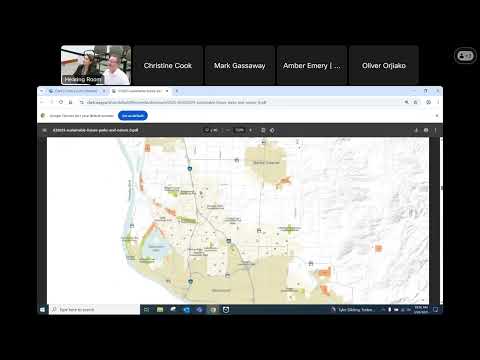
Why it matters: Clark County is projected to continue rapid population growth, and the department’s Parks, Recreation and Open Space (PROS) plan identifies acreage and development gaps the county intends to fill. Staff told councilors the primary constraint to filling those gaps is operating funding, not capital: the county can identify and acquire sites but lacks the recurring dollars to staff and maintain them.
Staff presented three budget scenarios: “decline” (do nothing, accept closures and reduced services), “sustain” (close the current gap so parks remain open at current levels), and “fulfill” (fund operations at levels consistent with peer counties to address deferred maintenance and meet projected growth). Hoover and Coker recommended steps common to any scenario: rebalance the Parks and Nature portfolio with city partners, revitalize regionally significant sites, operationalize existing assets through partnerships, and plan intentionally for transfers of neighborhood parks as cities annex growth areas.
Staff also described operational indicators and usage: 1,700 picnic shelter reservations in 2024; about 3,600 hours of use at Luke Jensen Park in a year; 5,616 annual parking passes sold; and roughly 39,000 day‑of parking transactions, which staff said undercount total visits. The county’s population was cited in the presentation at about 521,000 residents.
Council questions and discussion focused on level‑of‑service standards, the Greater Clark Park District (GCPD) funding boundary, holding land for future parks, and potential funding mechanisms. Hoover explained that the county’s PROS plan defines local level‑of‑service targets (for example, 5 acres per 1,000 residents within the Vancouver urban growth boundary) and that impact fees and other capital funding can buy land but operating funds are needed later to open and maintain it. "There is a time period by which impact fees need to be expended," Hoover said.
Budget staff explained a one‑year spike in revenue in 2023 reflected a general‑fund subsidy to help cover deferred maintenance; Nick Bundy of the budget team said general‑fund dollars had subsidized operations that year. Councilors asked staff to separate general‑fund subsidies from baseline revenues in future forecasts.
Staff recommended creating a “sustainable future” stakeholder task team (or a similarly named body) to evaluate potential funding mechanisms and report back to council. The proposed group would include broad community representation (cities, nonprofits, frequent park users, trail advocates and experts on public‑finance mechanisms). Staff proposed a roughly six‑ to nine‑month process with monthly or more frequent meetings and the potential to include parks advisory board members, city staff, and technical experts on funding mechanisms.
No formal action or vote occurred during the work session; councilors asked staff to return with more detail on a proposed task team charter, membership and timelines for council consideration.
Looking ahead: Staff said they will draft a proposal for the task team’s membership, meeting cadence and scope and bring that proposal back to council. The presentation materials and a PROS plan appendix that lists Camp Bonneville were referenced during the discussion; staff said Camp Bonneville appears in the PROS plan as 350 undeveloped acres of the larger Camp Bonneville property.
Ending: Council did not vote on any funding measures or create the task team during the session. Staff will prepare a task‑team proposal and additional financial breakdowns for a future council meeting.