Get Full Government Meeting Transcripts, Videos, & Alerts Forever!
Get email alerts on the Public Health Foundational Services topic
No spam. Unsubscribe anytime.
Clark County public health director reviews core functions, warns state funding remains fragile
Summary
Public health director Alan Milnick outlined the department's core functions and the county's reliance on state foundational public health services funding, saying local programs benefited from recent state dollars but that proposed state cuts could reduce resources.
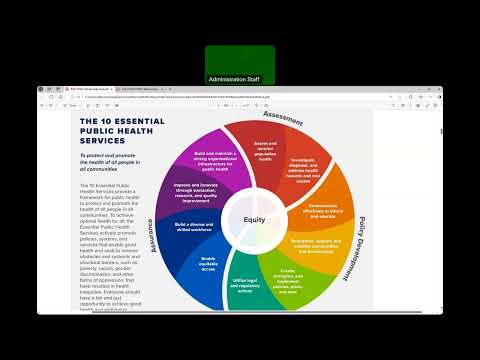
Alan Milnick, Clark County public health director, told members of the Board of Health and the Public Health Advisory Council (FACC) at a retreat that the department's work centers on three core public health functions: assessment, policy development and assurance.
"The core functions of public health are assessment, policy development, and assurance," Milnick said, describing how the agency gathers community data, advises on policy and then works to ensure delivery of services.
Milnick laid out the department's role under the 10 essential public health services and Washington's foundational public health services (FPHS). He said a consultant assessment found a statewide FPHS funding gap of about $450 million every biennium and that the Legislature's recent investments improved Clark County's position. "This made a difference of about $7,000,000 for our department," he said.
But Milnick warned the gains are vulnerable. He said the governor's proposed budget would cut $59 million from FPHS for the coming biennium and that final funding will depend on negotiations in the House and Senate. Milnick described the county's dependency on a mix of state, federal and local revenues and noted federal grants currently make up roughly 12.5% of the department's budget.
Milnick and other staff described how the department uses assessment tools (birth/death records, youth and community surveys, local dashboards) to identify priorities such as prenatal care access, chronic disease prevention, environmental health and communicable disease control. He emphasized the department's role in convening partners and giving technical recommendations to policymakers rather than setting law directly.
Board members and FACC representatives discussed next steps for aligning data, priorities and the county's budget decisions. The group agreed to continue joint discussion and to ask FACC to review the county's governance options and recommend communication steps back to the Board of Health.