Get Full Government Meeting Transcripts, Videos, & Alerts Forever!
Get email alerts on the Agritourism Ordinance topic
No spam. Unsubscribe anytime.
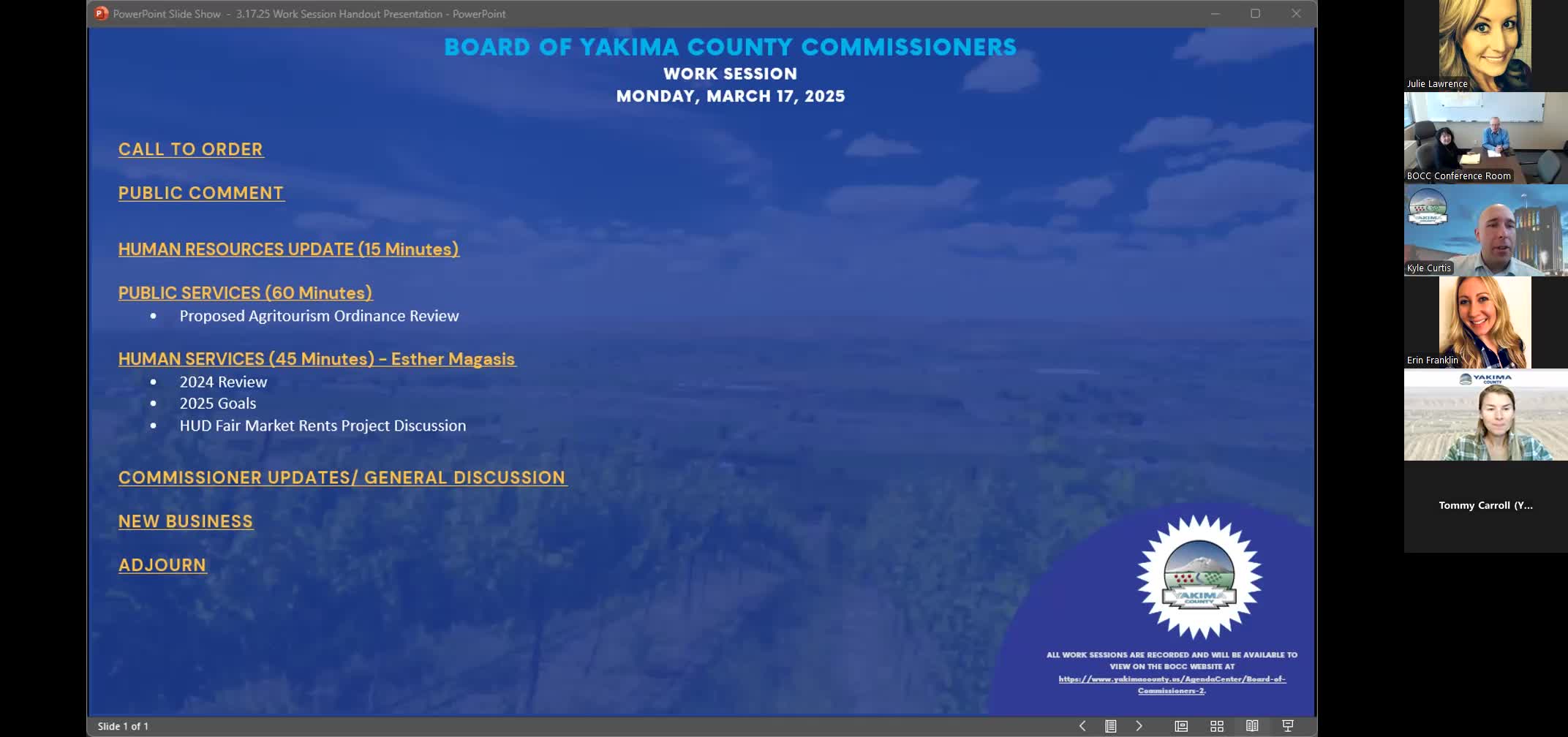
Yakima County commissioners advance agritourism ordinance to public hearing amid legal uncertainty
Summary
Yakima County commissioners voted to move a draft agritourism ordinance to a continued public hearing after staff outlined legal and environmental-review risks tied to a recent Washington Supreme Court decision affecting how tasting rooms and related activities are classified.
Yakima County commissioners voted to move a draft agritourism ordinance forward to a continued public hearing after staff described legal and environmental-review risks tied to a recent Washington Supreme Court case involving King County.
Tommy (Public Services staff) told the panel that the King County decision raised questions about whether tasting rooms and similar activities should be treated as agricultural uses. He said the county’s draft ordinance largely retains Yakima County’s current approach — treating wineries, bottling and similar production activities as agricultural uses while limiting nonagricultural activities such as food service and event venues to a one-acre area of the farm — but warned the court’s ruling complicates that approach and could require a detailed environmental impact statement. "The Supreme Court basically ruled, I wouldn't, I shouldn't say ruled, I should say insinuated, that activities such as wineries were questionable as considering agricultural uses," Tommy said.
Why it matters: the way tasting rooms, events and overnight lodging are defined affects whether rural properties can continue current operations without new permits or will need full review, with possible buffers or other restrictions that could limit agribusiness operations and agritourism income for farmers.
Key points from staff and commissioners
- Existing interpretation preserved: County staff said Yakima County has historically and in its proposed code treated wineries, processing and bottling as agricultural uses; nonagricultural uses (events, food service, event facilities) remain limited to one acre or less and must not remove production areas.
- New allowances: The proposed code reduces the minimum acreage required to qualify as an Ag Tourist Operation (ATO) from five acres to three acres and explicitly allows events and more detailed food-service rules and overnight lodging for ATOs.
- Buffer and setbacks: Tommy noted Yakima County’s code already includes an "ag resource setback" requiring especially sensitive uses (houses, churches, schools) to be set back 150 feet from agricultural parcels, but the proposed ordinance did not add a specific event buffer. Commissioners discussed whether to include a 150-foot or other buffer between event facilities and adjacent agricultural operations.
- SEPA / EIS risk: Staff explained the county used a non-project State Environmental Policy Act (SEPA) review for the ordinance, the common approach for long-range code changes. But the King County ruling required King County to prepare a full environmental impact statement (EIS), not a non-project SEPA, and Tommy warned that producing a similar EIS for Yakima County would require analyzing every existing winery/parcel that could become an ATO and probably hiring a third party, likely taking months and substantial funds. "For us to do that, it would require a significant amount of time, submit significant amount of money. We'd have to hire a third party group to do the EIS," Tommy said; he later estimated contracting and procurement alone could take about three months and the full work roughly nine months or more.
- Grandfathering and permitting: The King County case also cautioned against automatically grandfathering existing operations into newly expanded uses. Tommy said the court indicated that if an operator wanted to add events or food service beyond the original permit, the county must evaluate the new permit under the current code and SEPA standards rather than assume grandfathering. Commissioners discussed whether to require existing operators to reapply or instead grandfather them in; Commissioner Curtis said he may propose at the hearing that operators reapply rather than be automatically grandfathered.
Board direction and next steps
- The commissioners indicated consensus to move the draft ordinance to a continued public hearing. Tommy said staff would prepare materials and work with the Clerk of the Board to schedule the hearing; Julie Lawrence (Clerk) said the packet would be provided in advance and that because this is a continued hearing the tentative date of March 25 may be acceptable pending legal review of notice requirements.
- Legal advice: Corporate counsel Dan Clark told the board that the King County decision appears to limit the county’s options and that seeking guidance from the Department of Commerce would not override a court ruling. "With the Watkins States Supreme Court current ruling, Commerce would not be the appropriate agency in the event that even if he said we look great with our ordinance, that's not gonna carry any weight in the event we're sued," Dan said.
- Commissioners’ comments: Commissioner McKinney urged an assertive approach and proposed asking Commerce to review the draft ordinance for compliance and how it would be perceived under state law; she argued counties must act to protect agricultural livelihoods. "If we're gonna save agriculture in Washington state, it's gonna take Yakima County reaching out to Commerce," McKinney said. Commissioner Lindy agreed staff had phrased the legal issues carefully and supported moving to a hearing while noting concern about potential state and federal regulatory impacts.
What the draft ordinance changes (staff summary)
- ATO lot size: minimum reduced from 5 acres to 3 acres (expands potential ATOs). - Events: ordinance adds explicit allowance and procedural details for events on ag parcels. - Food service: clarifies how food service at ATOs is regulated and permitted. - Nonag uses: retains one-acre limit for nonagricultural uses associated with an ATO. - Setbacks: current county ag resource setback (150 feet for especially sensitive uses) remains on the books; the new draft does not add a separate event buffer (board may consider adding one).
Process notes and risks
- Staff signaled significant implementation risk if courts interpret the King County decision the same way in Yakima County — an EIS could be required and would be time-consuming and costly. - Commissioners discussed options including (a) proceeding to hearing and adoption and letting courts rule on disputes, (b) requiring reapplication rather than grandfathering, and (c) seeking input from the Department of Commerce (legal counsel warned Commerce guidance would not overrule a court).
Ending
Commissioners instructed staff to docket the continued hearing packet and provide the draft ordinance and edits in advance. The board set a tentative hearing date and signaled readiness to debate small edits (grandfathering provisions and buffer language) at the public hearing.