Get Full Government Meeting Transcripts, Videos, & Alerts Forever!
Get email alerts on the Property Tax Levy topic
No spam. Unsubscribe anytime.
Johnson County holds public hearing on proposed FY2026 property tax levy; residents press for road, waste and library details
Summary
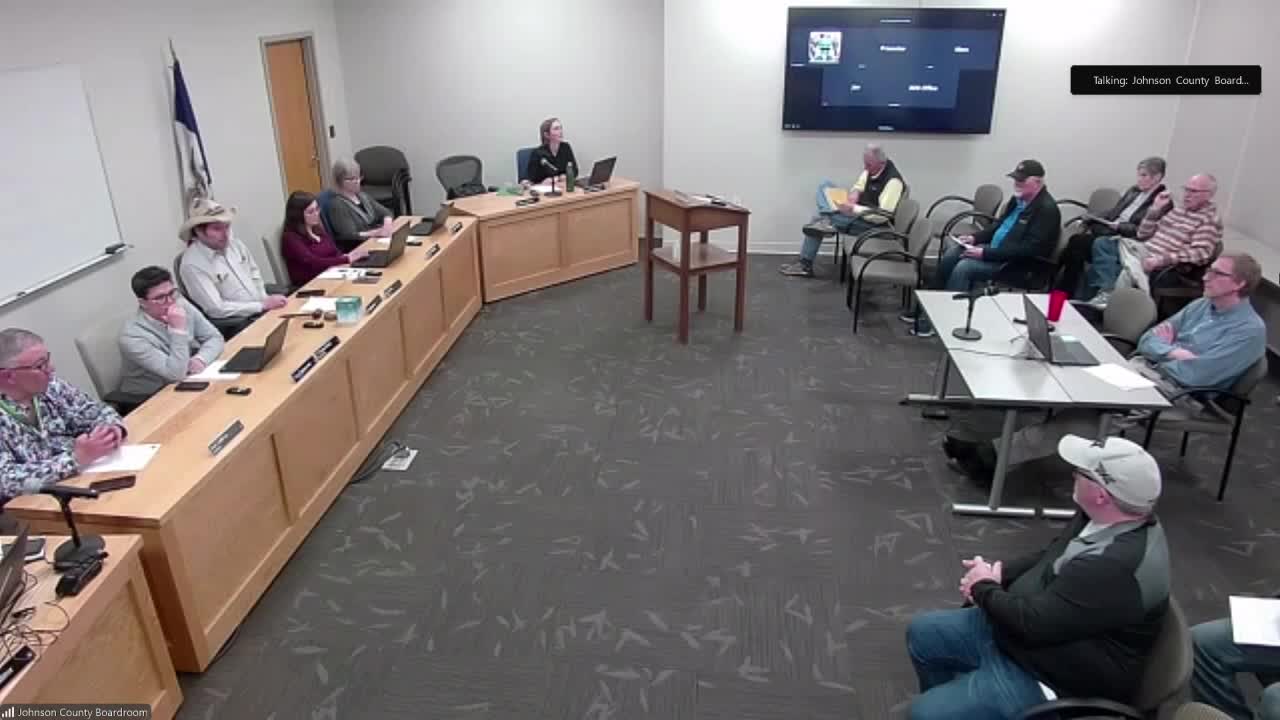
Johnson County Board of Supervisors opened a public hearing Wednesday on the county's proposed fiscal year 2026 property tax levy, hearing a staff presentation and taking more than an hour of public comment focused on rural roads, landfill tipping allowances and library and conservation funding.
Johnson County Board of Supervisors opened a public hearing Wednesday on the county's proposed fiscal year 2026 property tax levy, hearing a staff presentation on the proposed increases and taking more than an hour of public comment from rural residents concerned about road maintenance, landfill tipping limits and library and conservation funding.
Dana Ascherbender, of the Johnson County finance department, told the board the county's proposed general services tax asking for FY2026 is about 8.75% higher than the current year — an increase Ascherbender described as “about a $5,700,000” rise to a total of roughly $70,800,000 — and that the countywide levy rate would rise by roughly 4.7%, or about 30 cents, to $6.73 per $1,000 of assessed value. Ascherbender said the increases are driven primarily by planned courthouse construction, restoration and repair work at the county jail and sheriff's office, and higher transfers to the secondary roads department.
Ascherbender also said the county's rural services tax asking would rise roughly 2.6% (an increase of about $191,359) to a total of $7,448,166 and that the rural services levy rate was proposed to remain unchanged from the current fiscal year. Ascherbender explained one county benefit for unincorporated households: an annual household allowance to use the Iowa City landfill. Ascherbender said the minimum tipping weight at the landfill is 600 pounds and that households are permitted up to 2,000 pounds per year; she described that allowance as a benefit for occasional large or heavy items.
Why it matters: the county's tax-levy decision determines how much revenue the county raises to pay for public-safety facilities, roads, libraries and other services. Supervisors said this is the first of two required public hearings on the levy and emphasized that the hearing is part of a multi-step budget process that will include additional votes before the levy is finalized.
Public comment focused on rural roads and budgeting transparency. Steve Kurt, a rural Solon resident, asked directly, “If this levy goes through, what we could expect to see happening on our road that would be different than what we're seeing right now?” Kurt and several other speakers said they experience long delays on snow removal, concerns about gravel supply and placement, and what they described as inconsistent maintenance.
Multiple speakers asked where additional gravel or rock purchases are held and whether the county is prioritizing where rock is placed. Jim Martin, who said he lives south of Highway 1, pressed for details about which rural libraries are supported by rural levies; Ascherbender and county staff named several library services and outreach programs (including Springmeyer, the Antelope Traveling Lending Library and Lone Tree) and said rural residents may use library services at no fee because of that funding.
Several residents also challenged the published notice forms that accompany the hearing. One attendee pointed out that the state-required form assumes a 10% assessment increase when projecting taxes, which can make the percentage increases on the notice look larger than what will actually appear on individual bills. Ascherbender and county staff explained that the state form uses an assumed assessment growth (10%) for the projection and recommended that residents use the state Department of Management online tool or visit the county auditor's office to see their individual estimated change.
Auditor and staff availability: Julie (County Auditor) told residents the county posts the proposed-levy statement on the county website and offers one-on-one help in her office to compute a specific property's projected tax change. She pointed attendees to a link to the state Department of Management and said county staff can pull up individualized details in person.
Questions about conservation and parks arose as well. Residents asked whether county parks and conservation acquisitions are part of the levy. Supervisors and staff explained that land purchases and capital acquisition are often paid from separate conservation bonds and that annual operating needs for conservation (equipment, maintenance, salaries) are included in the regular budget the board considers during budget meetings.
Board response and next steps: supervisors encouraged residents to review the detailed budget documents posted on the county website, to use the five-year roads plan available online, and to meet with staff before formal votes occur. Supervisors said department-specific decision packets and budget meeting minutes are public and that the board reviews requests and required cut lists during its multi-vote budget process. The board closed the public hearing after hearing multiple speakers and discussion; the levy itself was not adopted at the meeting.
Votes at a glance: the board approved the meeting agenda at the start of the session. The motion to approve the agenda carried on a roll call vote, 5-0 (Vicksmore Reyes, Green, Remington, Douglas and Sullivan voting aye). No vote on the proposed levy occurred at the hearing.
The board noted this hearing is the first of two required hearings on the proposed levy and reminded the public the formal process includes additional meetings and votes before a final levy is adopted.