Get Full Government Meeting Transcripts, Videos, & Alerts Forever!
Get email alerts on the Capital Program topic
No spam. Unsubscribe anytime.
WTD outlines capital forecasting process; staff warn contractor market and tariffs are raising delivery costs
Summary
King County Wastewater Treatment Division staff summarized how the division builds a long‑range capital forecast and flagged market stressors — constrained trades labor, sustained high material and equipment costs, and the prospect of new tariffs — that are increasing construction and delivery costs for the capital program.
King County Wastewater Treatment Division (WTD) staff briefed the Regional Water Quality Committee on March 5 on how the division creates long‑range capital forecasts and the market factors currently influencing project delivery.
Crystal Fleet, Capital Portfolio Planning and Analysis Manager, described the WTD prioritization and governance process used to produce the capital forecast that feeds the sewer‑rate model: subject matter experts score projects against criteria such as condition, criticality and obsolescence; division leadership sets strategic priorities; and a tiered governance structure — a definition board (division leadership), a delivery board (functional unit managers) and a project oversight board — manages resource allocation. Fleet said WTD typically has about "250 active projects" at any given time and roughly "500 conceptual projects" awaiting funding.
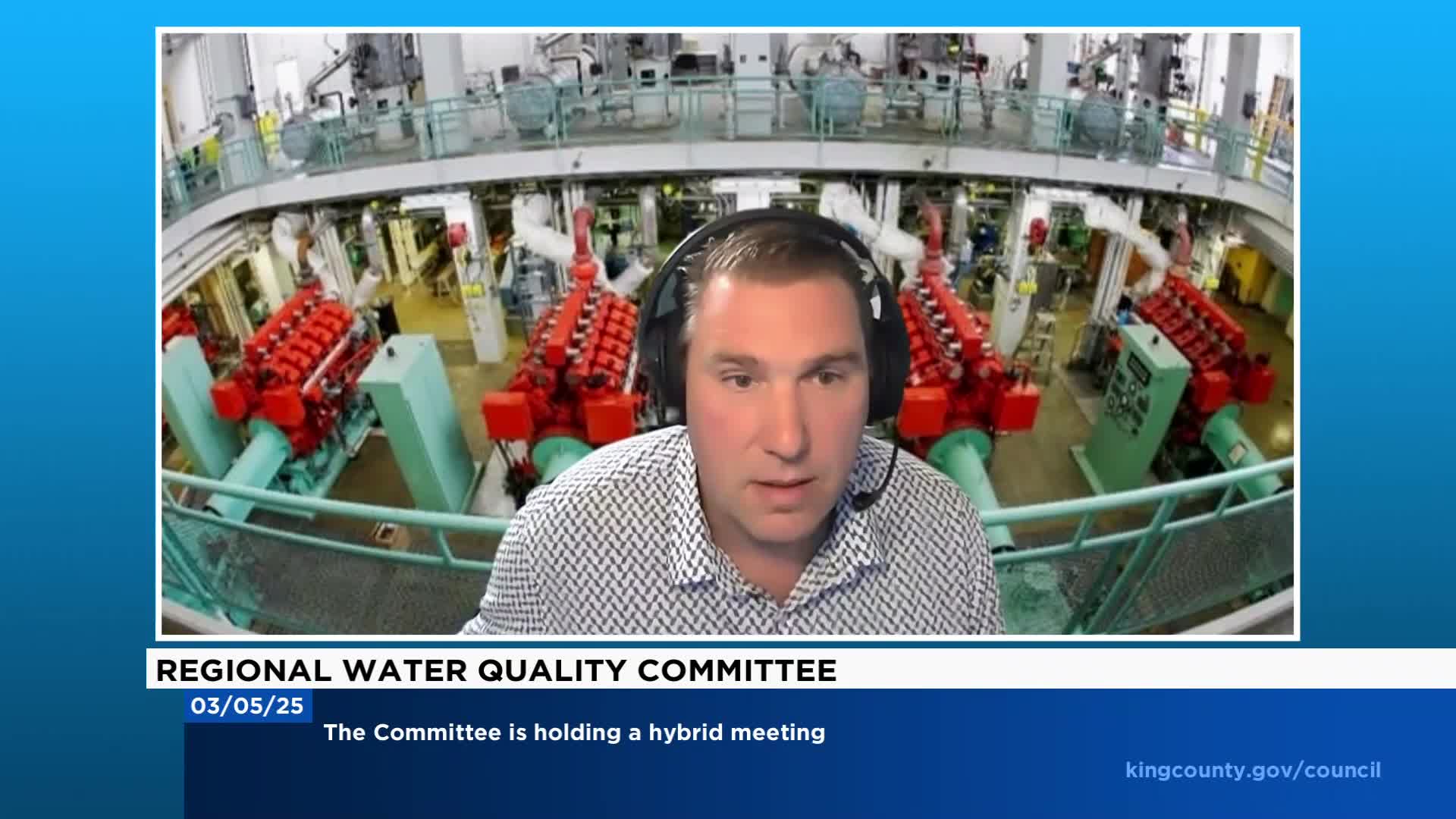
Chad Merrill, manager for capital delivery strategy, said the construction market remains expensive and tight. He warned that while material and equipment costs have started to level, uncertainty at the federal level (including tariff threats affecting steel and aluminum) could push costs higher. Merrill said labor capacity for wastewater trades is limited in the Seattle metro, which contributes to intense bidding and higher prices.
Fleet told the committee WTD uses a methodology developed under motion 16410 to extend the forecast to 20 years this year and that the division aims to avoid collecting rate revenue that cannot be reasonably delivered as capital work.
Ending: Staff asked the committee to use packet material and follow‑up meetings to review the more detailed slides and invited more time for discussion at a future meeting; committee leadership said they would schedule additional time to review the capital‑program slides.