Get Full Government Meeting Transcripts, Videos, & Alerts Forever!
Get email alerts on the Sewer Rates topic
No spam. Unsubscribe anytime.
King County wastewater director warns MDCSO cost revisions push out‑year sewer rates sharply higher
Summary
King County’s Regional Water Quality Committee heard March 5 that the county is proposing a 7.5% sewer rate increase for 2026, but that revised cost estimates for a large combined‑sewer‑overflow control project and concurrent capital needs mean much larger increases are likely in later years.
King County’s Regional Water Quality Committee heard March 5 that the county is proposing a 7.5% sewer rate increase for 2026, but that revised cost estimates for a large combined‑sewer‑overflow control project and concurrent capital needs mean much larger increases are likely in later years.
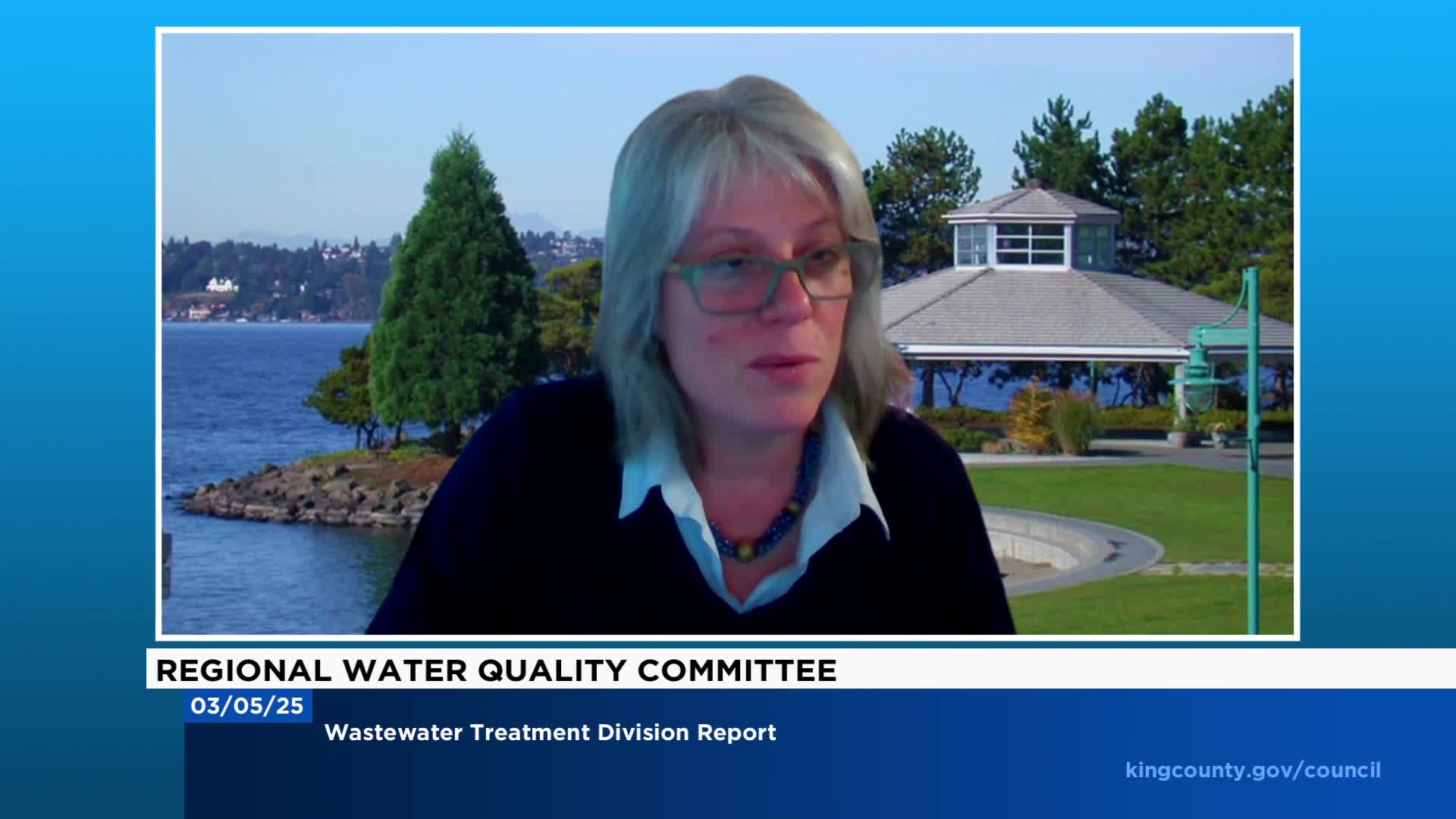
Director Cameron Gural, director of the Wastewater Treatment Division (WTD), told the committee that "the proposed rate for 2026 is a 7.5 increase over 2025, fairly close to the 7% increase that we forecasted last year." He said the primary driver of the higher out‑year forecast is an updated, higher‑class cost estimate for the mouth‑of‑Duwamish CSO project (MDCSO), a regulatory‑mandated CSO control project in South Seattle. Gural said the MDCSO class‑5 estimate now exceeds $3,000,000,000 and that the forecasted annual sewer rate after 2026 could rise into the low‑teens percentage range for several years.
Why it matters: committee members and partner agencies are concerned that a steep multiyear rate path will create "rate compression," meaning King County’s increases combined with cities’ own sewer rates will make it harder for local agencies to fund their separate capital needs. John McClellan, chair of the Municipal Utility and Public Agency Committee (MUPAC), said, "seeing these rate projections is really, challenging frightening and surprising" and urged continued engagement between WTD and partner agencies.
Committee members pressed WTD on options to reduce near‑term impacts and asked about tools to measure affordability. Commissioner Warren and others emphasized the need for a working affordability definition that can inform policy and rate decisions. Commissioner Clark suggested presenting rate scenarios as ranges rather than single point forecasts so member agencies and constituents can see upside and downside risk. Councilmember Sweet described the outlook as "untenable" for many ratepayers and asked the county and cities to look for reprioritization or additional funding sources.
Gural said three broad categories — regulatory mandates, asset management (replacement/renewal), and capacity needs — are “stacking” in the same time frame, producing the higher rate path. He said WTD has been applying industry best practices to cost estimation, has released a recorded two‑hour cost estimation workshop and slide deck for technical review, and welcomed scrutiny. He also told the committee the County Auditor has opened an intake meeting to provide independent capital‑project oversight of MDCSO.
No formal decision was taken by the committee on rates; WTD will present the formal 2026 proposed rate and forecast at MUPAC and will bring two regular briefings to RWQC in April and May. Committee members were invited to provide written comments to staff ahead of those sessions.
Ending: WTD and committee chairs said they will continue working with partner agencies, the County Auditor, and affected cities to refine cost estimates, consider mitigation options and develop measures to evaluate affordability ahead of the formal rate‑setting process in spring.