Get Full Government Meeting Transcripts, Videos, & Alerts Forever!
Get email alerts on the Transit Service Safety Fares topic
No spam. Unsubscribe anytime.
King County Metro outlines safety upgrades, fare enforcement relaunch and service changes ahead of Redmond Link opening
Summary
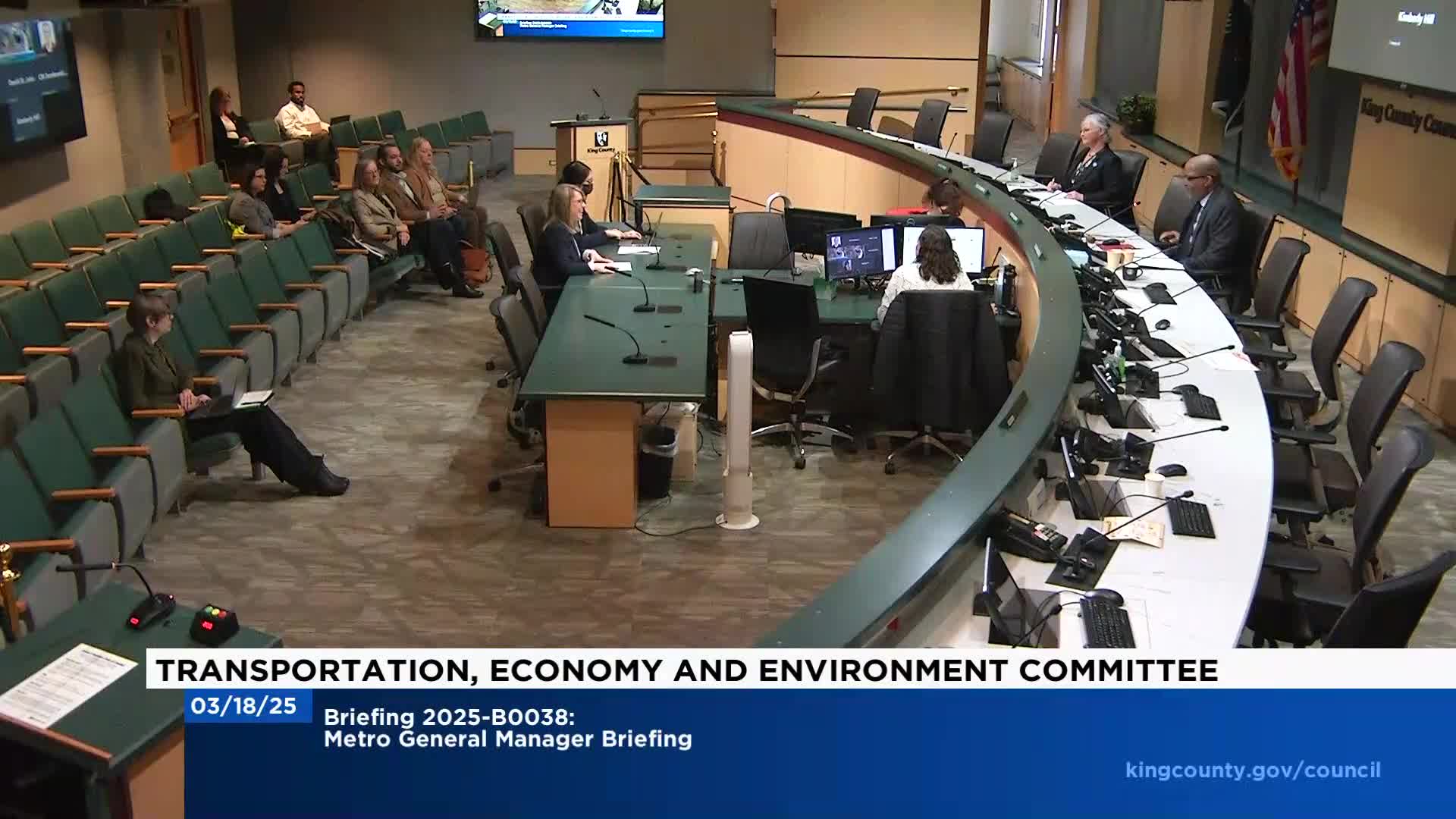
Metro General Manager Michelle Allison briefed the Transportation, Economy and Environment Committee on March 18 on safety reforms, operator protections, a resumption of fare inspections and service changes tied to the Downtown Redmond Link extension and spring service updates.
At the March 18, 2025 meeting of the Transportation, Economy and Environment Committee, King County Metro General Manager Michelle Allison gave a quarterly update on safety, reliability and upcoming service changes ahead of the Downtown Redmond Link extension opening and spring service changes.
Allison told the committee Metro’s top priority is safety and described the agency’s SAFE (safety, security and fair enforcement) reforms launched in 2020 and its “care and presence” model, which combines traditional security methods with behavioral-health specialists and community ambassadors to respond to incidents on and near transit. She said Metro has created a cross‑divisional safety emphasis coordination team that works with county agencies, 39 jurisdictions and community groups to address chronic issues and route local responses where they are needed.
Allison said Metro has accelerated operator protections after the December death of a colleague, including installing stronger, laminated tempered‑glass partitions with lockable metal doors on a new order of 89 battery‑electric coaches and planning a retrofit program for about 1,200 existing coaches. Metro also increased required risk‑mitigation training for operators from one to three courses; the agency is 37 percent through the first of the three required trainings.
On fares, Allison said Metro will resume fare inspection on March 31 with verbal reminders and will begin the full inspection program with penalties on May 31. Metro launched a multilingual outreach campaign explaining reduced‑fare eligibility and payment options. She noted fare revenue remains an important source of operating funds (Metro reported roughly $71 million in fare revenue in 2023, with about 55 percent coming from employer transit passes) and encouraged riders who receive free youth fares to “tap” ORCA cards to support service planning.
Allison discussed trip cancellations and efforts to increase “trip delivery” (the share of scheduled trips actually operated). She said Metro tracks cancellations by route, by base and systemwide, and is working to recruit and retain operators and mechanics. Trip delivery moved from about 94 percent in 2023 toward a 99‑percent goal; Allison said Metro’s stated target is 99.7 percent. She described tools riders can use to manage missed or canceled trips, including Metro alerts, third‑party transit apps and text‑back service, and said some cancellations are missed in real time due to GPS/connectivity or when a trip is canceled mid‑route.
Allison also previewed service changes tied to regional rail openings. She said East Link connections will add more than 3,300 weekly bus trips on the Eastside to connect with light rail and that the Downtown Redmond Link Extension will open May 10; Metro plans route adjustments timed to that opening and a spring service change on March 29 with added evening and weekend service in South King County. Regional ridership grew in 2024, she said, with the six ORCA transit agencies reporting about 17 million more trips than in 2023 (roughly a 12 percent regional increase).
Committee members thanked Allison and asked for written materials on trip‑cancellation reporting and clarification about the budget outlook. Allison said county, state and federal revenue uncertainties and cost pressures make longer‑term revenue forecasting more challenging and that Metro is coordinating a biennial budget outlook with the Executive’s office. Allison also invited council members to participate in Transit Appreciation Week events and highlighted partnerships with ATU local 587 and the King County Sheriff’s Office’s Operation Safe Transit.
Metro staff provided contact information and asked riders to report incidents; Allison reiterated the agency’s safety goal of zero incidents and encouraged use of 911 for threats or active criminal behavior. Committee members followed with questions about aligning enforcement with Sound Transit, restroom and facilities investments, trail and station access, and budget timing; Allison and Metro staff said they will provide follow‑up materials to the committee.