Get Full Government Meeting Transcripts, Videos, & Alerts Forever!
Get email alerts on the Hazardous Waste topic
No spam. Unsubscribe anytime.
King County hazardous waste program briefs Board of Health on funding, services and upcoming rate decision
Summary
Program staff told the Board of Health that the Regional Hazardous Waste Management Program serves about 2.3 million residents and 70,000 businesses, operates on an approximately $21 million annual budget, and expects its fund balance to be depleted by 2029 absent a rate adjustment; staff signaled a likely rate increase in 2027–28.
Program leadership briefed the King County Board of Health on March 20, 2025, describing the Regional Hazardous Waste Management Program’s structure, services, funding and near-term decisions about rate adjustments.
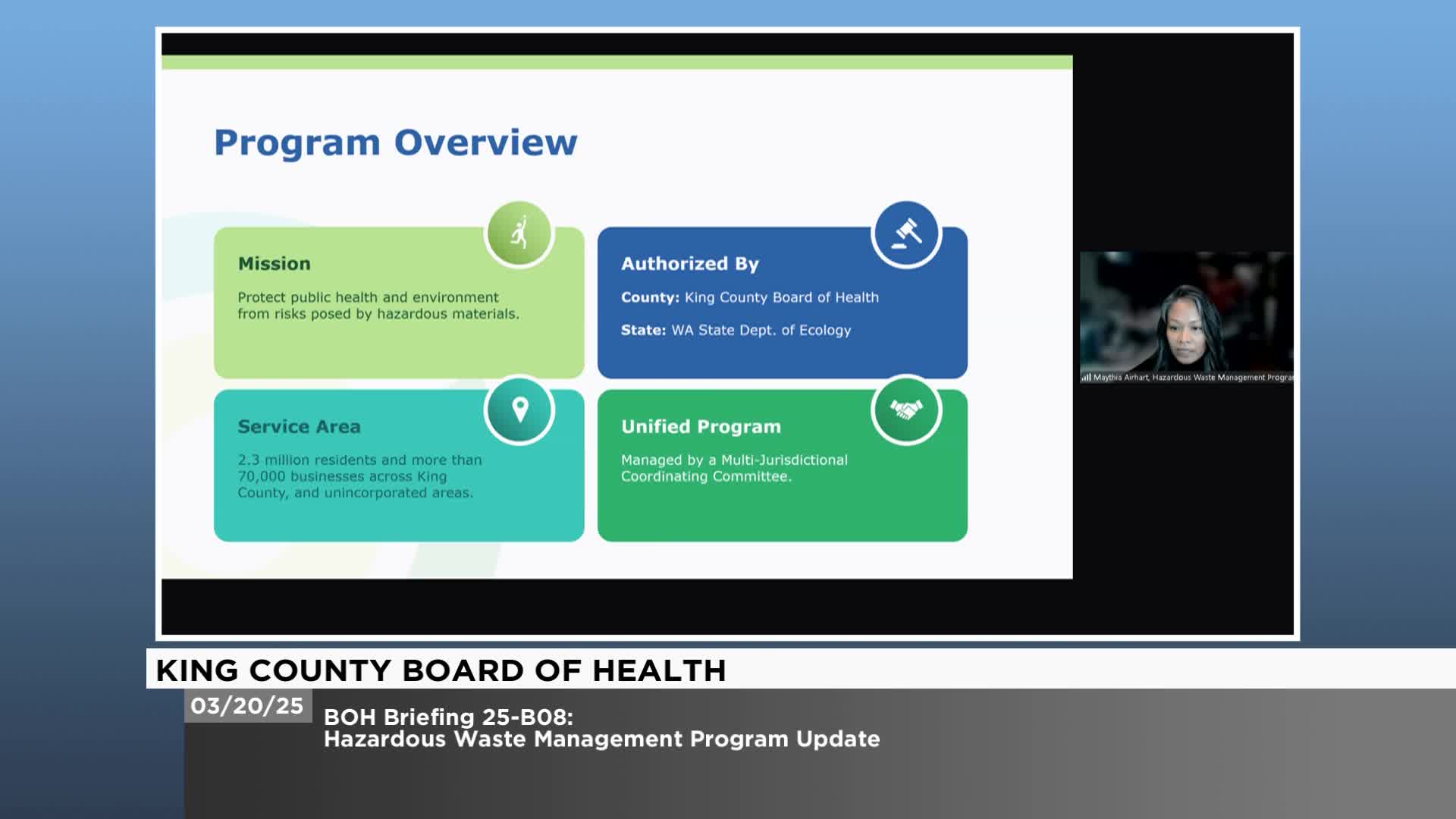
Program staff said the service area covers roughly 2.3 million residents and more than 70,000 businesses across King County. The program operates an annual budget in the range of $20.3 million to $21 million and is funded primarily through a local hazardous-waste fee assessed on solid-waste collection, transfer-station use and wastewater utilities; staff reported roughly 61% of revenue comes from solid-waste accounts, with sewer and transfer-station revenue making up the balance and small shares from interest and a state grant.
Staff told the board the program moved into the King County Department of Natural Resources and Parks (DNRP) and reorganized in 2023; governance remains connected to the Board of Health and a five-member Management Coordination Committee (RMCC) that approves budgets, rate adjustments and work plans. The program’s 10-year management plan was approved by the Washington State Department of Ecology in 2022 and is being implemented in staged phases through 2031; the plan is the program’s guiding framework for services and rate setting.
Program directors said the program has not proposed a rate increase for 2025 because of a healthy fund balance and prior increases in 2022, but that inflation and rising costs are expected to draw down the fund so that the balance would be depleted by approximately 2029 unless rates are adjusted. Staff described stakeholder engagement on the timing and scale of a future rate adjustment and said they expect to return to the Board of Health and the RMCC with a recommended rate package toward the end of 2025 or in 2026 to inform a 2027–28 implementation window.
Staff also summarized program work on policy and prevention, including attention to PFAS in products and biosolids recycling reform, technical assistance to small businesses, and fixed and mobile collection services that include home pickups for seniors and people with disabilities. The Board of Health will receive the program’s annual report later in the spring, staff said, and was invited to join ongoing stakeholder discussions about rate-setting timing and potential adjustments.