Get Full Government Meeting Transcripts, Videos, & Alerts Forever!
Get email alerts on the Poet Laureate Selection topic
No spam. Unsubscribe anytime.
St. Louis task force interviews three poet-laureate finalists; members to score rubrics and forward recommendation to Board of Aldermen
Summary
A St. Louis City task force held recorded interviews with three finalists for poet laureate, heard each candidate outline plans for community convening, archives and youth programming, and agreed to submit scored rubrics and a ranked recommendation to staff ahead of a follow-up meeting and a vote by the Board of Aldermen.
The St. Louis City Poet Laureate Task Force held recorded interviews with three finalists for the city’s poet-laureate position and agreed to collect scored rubrics and a ranked recommendation to forward to staff and, ultimately, the Board of Aldermen for approval.
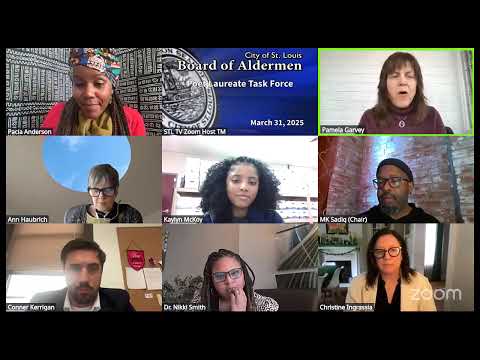
The interviews, held during a virtual session and livestreamed for the public, gave each finalist 30 minutes to describe their practice and outline a vision for the term. Task force members discussed logistics for scoring and scheduled a follow-up action to assemble a formal recommendation.
The three finalists described overlapping priorities: documenting local poetic history, building sustained convening and mentorship programs, expanding youth and intergenerational opportunities, and finding ways to connect poetry to city life beyond performances. Paysha [last name not provided], poet laureate candidate, emphasized preservation and teaching: “Poetry is the wellspring of tradition, the bleeding connector of yesterdays and the free passport to futures,” and proposed digital or physical archives and more centralized pathways for young poets. Tracy Stanton, poet laureate candidate, described a grassroots approach focused on “getting into the cracks and crevices” of neighborhoods to convene people where they already are and to bridge gaps between organizers, artists and policy work. Corinne [last name not provided], poet laureate candidate and longtime instructor, said she would pursue low‑pressure writing spaces and citywide site‑based programs; she also cautioned about overreliance on technology, saying, “AI can't do good poetry. Let's put it that way.”
All three candidates raised funding and capacity concerns. Multiple candidates noted there is no established stipend or dedicated budget for the poet‑laureate role; the task force discussed whether the position should be paired with city resources or rely on outside funding and partnerships. Several members pressed candidates on how they would sustain programming without guaranteed city funding.
Task force members also clarified the mechanics of evaluation and next steps. Christine [last name not provided], staff member coordinating the task force, asked members to score each candidate by question (the rubric used on the call assigns points per question) and to submit both numeric rubrics and an overall ranking. The group set a follow‑up meeting date as a backup (April 7) but said they expect to complete most of the work via email if the scores point clearly to a recommendation.
Votes at a glance
- Motion to recess until 04:40 — moved and seconded during the meeting; approved by voice vote (all in favor “Aye” recorded). - Motion to return from recess (first return) — moved and seconded; approved by voice vote. - Motion to recess until 05:10 — moved and seconded; approved by voice vote. - Motion to return from recess (later return) — moved and seconded; approved by voice vote. - Motion to adjourn — moved and seconded at the end of the session; approved by voice vote.
Direction and next steps
Task force members were instructed to submit their scored rubrics (each candidate answered roughly six questions on the call) and an overall ranking to Christine by email. Members were asked to provide rubrics and a 1‑2‑3 ranking so that numeric scores can be compared with members’ qualitative impressions; Christine requested submissions as early as possible and by Saturday night if feasible to allow staff time to compile results. The task force will use email to finalize the recommendation where possible and will convene on April 7 only if needed to move a nomination forward to the Board of Aldermen.
Why it matters
The poet‑laureate position is an appointed civic role that serves as a public representative for poetry and the literary arts; the task force’s recommendation will go to the Board of Aldermen, which — according to candidates’ remarks during the call — approves the appointment via ordinance. The finalists’ proposals emphasize outreach, archival work and youth programming that could change how poetry is integrated into local cultural programming and education.
The task force expects to report a recommendation to the Board of Aldermen after compiling rubrics and rankings. If members’ scores diverge, they reserved April 7 for a short meeting to adjudicate the recommendation and move a candidate forward.