Get Full Government Meeting Transcripts, Videos, & Alerts Forever!
Get email alerts on the Federal Funding Cuts topic
No spam. Unsubscribe anytime.
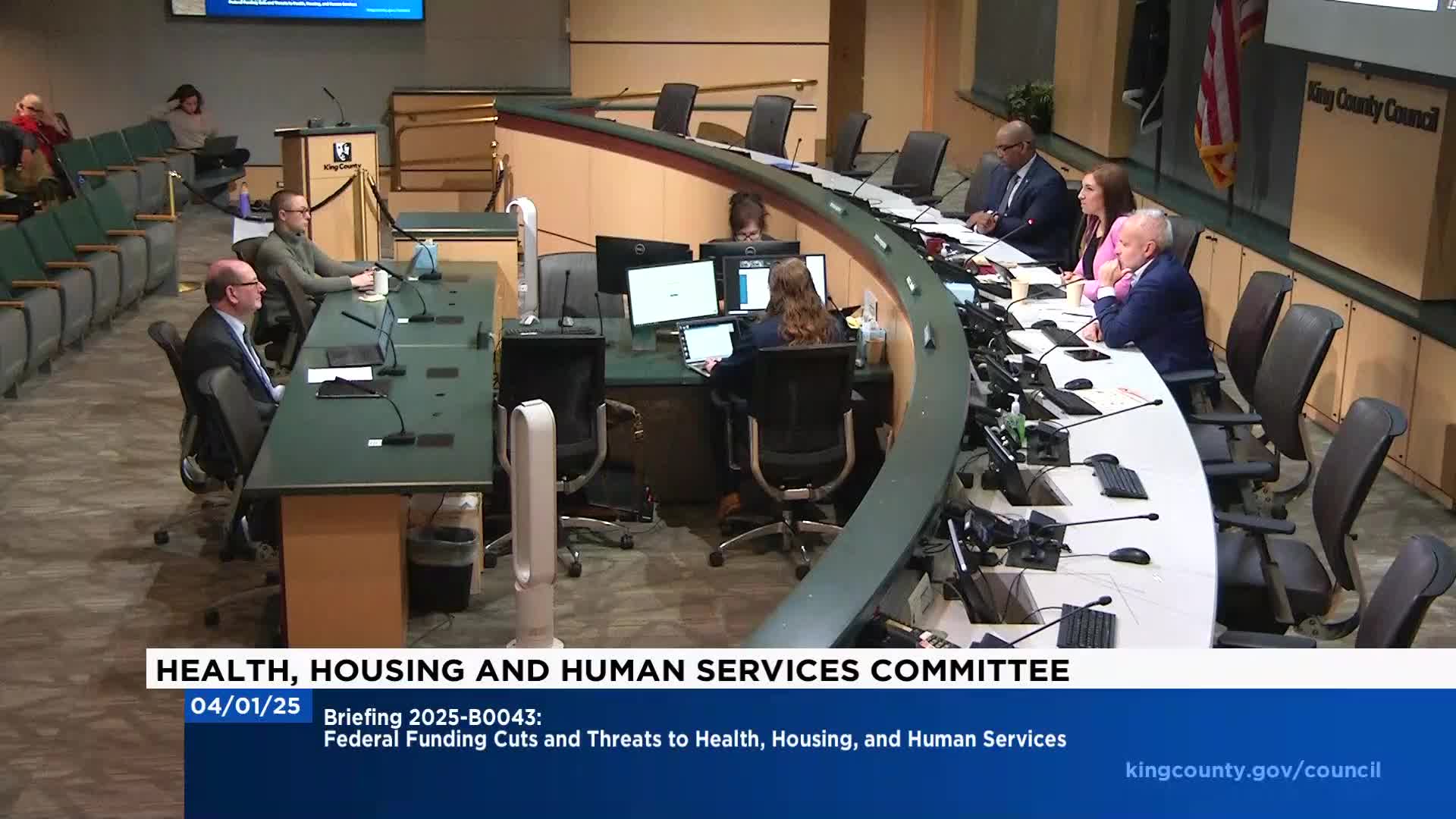
King County officials, providers warn federal funding cuts could disrupt local health, housing and human services
Summary
County analysts and community providers told a King County committee on April 1 that abrupt federal funding pauses, new conditions on grants and proposed federal budget cuts are already disrupting programs the county and local nonprofits rely on for public health, housing and behavioral health services.
King County officials and community providers told the committee overseeing housing, health and human services on April 1 that recent federal actions — including pausing grants, imposing new conditions, and possible deep cuts in next year’s federal budget — are already disrupting local programs and could force service reductions, layoffs and program closures.
The warning came during a briefing led by Dwight Dively, director of the Office of Performance, Strategy and Budget, followed by presentations from community health center HealthPoint and housing provider Plymouth Housing. County leaders and providers described recent examples of funding pauses, grant cancellations and new conditions attached to renewals, and outlined how those actions ripple through local service networks.
The committee was told the problem has three parts: (1) federally appropriated grants and contracts are being paused or payments withheld; (2) routine renewals are increasingly being returned with new conditions that local law or county policy cannot accept; and (3) congressional budget moves and House budget resolutions point toward large domestic discretionary cuts that, if enacted, would reduce many programs counties rely on. King County’s analysts said those pressures are already producing immediate administrative and service risks.
"This literally changes every day," said Dwight Dively, director of the Office of Performance, Strategy and Budget. He told the committee the county received updated cut notices as late as 10 p.m. the night before the briefing. Dively said the county receives roughly $200 million in federal revenue that the office tracks daily, not counting Medicaid pass-through dollars. He described recent examples: the Environmental Protection Agency terminated a roughly $1 million grant for indoor air quality work; several public health pandemic-era grants were canceled, reducing this year's spending ability by about $2 million even though the total cancelled amounts were larger; and the Substance Abuse and Mental Health Services Administration (SAMHSA) funding stream of about $11 million annually had a $1.4 million portion canceled the prior day.
Dively said some federal court injunctions have forced agencies in some districts to keep funding flowing, but the pattern is inconsistent and litigation is likely to reach the U.S. Supreme Court. He also described recent federal notices suggesting unspent pandemic-related funds could be clawed back, and a U.S. Treasury announcement about such recoveries. "There is no consistent pattern; it presumably depends on who at an agency is deciding whether or not they are going to comply with the federal court order," Dively said.
HealthPoint President and CEO Lisa Yeoman said Medicaid is the largest single funding source for community health centers and that potential federal Medicaid cuts would be devastating. HealthPoint serves just over 100,000 King County residents, Yeoman said, including approximately 62,000 patients covered by Medicaid; 77% of HealthPoint’s funding comes from Medicaid and the center treats roughly 16,000 uninsured patients. She said proposed changes such as "work requirements" or reductions in reimbursement rates would both reduce access and lower the revenue that clinics need to operate.
"Cuts to Medicaid would increase the number of people who are uninsured, likely increasing demand at health centers while also significantly decreasing revenues that health centers rely on," Yeoman said.
Sarah Dickmeyer, External Affairs Manager at Plymouth Housing, described how federal pauses and new conditions have already heightened uncertainty for housing providers. Plymouth operates 17 buildings and expects to operate additional properties this year; many residents rely on Medicaid, vouchers and other public benefits. She said HUD’s March guidance paused renewal awards after April and introduced new conditions tied to executive orders on issues like immigration and DEI, and that Continuum of Care renewals and voucher funding are areas Plymouth is monitoring closely. Soy said higher tariffs are already being priced into construction budgets, increasing future development costs.
Committee Chair Teresa Mosqueda and council members asked executives and providers about contingency plans. Dively said some county units, such as Public Health, have modest fund balances that could temporarily cover shortfalls. He also said the county is considering litigation and has been coordinating with other jurisdictions. "In what cases does the county — particularly if we're in litigation to try to get the money — say we will continue to pay you using our own money with the hope of getting it back from the feds? It is a very complicated question to answer," he said.
Public commenters who attended the meeting connected federal executive action to local impacts. Kenneth Randolph urged the council to sponsor resolutions opposing federal executive orders and to request an emergency proclamation; Janet Wei from Shoreline made a similar public appeal for public debate and local action.
The committee agreed to continue monthly briefings on the topic and signaled support for coordination with congressional partners and local providers to track and document impacts.
Looking ahead, Dively and county staff said their top near-term concerns are (1) grant renewals returned with conditions the county cannot accept, (2) further cancellations of pandemic- or crisis-related grants, and (3) the possibility that a House budget resolution could lead to deep cuts in domestic discretionary spending, including programs that fund public health, housing and behavioral health services. Larger structural changes discussed by witnesses — including talk in some federal circles about eliminating whole agencies such as FEMA or the federal library agency — would present longer-term systemic risks if carried out.
The committee requested continued message coordination with state and congressional partners and additional briefings to collect provider stories that could support litigation or advocacy.
For now, county staff and providers emphasized that the combined effect of paused grants, conditional renewals and possible broad budget reductions could reduce services, create staffing layoffs, and increase homelessness and unmet behavioral-health needs unless mitigations are found.
Ending: Chair Mosqueda directed staff to keep the committee updated and to return with additional examples and requests for support as the situation evolves.