Lifetime Citizen Portal Access — AI Briefings, Alerts & Unlimited Follows
Boston council committee explores municipal climate bank and funding options for coastal resilience
Loading...
Summary
City officials and climate experts outlined existing coastal projects, financing gaps and governance choices as Boston considers a municipal climate bank to support coastal resilience, energy transitions and community-focused adaptation.
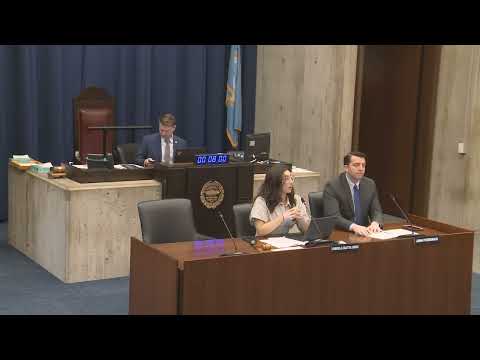
Boston City Councilors and city officials on March 31 held a hearing on docket 0169 to discuss financing coastal resilience projects and the possible establishment of a municipal climate bank.
The hearing, convened by Councilor Gabriela Colette Zapata, chair of the City Council Committee on Environmental Justice, Resiliency and Parks, brought city climate staff, federal partners, and green‑bank experts to the chamber. Chief Climate Officer Bridal Sweatt said the hearing’s timing is “really, powerful and positive,” and framed the discussion as the moment to move from planning to delivery on projects that protect Boston’s 47 miles of shoreline.
City and administration presenters — including Chris Osgood, director of the Office of Climate Resilience, and Nayeli Rodriguez, deputy director of that office — outlined current and planned coastal projects, the city’s funding to date, and the financing tools under consideration. The administration told the committee that Boston has identified roughly 18 near‑term project sites and has allocated more than $175 million in capital with a $75 million coastal resilience reserve in the most recent capital budget. “Projects that get funded, through the Army Corps come with 65% federal investment and 35% non federal cost share,” Osgood told the committee when describing the U.S. Army Corps of Engineers partnership under study to secure large-scale federal investment.
Why this matters: Boston officials and experts said the scale of need is large — estimates discussed at the hearing ranged from roughly $4 billion to more than $10 billion to protect the shoreline — and that delay raises both financial and human risks. The administration cited Climate Ready Boston neighborhood plans and a growing pipeline of grants, but said new, repeatable sources of capital and governance arrangements will be necessary to accelerate construction and long‑term maintenance.
What the city described - Current capital and grants: City presenters reported $175 million in city capital aligned to coastal resilience projects and roughly $120 million in state and federal grants either secured or sought for design and construction. Examples of projects cited were McConnell Park, Ryan Playground, Border Street (East Boston), Tenean Beach, and Pierce Park, each funded through mixed stacks of city capital, state and federal grants, and private investment. - Army Corps study: The city is participating in a coastal storm risk management study with the U.S. Army Corps that will culminate in a report to Congress in spring 2028; Osgood said Corps involvement could unlock federal funding at a scale that would be hard to match locally. - Near‑term priorities: Officials said about 18 locations have been identified as the most critical near‑term projects; many more will be required over decades to protect shorelines and low‑lying infrastructure, including transit lines and arterial roads. - Project framing: City staff emphasized that resilience investments should “invite people to the waterfront” rather than walling it off, that they should be paired with environmental justice goals, and that operations & maintenance (O&M) planning must be addressed up front.
Experts and advocates - Green bank options: Witnesses from the Green Ribbon Commission, the Climate Reality Project, the Global Center for Climate Justice, the Montgomery County Green Bank and others described multiple green‑bank models — public, quasi‑public and nonprofit — and how each handles capitalization, governance and the ability to leverage private capital. - Use cases: Panelists said green banks have proven most effective to date funding energy efficiency, renewable energy and housing retrofits; resilience projects are more difficult to finance because they typically do not generate an ongoing revenue stream to repay loans. “Resilience investments do not generate an immediate return on investment,” said Rebecca Hurst, associate director for resilience at the Boston Green Ribbon Commission. - Catalytic role: Laura Mondegren of the Montgomery County Green Bank described her organization’s role as providing “fast catalytic capital to prove concepts” and packaging resilience with clean‑energy financing to make projects bankable for developers and building owners. - Private capital leverage: Jeremy Lisker of the Climate Reality Project said green banks frequently claim strong leverage ratios; “green banks generally claim $3 to $8 in private investment crowded in for every $1 spent by the green bank,” he said.
Community and equity concerns Advocates and community leaders at the hearing urged that any new financing structure prioritize environmental justice neighborhoods, protect low‑income renters and homeowners, and include community co‑governance. Several public speakers and coalition representatives said a municipal bank or finance authority should include sustained community representation and decision‑making power on the board or advisory body.
Barriers and policy choices discussed - Revenue challenge: Multiple witnesses flagged a core problem for resilience finance: unlike energy upgrades, flood mitigation typically does not create a direct cash flow to repay loans, so cities must identify other revenue streams (stormwater fees, special districts, TIF/DIF, bonds, public appropriations or legislative authority) to support borrowing or direct investment. - Ownership and jurisdiction: Chris Osgood noted the shoreline is owned by multiple parties — the city, state agencies, Massport, private owners and the federal government — and said implementing projects will require multi‑party governance and coordination. - Regulatory and permitting friction: Panelists described the need to align permitting and state policy to enable timely construction and to codify community engagement practices.
Discussion points and directions - The committee asked the administration to continue exploring financing models, to engage state partners, and to return with options for governance, capitalization, and equity safeguards. Councilors emphasized the need to protect households in basement units and other high‑risk, low‑income housing. - Administration staff offered operational steps already underway: tracking milestone progress on the Green New Deal dashboard, advancing the Army Corps study, pursuing federal and state grants, piloting deployable flood defenses and cooling measures, and expanding community outreach and technical assistance.
No final action recorded The hearing was informational; no ordinance, resolution or formal vote was taken. Councilors left the record open for follow‑up and indicated the matter would remain in committee for additional hearings and detailed proposals.
Ending Councilor Gabriela Colette Zapata closed the hearing by saying the docket would remain in committee and that she would follow up with advocates and administration staff to develop more detailed proposals on governance, capitalization and equitable eligibility standards. The committee repeatedly emphasized that the scale of work to protect Boston’s shoreline will require both large federal partnerships and new local tools, including potential municipal or quasi‑municipal finance vehicles.