Get Full Government Meeting Transcripts, Videos, & Alerts Forever!
Get email alerts on the Anti Displacement Action Plan topic
No spam. Unsubscribe anytime.
Boston unveils first citywide anti‑displacement action plan; council hears rollout and community concerns
Summary
Boston City officials presented the city’s first comprehensive anti‑displacement action plan to the City Council committee on March 31, 2025, proposing a two‑year roll‑out, new disclosure requirements for redevelopment projects and targeted programs to help tenants, homeowners and small businesses at risk of displacement.
Boston City officials presented the city’s first comprehensive anti‑displacement action plan to the City Council Committee on Planning, Development and Transportation on March 31, 2025, outlining a two‑year roll‑out, a 45‑day public comment period and specific tools the administration says will protect residents, small businesses and cultural organizations from being priced out as new development proceeds.
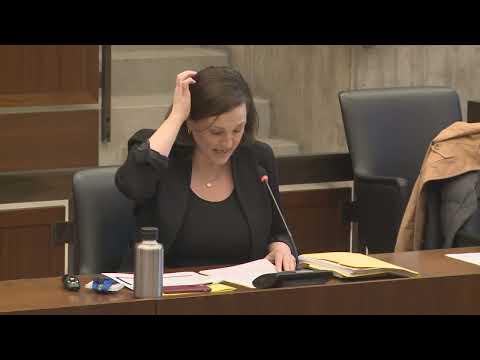
The plan, released March 19, was described at the hearing by Katharine Lusk, executive director of the Planning Advisory Council, who said it “is specifically focused on addressing gaps in our toolkit.” Lusk told council members the cross‑department effort spans six mayoral cabinets and more than 20 city departments and was informed by more than 1,400 pages of community input representing about 2,300 Bostonians.
“The plan,” Lusk said, “lays out all the actions in one place that the city takes to protect people, preserve homes and communities, produce more housing and quality commercial spaces and help our residents and business owners prosper.” The plan groups actions under the familiar four “P” framework used in many cities: protect, preserve, produce and prosper (resident prosperity).
Sheila Dillon, Chief of Housing and Director of the Mayor’s Office of Housing, outlined immediate and longer‑term tools the city intends to use. Dillon told the committee that, because statewide rent‑stabilization authority has not been enacted, “we don't have any rent stabilization or rent control in the city,” and emphasized programs the city can deploy now, including legal help for tenants, targeted lottery preferences for at‑risk households and prioritizing some new income‑restricted units for families and seniors facing displacement.
Devin Burke, deputy chief of the Planning Department, described two technical changes the administration plans to deploy: a new residential displacement risk map at the census‑block‑group level to guide targeted interventions, and a proposed Article 80 displacement disclosure to require developers to report on existing residents and businesses on redevelopment sites so the city can plan mitigation. “There is no silver bullet,” Burke said during the discussion, adding that the city must balance production of housing with protection of existing communities.
What the plan proposes and how it would be used
- Displacement risk map: a new tool the city says will help identify neighborhoods and small areas at highest risk and guide where mitigation and outreach should be concentrated. - Article 80 displacement disclosure: a proposed change in the project review process to document on‑site residents and businesses and trigger negotiated mitigation such as relocation assistance, right of first return or unit set‑asides where feasible. - Program and policy toolkit: more than two dozen new or improved items are proposed across residential, commercial and cultural stability goals. City officials said roughly 16–17 of the residential tools are “net new” actions rather than minor tweaks; examples discussed included updating the condo‑conversion ordinance, co‑purchasing supports for neighbors, expanded housing lottery preferences for at‑risk households, and new outreach to seniors facing displacement. - Small business supports: measures the administration described include tax‑relief proposals (personal property tax exemption cap changes), expanded site‑finding services and a “space” program that has received city funding. Officials said an initial $10 million appropriation helped seed the program and that a CAP (commercial acquisition program) is being developed with outside fundraising. - Housing production and finance: the plan reiterates use of existing tools — inclusionary zoning (recently expanded to apply to buildings with seven or more units), linkage fees for large commercial development and a $110 million housing accelerator/finance effort discussed earlier by the city — to produce income‑restricted units alongside market rate housing.
What councilors and community speakers raised
Councilor Enrique Pepin, the lead sponsor of the hearing, and other council members repeatedly pressed the administration on practical questions: how the city will identify individuals and small businesses at risk; whether lottery and outreach changes will help people displaced from neighborhoods such as Roslindale or Mattapan; and what new resources the city will request in the next municipal budget. Pepin opened the hearing saying “prices in Boston have skyrocketed throughout the years,” and several councilors said they wanted concrete scenarios showing how the plan applies to an individual tenant, homeowner or storefront.
Small business and neighborhood advocates urged faster, neighborhood‑specific protections. Scott Beatty, a Hyde Park resident and business advocate, told the committee that in Clary/Cleary Square “we feel that our small businesses are gonna be swept right out of the square” unless they can purchase buildings or receive stronger protections. Several speakers pressed the committee to pause or slow zoning codification in areas where Squares and Streets rezoning is planned until anti‑displacement measures are fully implemented and tested.
Targets, timing and public input
City staff said the action plan is an evolving work program. The administration described a two‑year roll‑out of priorities with a required one‑year review to assess progress and a formal 45‑day public comment window after the March 19 release. City leaders said many items in the plan do not require new funding, while a subset will be proposed for the council during upcoming budget cycles (for example, targeted staffing for tenant outreach, mapping and site‑finding).
Officials also said they would continue to press the state for policy tools Boston cannot enact on its own (for example, rent stabilization), and to seek state and private funding to extend pilots such as access to counsel for tenants and the small‑business acquisition programs.
What the plan does not do (and known limits)
- It does not create rent control: city officials reiterated that state law currently limits Boston’s authority on rent stabilization and the plan focuses on actions the city can take now. - It does not yet capture every displacement dynamic: officials acknowledged information gaps, for example where a small owner raises rent and a family moves without a formal eviction record; staff said better reporting will be needed to measure those losses. - It depends on developer cooperation and finance: several councilors and panelists noted that the plan’s success depends on disclosure from developers, funding for permanent affordability and negotiated outcomes that developers must accept.
Next steps and how to comment
City officials told the committee the plan will be refined through public comment and added that an online survey and additional listening sessions will be scheduled. Committee members were given advance copies; the hearing record includes the committee email (ccc.plandev@boston.gov) where written comments may be sent and will be added to the public record.
The committee did not take any formal votes at the hearing. Committee members and the administration agreed to continue oversight of the plan’s implementation and to return with progress updates and specific budget requests where required.
Ending
Councilors and administration officials described the action plan as a first step in an iterative process. The city characterized the plan as both a compendium of existing tools and a set of new interventions meant to make those tools easier for residents and small businesses to use. Officials said the displacement risk map and the Article 80 disclosure are among the next implementation items staff expect to prioritize during the coming year.