Get Full Government Meeting Transcripts, Videos, & Alerts Forever!
Get email alerts on the Criminal Variance Notice topic
No spam. Unsubscribe anytime.
Appeals court hears challenge that strangulation charge was widened to permit assault conviction
Summary
A three-justice appeals panel heard arguments over whether a trial that began as a strangulation prosecution was constructively amended—allowing conviction on broader assault-and-battery theories—and whether the defendant preserved the objection.
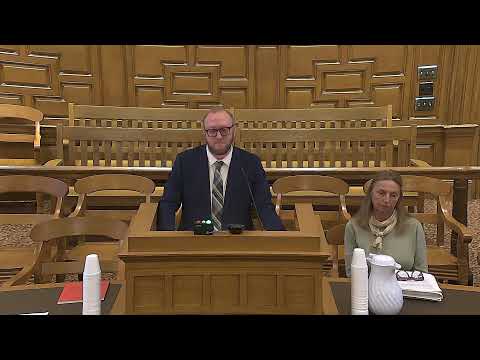
Chief Justice Amy Blake and Justices Suk Kyung Shin and Maureen Walsh heard oral argument in Commonwealth v. David Juden, docket 24P488, over whether the trial court’s midtrial shift from a strangulation charge to a simple-assault theory improperly allowed conviction for conduct the defendant said he was never charged with.
Attorney Emma Quinn Judge represented David Juden and argued that the trial record shows defense counsel objected at multiple points “I would respectfully ask the court to direct out the strangulation, but also not to initiate the assault and battery,” and that the case was annotated on the docket as amended over defense objection. Judge said the amendment/variance expanded the factual basis from touching the defendant’s neck to “an unwanted touching anywhere on her body,” raising notice and fairness concerns.
The panel explored two related legal routes the defense urged: (1) constructive amendment/amendment doctrine (was the change one of form or substance?) and (2) variance/prejudice analysis if the change altered the theory of the charged conduct. Justice Walsh asked whether assault-and-battery would have been a lesser included offense of strangulation and whether, if so, the amendment issue would be one of form and therefore turn on prejudice. Quinn Judge replied she did not press the lesser-included point as dispositive but said prejudice was clear because defense strategy—her client’s planned testimony and cross‑examination—was shaped by a strangulation focus.
Commonwealth Deputy Attorney Molly Paris responded that even if simple assault under an intentional theory is treated as a lesser included of strangulation, the record supports that the trial consistently focused on the neck injuries: photographs of the victim and officer testimony emphasized neck marks and the judge withdrew the strangulation count and instructed the jury on the lesser offense during trial. Paris told the court that the jury instructions, the photographic evidence, and the officer’s testimony make it more likely the jury relied on neck-focused evidence rather than an uncharged “whole-body” theory.
The justices probed how the jury could have reached its verdict given mixed testimony (the victim twice said breathing was not impeded) and conflicting emphases in the Commonwealth’s closing. Both sides agreed closing argument is not evidence, but the justices pressed on whether there was a substantial risk the jury convicted on conduct that was not charged. Attorney Quinn Judge emphasized the possibility that the jury relied on different testimony (chest, grabbing phone, jumping on top) and said the record does not permit a reliable inference about which act the jury used to convict.
The panel took the case under advisement after argument. No decision was announced from the bench.