Get email alerts on the State Budget Forecast topic
No spam. Unsubscribe anytime.
Legislative analysts warn New Jersey surplus is large but eroding; structural deficit a concern
Summary
Office of Legislative Services told the Senate Budget and Appropriations Committee that a projected $6.3 billion year-end surplus for FY 2026 is substantial historically but will shrink if current trends continue; OLS and the executive branch differ modestly on revenue forecasts and flagged heightened uncertainty for FY 2026.
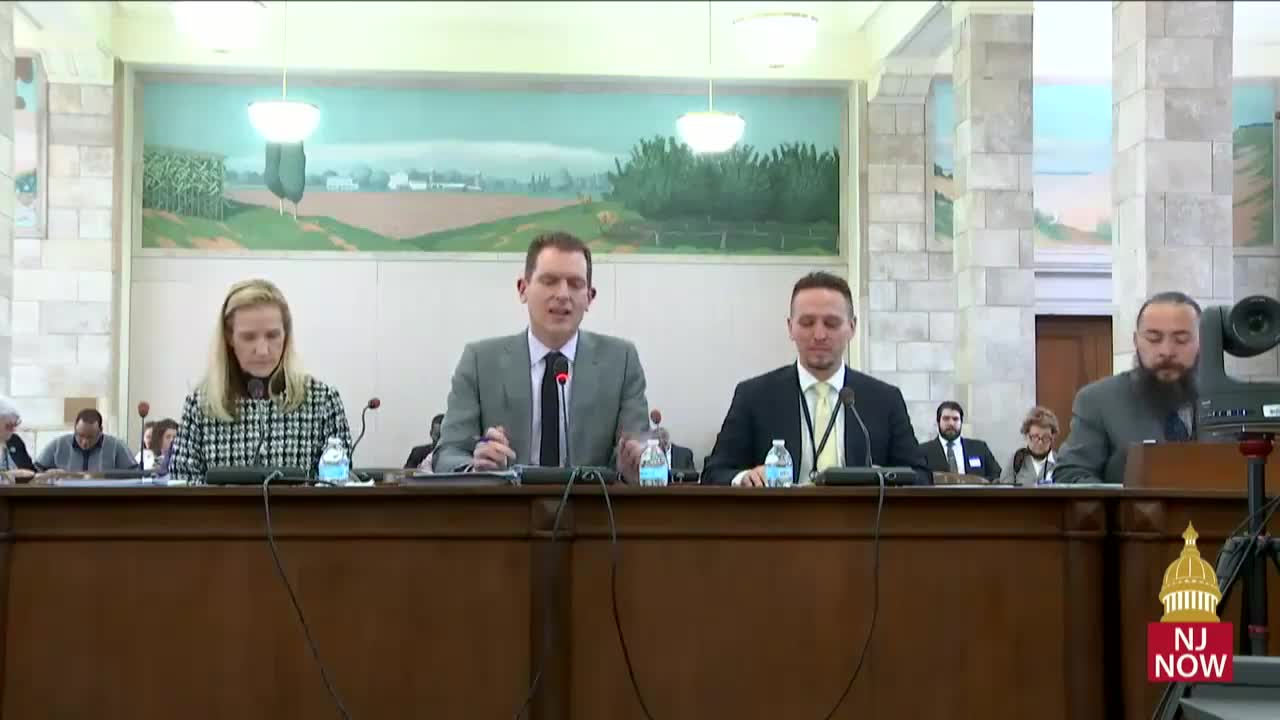
The Office of Legislative Services told the Senate Budget and Appropriations Committee on April 1 that New Jersey faces a substantial but shrinking budget surplus and a structural imbalance between recurring revenues and recurring spending.
"Since fiscal 24, state spending has exceeded and is anticipated to continue to exceed slowly growing revenue collections, a scenario that steadily erodes the state's relatively elevated reserves," Thomas Koenig, legislative budget finance officer, told the committee. Koenig said the state's projected year-end surplus would be "substantial by New Jersey's historical standards" but warned that, if current trends persist, the surplus could be nearly exhausted by the end of fiscal 2028.
The warning framed the committee's review because a diminishing surplus limits the state's cushion against shocks. "A large surplus provides protection against fiscal risks," Koenig said, but added the projected $6.3 billion surplus at the end of FY 2026 is only a point-in-time snapshot.
Office of Legislative Services revenue analyst Oscar Mendez presented OLS’s updated revenue forecast and noted that collections for FY 2025 have outperformed earlier estimates. "To date, growth in fiscal 2025 state revenue has surpassed expectations, leading to an upward revision," Mendez said, and OLS’s FY 2025 forecast is $456.5 million above the executive's revised estimate and $819.1 million above the amount certified when the FY 2025 Appropriations Act was enacted.
OLS’s FY 2026 revenue estimate is $57.04 billion, $227.8 million above the executive branch forecast of $56.81 billion. OLS and the executive differ across several major taxes: OLS estimated higher collections in final payments and business alternative income tax (past-due BAT/PDB) and corporation business tax, while projecting somewhat lower gross income tax and sales-and-use tax receipts than Treasury’s February revision.
Committee members pressed OLS about the implications. Senator Testa described the pattern of relying on one-time or nonrecurring resources and questioned whether the budget showed signs of "Enron-style" gimmicks; Koenig said deliberate manipulation does not appear present but confirmed the proposal relies on drawing down reserves and makes use of broader executive appropriations authority. OLS and multiple senators raised the growing uncertainty in capital markets and the risk that volatility—especially in nonwage income tied to capital gains—could reduce revenue.
The OLS presentation also quantified drivers of future erosion: the removal of roughly $1.9 billion in nonrecurring FY 2026 resources and a projected $1.3 billion increase in expenditures in FY 2027 tied to an expansion of the "Stay New Jersey" program could shrink the surplus by an estimated $3.0 billion in FY 2027 under a simplified model, OLS said.
Koenig and members discussed mechanisms to respond to midyear shocks. Koenig said legislators can enact supplemental appropriations and that the governor also holds certain supplemental appropriation authority for programs such as Medicaid.
The committee's exchange emphasized three takeaways in OLS testimony: (1) the current surplus is historically large but declining if recurring expenditures continue to outpace recurring revenues; (2) OLS’s near-term revenue estimates are cautiously higher than the executive’s, but FY 2026 carries elevated downside risk; and (3) fiscal options exist to rebalance the budget midyear but would require policy choices about spending cuts, efficiencies or one-time resources.
The committee deferred further budget deliberations to upcoming hearings and an OLS update in May after the April tax filing season.
AI generated
The text on this page is AI generated. Summaries, highlights, analysis, and video transcripts are all produced from the original source material.
AI can make mistakes, so if you spot one, and we will fix it for everyone.
Note: the source content is unaltered by us. Any content source we link to, be it a video, an audio recording, or a document, is presented exactly as its publisher released it. That publisher is usually a government body, sometimes an individual official or another organisation.