Get Full Government Meeting Transcripts, Videos, & Alerts Forever!
Get email alerts on the Operating Budget topic
No spam. Unsubscribe anytime.
House advances FY2026 operating budget amid disputes over school funding and childcare payments
Summary
Missouri lawmakers debated and approved parts of the House Committee substitute for House Bill 2, the FY2026 operating budget, including amendments on teacher recruitment grants and 'grow your own' programs. A proposal to move child-care subsidy payments from attendance to enrollment failed 50–89 on a roll call.
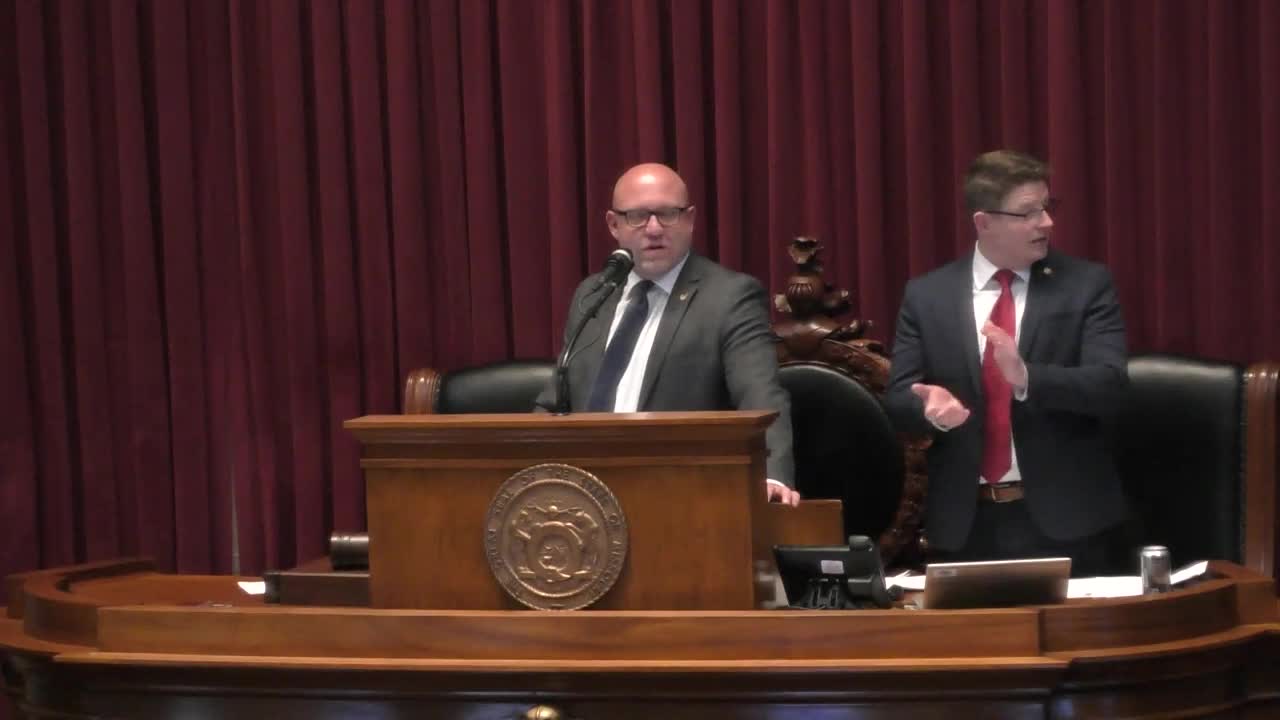
Gentleman from McDonald, the budget chair, presented the House Committee substitute for House Bill 2, the operating budget for fiscal year 2026, saying the measure totals about $47,900,000,000 and “includes over $4,000,000,000 of funding to public education.”
The bill’s backers emphasized increased investment in K‑12 education: “200,000,000 into the foundation formula is what our ... house bill 2 provides,” the budget chair said, and noted recent multi‑year increases in education and transportation funding.
The matter drew extended floor debate over how the budget funds schools and early‑childhood care. Representative Boone offered a pair of linked amendments to reallocate $2,500,000 from the Mo QPK program to the state’s “grow your own” teacher recruitment grants and to set that grant funding at roughly half of past levels. The House adopted both amendments (House Amendment 1 and House Amendment 2) after discussion and floor votes.
Lawmakers also debated a separate proposal from the House Democratic caucus, led in floor remarks by Lady from Green, to restore money the governor had proposed so child‑care subsidy payments would be made on enrollment rather than attendance. Lady from Green said paying “by enrollment would have alleviated most of those issues” that had destabilized providers during the prior rollout. Supporters argued the change would stabilize providers and encourage more slots; opponents said the federal funding proposed to pay for the change is a one‑time balance and that implementing an enrollment payment model immediately risks repeating recent software and payment problems at the Department of Elementary and Secondary Education (DESE). On the roll call, that amendment failed by a vote of 50 yes and 89 no.
Another amendment (offered by Representative Boone) would have directed DESE to allocate any leftover appropriation dollars up to a slightly higher state adequacy target back to school districts (an effective $10 per‑student reallocation rather than an increase in total appropriations). Members debated that language and requested a roll call on the measure; the transcript shows the motion and roll‑call request but does not record the final tally or the clerk’s announcement of the result.
Why it matters: House Bill 2 sets the state’s operating spending for next fiscal year and includes multi‑hundred‑million dollar decisions that affect classrooms, teacher pay and recruitment programs, and the child‑care sector that determines workforce participation for many Missourians. Floor amendments moved some dollars into teacher pipelines while a proposed payment method change for child care failed on a recorded vote.
Votes at a glance - House Amendment 1 (Boone) — reallocate funds to grow‑your‑own teacher grants: adopted (floor announcement). - House Amendment 2 (Boone) — increase part of the grow‑your‑own funding (50% of prior funding level): adopted (floor announcement). - House Amendment 3 (Green) — restore governor’s funding to pay child‑care subsidy on enrollment rather than attendance: failed by roll call, 50 yes, 89 no. - House Amendment 4 (Boone) — language to direct DESE to return any excess appropriation up to a $6,770 SAT to districts (no additional general revenue requested): motion and roll call recorded; final tally not specified in the transcript.
Discussion and next steps: Sponsors said the substitute funds key priorities and leaves nearly $1.9 billion on the bottom line to protect future budgets. Several members pressed for or against accelerating programmatic changes (for example, changing subsidy software and payment rules immediately), and proponents said the Senate could restore or adjust funding later. The House continued work on House Bill 2 after the votes recorded here.