Get Full Government Meeting Transcripts, Videos, & Alerts Forever!
Get email alerts on the Hemp Regulation Taxation topic
No spam. Unsubscribe anytime.
Committee advances hemp-to-cannabinoid regulatory overhaul, shifts enforcement to ABC and adds wholesale tax
Summary
Senate Bill 1413, which moves retail enforcement of cannabinoid products from the Department of Agriculture to the Alcoholic Beverage Commission, creates new licensing and wholesale taxes and was recommended to the calendar committee after committee amendments and fiscal review.
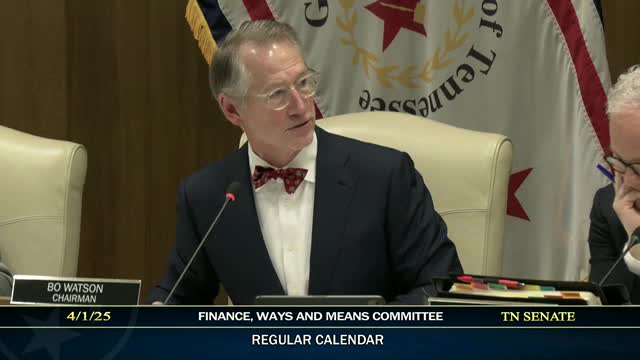
The Senate Finance, Ways and Means Committee on April 1 recommended Senate Bill 1413 as amended for passage to the calendar committee, advancing a 30‑page bill that restructures regulation and taxation of hemp‑derived cannabinoid products. The measure transfers retail compliance and enforcement from the Department of Agriculture to the Tennessee Alcoholic Beverage Commission (ABC), imposes a wholesale tax per milligram on cannabinoid products and creates licensing and fee structures for suppliers, wholesalers and retailers.
Sponsor Senator Briggs said the bill creates a three‑tier regulatory model similar to alcohol: “It allows the Department of Agriculture to continue to monitor the hemp in the field… but once it gets to what we call a supplier… those responsibilities for compliance and enforcement will be transferred to the alcoholic beverage commission,” Briggs said. He said retail and wholesaler licensing fees and a wholesale per‑milligram tax are intended to fund enforcement and testing.
The committee adopted Finance Amendment 1 (Drafting Code 6826), which reallocates portions of the existing 6% additional tax and directs funding to ABC to cover new enforcement staff and operations. The amendment also specifies revenue splits for the additional 6% sales tax and a brand certification fee collected by the Department of Revenue.
Fiscal Review presented estimates that the current 6% additional tax collections would total about $13.6 million next fiscal year and that transferring portions to ABC would increase ABC revenue by roughly $7 million while reducing Department of Agriculture collections. A newly created wholesale tax (a $0.01 per‑milligram tax on cannabinoid content) is projected to generate approximately $12 million annually to the general fund, Fiscal Review said. Licensing and fee revenues were estimated at roughly $5 million annually to ABC, with a small brand fee to the Department of Revenue (about $60,000). The fiscal note assumes ABC will hire additional enforcement staff (the fiscal note estimated 28 positions costing about $2.4 million recurring) and Department of Revenue would add five positions (about $340,000 recurring).
Committee members asked about product definitions (including THCA treatment), the timing of regulatory changes relative to existing rules and impacts on businesses that had prepared under prior Department of Agriculture guidance. Senator Yarbrough warned that the piecemeal approach and uncertainty about the market’s long‑term trajectory could produce unintended taxation outcomes for future reforms. Senator Hensley asked about license costs and renewals; the sponsor and staff said the legislation sets application fees ($500) and annual license fees (retail $1,000 per location; supplier $2,500; wholesaler $5,000), and that the $500 application fee is charged once while licenses are annual.
Senator Wally and others voiced concerns about removing THCA greater than 0.3% from permissible provisions; Briggs and Fiscal Review staff said the Department of Agriculture had previously addressed THCA and federal guidance uses THC measures to distinguish hemp from marijuana. The bill’s fiscal note assumes the current ban on THCA accounted for roughly 30% of current 6% tax collections and adjusts estimates accordingly.
After debate and fiscal review, the committee adopted the finance amendment and recommended the bill as amended to the calendar committee. The committee record shows final passage to the calendar; the transcript records the committee’s recommendation and the adoption of the finance amendment.