Get Full Government Meeting Transcripts, Videos, & Alerts Forever!
Get email alerts on the Csam Platform Liability topic
No spam. Unsubscribe anytime.
Sponsor seeks steep civil penalties for websites that distribute child sexual abuse material; opponents warn of unintended consequences
Summary
House Bill 752 would impose large statutory damages on websites that profit from or host child sexual abuse material (CSAM) accessible in Montana, with a 48‑hour takedown defense; proponents called it necessary, opponents including trade groups and retailers warned it risks lawsuits, misclassification and cost shifts.
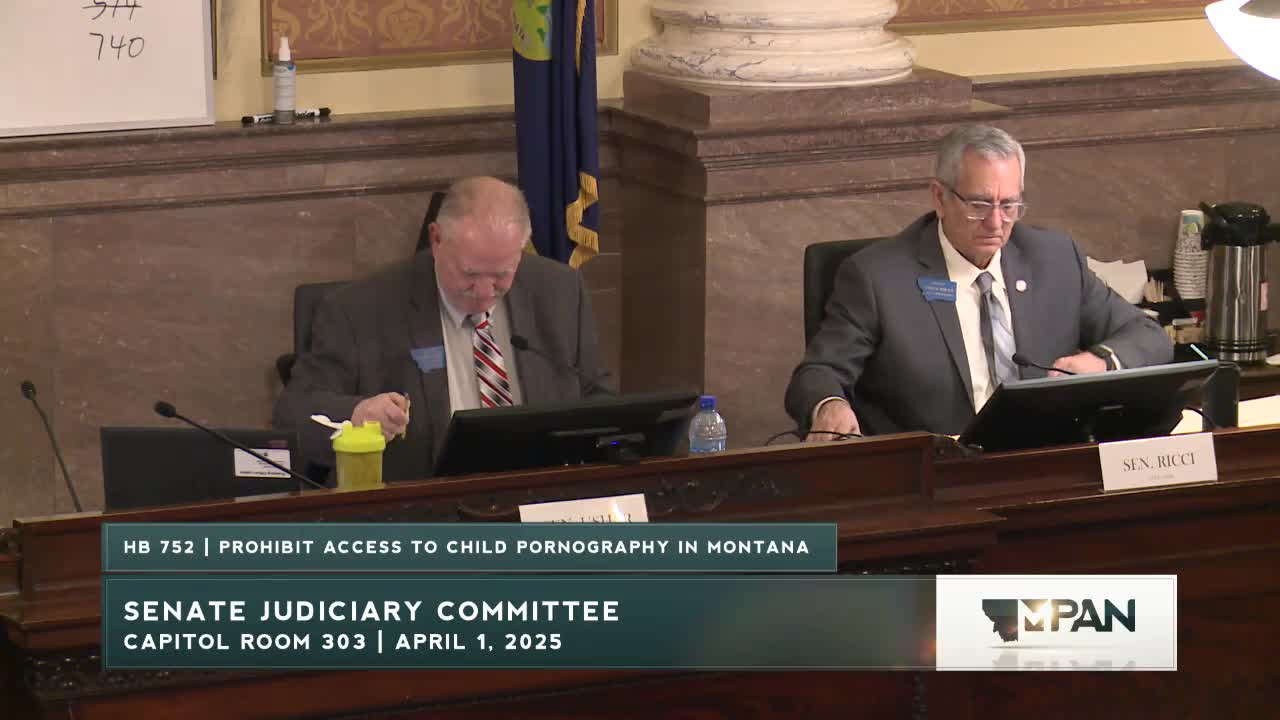
Representative Lucas Schubert opened the House Bill 752 hearing in Senate Judiciary, describing a proposal to impose civil liability on websites that profit from or distribute child sexual abuse material (CSAM) accessible to people in Montana.
Schubert said the bill would base liability for profit on revenue generated from distribution to a person in Montana and would treat each unique piece of CSAM as a discrete unit of liability. The sponsor proposed a statutory damages schedule in the bill’s discussion: $5,000,000 per piece for intentional violations, $1,000,000 for negligent violations and $100,000 for strict liability, and he described a 48‑hour takedown period as an automatic defense if content is removed.
Proponents included a mix of local residents and advocacy voices who told the committee that CSAM is being monetized and that stronger remedies are needed. Anna Shchemelinin described online exploitation and urged passage. Schubert told the committee he intended an amendment to narrow thresholds that would otherwise capture mainstream retailers and streaming services.
Opponents included the Montana Chamber of Commerce, the Montana Retail Association, TechNet and other industry groups. Chamber witness Charles Robinson said the bill’s original “5% threshold of sexually explicit visual content” would improperly capture many legitimate retailers and streaming services; he recommended a 33.3% threshold used in other statutes. Retail and tech witnesses also said the 48‑hour takedown defense is difficult to meet because illegal content is often hidden and only discoverable when notified.
Rose Feliciano of TechNet asked for a knowledge standard aligned with federal law and for the bill to exempt providers whose activity is limited to hosting, cloud or telecom services. Retail witnesses warned of extortion strategies that could flourish if litigants could sue for statutory damages. Schubert said his amendment would raise the “substantial amount” threshold and that the bill is intended to preserve prosecutorial focus while creating private enforcement options.
The transcript records a lengthy committee discussion about thresholds, the proposed private right of action, distribution versus profit standards, and potential fiscal impacts if statutory-damage funds were collected and administered; no committee vote is recorded in the provided transcript.