Get Full Government Meeting Transcripts, Videos, & Alerts Forever!
Get email alerts on the Criminal Justice Firearms Extreme Risk Orders topic
No spam. Unsubscribe anytime.
Tennessee committee rejects 'red flag' bill after testimony and debate on due process
Summary
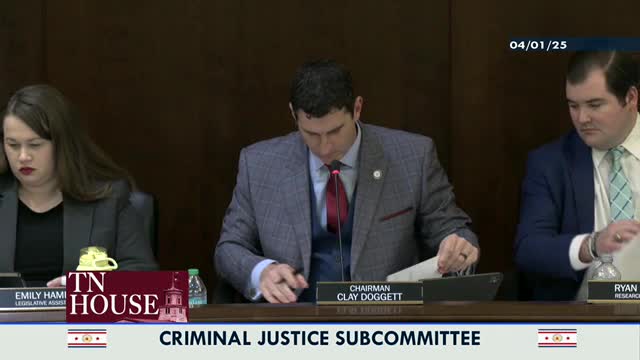
House Criminal Justice Committee members voted 7-2 on April 1 to defeat House Bill 12 22, an extreme risk protection order (IRPO or "red flag") measure that would have allowed courts to temporarily remove firearms from individuals judged to pose a significant risk to themselves or others.
House Criminal Justice Committee members voted 7-2 on April 1 to defeat House Bill 12 22, an extreme risk protection order (IRPO or "red flag") measure that would have allowed courts to temporarily remove firearms from individuals judged to pose a significant risk to themselves or others.
Why it mattered: Supporters told the committee the bill would give families and law enforcement a temporary legal tool to intervene in crisis situations and could reduce firearm suicides and mass‑shooting risk. Opponents focused on the bill’s ex parte mechanics and the potential for taking property or liberty without immediate adversarial process.
Representative Johnson, the sponsor, described the bill as "a tool to help prevent gun violence and suicides by temporarily removing firearms from individuals who are in crisis and risk of harming themselves or others," and framed it as a balance between public safety and due process.
Advocates provided testimony. Jason Sparks of Nashville, introducing himself as representing Moms Demand Action, said the bill "would empower law enforcement officers and close family members who recognize warning signs to petition a court for an order that separates people in crisis from firearms." Sparks cited studies and out‑of‑state experience, arguing the policy could lower firearm suicides and save lives.
Opponents and some committee members voiced procedural and constitutional concerns. Leader Lambert said his main legal objection was the bill’s potential to permit ex parte removal of firearms without an immediate in‑person hearing, stating: "If we are going to take someone's property under the Fourth Amendment, if we're going to take someone's liberty under the Second Amendment, it should not be an ex parte hearing." He said he would oppose the measure on that ground.
Committee action and outcome: After discussion and public testimony, the committee voted to send the bill to a recorded vote; the clerk reported 2 ayes and 7 nays and the bill failed.
What remains: Sponsor Representative Johnson urged members to vote yes, and supporters said the bill included post‑order processes that would allow petitioners to return to court and seek restoration of rights. The committee did not adopt amendments during the hearing; the bill was not advanced and will not proceed from this committee as presented.
Supporting details from the hearing: Jason Sparks noted research cited by advocates, including examples of reduced firearm suicide rates in other states after IRPO adoption; Representative Johnson and others framed the bill as a measure supported by many Tennesseans, citing a referenced poll during remarks.
Next steps: The bill failed at the committee level on April 1, 2025. Any future change would require reintroduction or modification addressing the due‑process concerns raised during the hearing.