Get Full Government Meeting Transcripts, Videos, & Alerts Forever!
Get email alerts on the Tax Policy Sales Vs Property topic
No spam. Unsubscribe anytime.
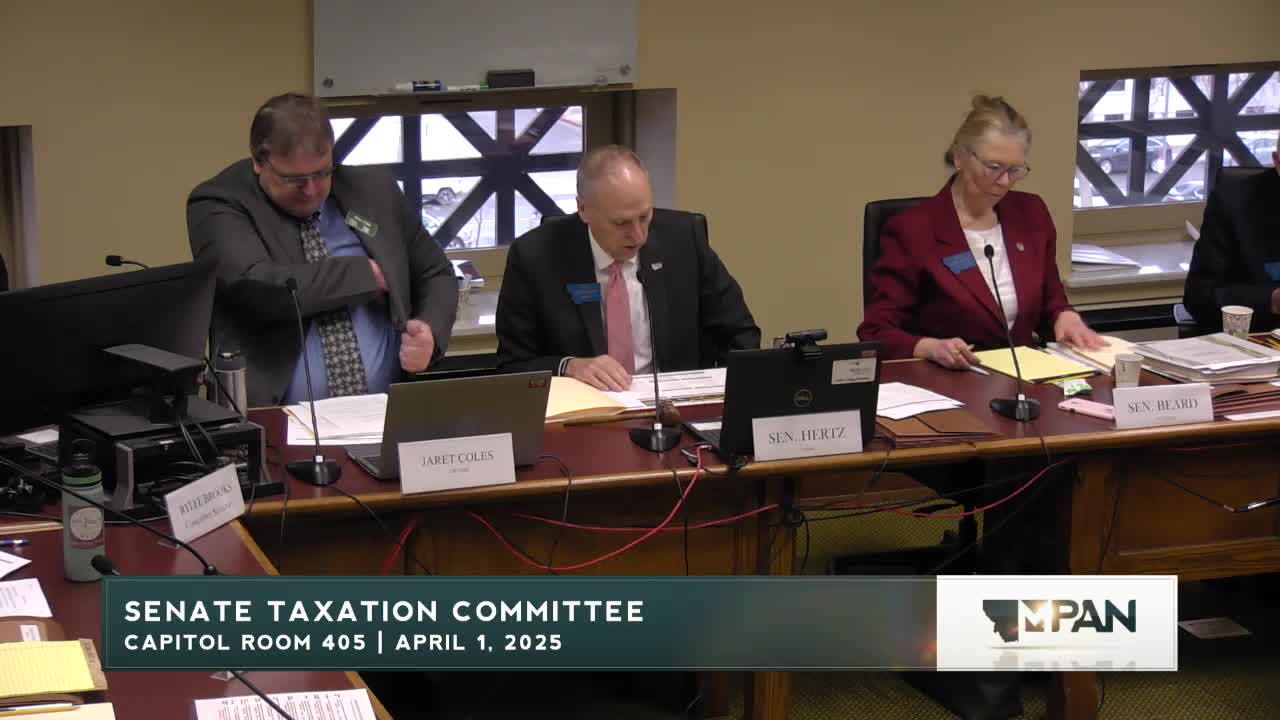
Senate Tax Committee hears wide-ranging proposal to replace school property levies with statewide sales tax
Summary
Senate Bill 558, introduced by Sen. Shelly Vance, drew hours of testimony and questions at a Montana Senate Tax Committee hearing where proponents urged the committee to consider a statewide sales tax dedicated to school equalization and opponents warned the change could be regressive and difficult to implement.
Senate Bill 558, introduced by Sen. Shelly Vance, drew hours of testimony and questions at a Montana Senate Tax Committee hearing where proponents urged the committee to consider a statewide sales tax dedicated to school equalization and opponents warned the change could be regressive and difficult to implement.
Sen. Shelly Vance, sponsor of SB 558 and a state senator from Senate District 34, told the committee she brought the bill to start a policy conversation about property tax relief and said a rebate would not satisfy her constituents. “I don’t want a rebate. That’s insulting,” Vance said, urging lawmakers to consider shifting school levies into a statewide sales tax account and thereby reduce property-tax bills for homeowners.
The proposal is modeled on a South Dakota sales tax package and would impose a broad sales tax with a long list of exemptions, Vance said. She cited a Department of Revenue memorandum estimating nonresident travelers spent roughly $3.76 billion in 2019 and said nonresident visitors could contribute an estimated $44 million to $55 million in annual sales tax revenue — figures she offered as context for taxing some visitor-driven consumption.
Supporters included Todd Devlin, a Prairie County commissioner testifying on behalf of the Montana Association of Counties (MACo). Devlin said MACo’s policy supports using any revenue from a tax on luxury goods and services to reduce property taxes and to distribute some funding to low- or no-revenue counties.
Several organizational opponents described practical and distributional concerns. The Montana Society of Certified Public Accountants (spokesperson identified as Lloyd) said the bill was provided with little notice and raised a specific concern about taxing mobile, highly mobile professional services such as accounting; that could create a competitive disadvantage for Montana firms, the witness said. Amanda Curtis of the Montana Federation of Public Employees said her membership opposes a sales tax even if revenue is directed to education. Rose Bender of the Montana Budget & Policy Center said sales taxes are more regressive than property taxes and more volatile across economic cycles, and Jake Brown of the Montana AFL-CIO said the measure would shift the burden onto working families and retirees.
Derek Bell, division administrator for the Montana Department of Revenue’s Business and Income Tax Division, testified as an informational witness and warned the committee about implementation challenges. Bell said South Dakota required about 70 full-time equivalent positions to administer its tax. “I would be extremely skeptical that we’d be able to stand this up by January 1, 2026,” Bell told the committee, citing staffing, technology, and membership in the Streamlined Sales and Use Tax Agreement as additional hurdles.
Representatives of public education also testified. Doug Reisig of the Montana Quality Education Coalition said school districts are watching levy success rates fall and that the discussion about how to fund schools merits a full, statewide conversation. Committee members repeatedly asked about exemptions for necessities, the treatment of lease and rental payments, protection of bonded levies, evolving online sales sourcing after the Wayfair decision, and options to protect low-income households (such as tax credits or special refunds).
Committee members and staff noted the bill’s 130-page structure includes numerous exemptions and specific deposit language referencing statutory procedures. No committee action was taken on SB 558 at the hearing; the chair closed the hearing and the committee moved to executive actions on other bills while fiscal notes and additional analyses remain outstanding.
The hearing record closed without a committee vote; members asked staff and the Department of Revenue to supply fiscal notes and implementation estimates so the committee can continue consideration in future meetings.