Get Full Government Meeting Transcripts, Videos, & Alerts Forever!
Get email alerts on the Lodging Tax Allocation topic
No spam. Unsubscribe anytime.
Senate committee hears bill to re-bucket lodging-tax dollars, sharply expands emergency lodging for trafficking and domestic-violence victims
Summary
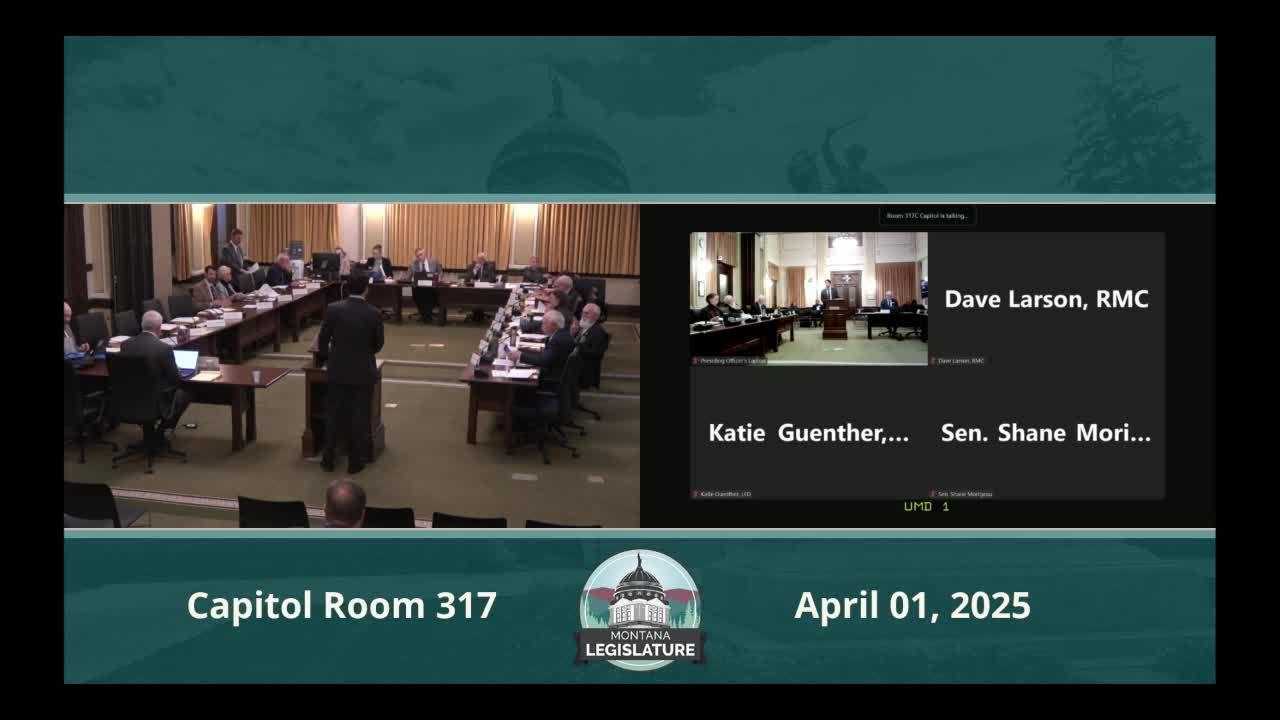
Senate Finance and Claims on Thursday heard testimony on Senate Bill 409, which would change how Montana’s lodging facility use tax is split among the Department of Commerce, historic preservation, university research and a new recovery fund for victims of domestic violence and human trafficking.
Senate Finance and Claims on Thursday heard testimony on Senate Bill 409, which would change how Montana’s lodging facility use tax is split among the Department of Commerce, historic preservation, university research and a new recovery fund for victims of domestic violence and human trafficking.
Sen. Daniel Zollnikov, R-Billings, the bill’s sponsor, told the committee he reworked last session’s language because the prior approach created auditing problems and left too little direction for how Commerce should spend the money. “So instead, I put together … and then kinda created buckets, and then created new buckets, and tried to put a little bit of direction in place,” Zollnikov said.
The bill replaces the 2023 scheme that routed a large share of lodging-tax revenue through a 60–63% “commerce purse” that was then internally allocated. Zollnikov said that structure became “an audit nightmare.” Under SB 409 the bill distributes named percentages directly from receipts, clarifying that Commerce may use funds for Montana promotions, Main Street programs, wayfinding and signage, trade-office support, and targeted “real tourism” pilot projects.
Why it matters: The measure redirects millions in lodging-tax revenue. Committee members and Commerce officials said the change shifts funding among well-known programs — marketing and wayfinding, the University of Montana’s Institute for Tourism, Recreation and Research (ITRR), the Montana Heritage Commission and a new recovery-and-lodging program administered through the Department of Justice. Supporters say the change gives Commerce clearer authority to seed rural and tribal tourism and to relieve pressure on law-enforcement and victim-services systems. Opponents warned it reduces funding available for existing Commerce programs and university research.
Key program changes and dollar cues
- Emergency lodging and recovery: The bill increases a lodging-tax allocation intended to reimburse emergency lodging and short-term recovery services for victims of domestic violence and human trafficking to 2.5% of receipts. Sponsor Zollnikov described the change as funding “a recovery system” to support victims beyond immediate emergency lodging, referencing 60–90 day recovery approaches used in other states.
- Bucketing and audit fix: Zollnikov said the bill removes last session’s 63% “commerce purse” and instead allocates specified percentages from the top. “We swiped we took out that 63% and did the adjustment of the percent,” he said. Department officials described the change as an answer to audit compliance problems when allocations were calculated at the end of the fiscal year.
- Montana Heritage Commission: Mandy Rambo, Acting Director at the Montana Department of Commerce, said the Heritage Commission — administratively attached to Commerce — will receive a flat 2% under SB 409 rather than the prior statutory language that gave 2.7% or $1,000,000, whichever was smaller. Rambo told the committee that change will amount to roughly a $500,000 increase to the commission’s budget for the upcoming biennium.
- University research (ITRR): Shauna Lyons, identified in testimony as an agency director, and representatives for the Office of the Commissioner of Higher Education said the bill would reduce OCHE’s Institute for Tourism, Recreation and Research appropriation by roughly $300,000. Lyons said ITRR would have to prioritize or delay projects such as research on the Bob Marshall Wilderness complex or short-term rental impacts.
Agency and industry support
Representatives of the tourism and victim-services communities spoke in favor. Chris Averill, speaking for the Montana Lodging and Hospitality Association, said the changes further the goal of dispersing visitation beyond heavily touristed Western Montana and noted broader economic impacts: “Out of state tourists spend $5,500,000,000 in Montana last year … the tourism industry supports 66,000 jobs for Montanans,” Averill said.
Victim-service advocates urged support for the expanded recovery funding. Kelsen Young, executive director of the Montana Coalition Against Domestic and ****** Violence, and Stephanie Bauchus, an attorney and co-chair of a human trafficking task force, thanked the sponsor and said the emergency lodging program is operational and would benefit from expanded recovery dollars. Bauchus called the funding “critical” and said it has been administered “very well.”
Questions and concerns raised in committee
- Scope and trade-offs: Several senators asked for a clear, side-by-side chart showing how the bill’s reallocations compare to the current distribution and to the allocations created by last session’s SB 540. Senator Ellis asked whether agencies had prepared a “cheat sheet” on where funds would move; Rambo agreed to prepare a spreadsheet of Commerce allocations for committee members.
- Rural and tribal tourism vs. marketing cuts: Senator Boldman and others pressed whether cuts to marketing and wayfinding would harm the Made in Montana program, trade offices and Main Street grants. Rambo said the department plans to cover those programs and to realize savings by using a new in-state marketing vendor and more targeted media buys. She told the committee that roughly $890,000 of the reduction in Commerce’s marketing/wayfinding lines would be redirected into the victims’ lodging and recovery allocation, and that other areas such as agritourism grants would see increases.
- Program design and administration: Senators asked how the recovery funding would be administered, whether it would create new state FTEs and how it would avoid duplication with federal grants already administered by the Department of Justice. Zollnikov and Rambo described the bill’s language as intentionally broad to allow DOJ and victim-service providers to design an appropriate recovery program (length and services), and both said third-party providers would likely deliver services. Zollnikov said the model used in other states typically provides “about 90 days” to help victims regain stability.
What the committee recorded as unresolved
Committee members asked for more technical clarifications before executive action: a side-by-side “bucket” chart showing year-by-year flows, clarification of dates and transfer mechanics in the bill’s technical note, and confirmation of which programs would be reduced (Rambo committed to provide Commerce’s internal spreadsheet). The sponsor closed by reiterating the bill’s intent to spread tourism dollars more evenly across Montana’s regions and to create a recovery pathway for trafficking and domestic-violence victims.
Ending: The committee closed the SB 409 hearing and asked Commerce to provide the requested bucket breakdown before executive action. No final vote on SB 409 was recorded in the hearing; the chairman said executive action would follow on the committee’s agenda.