Get Full Government Meeting Transcripts, Videos, & Alerts Forever!
Get email alerts on the State Budget Trusts topic
No spam. Unsubscribe anytime.
Montana bill would seed a 'Go Trust' with volatile revenue to fund water, bridges, pensions and housing
Summary
Representative Lou Jones introduced House Bill 924 to create the Montana Growth and Opportunity Trust, a new permanent-fund–style account seeded with one-time transfers and a share of what the bill defines as "volatile" revenue to generate interest for targeted projects including water, bridges, housing and a pension stabilization account.
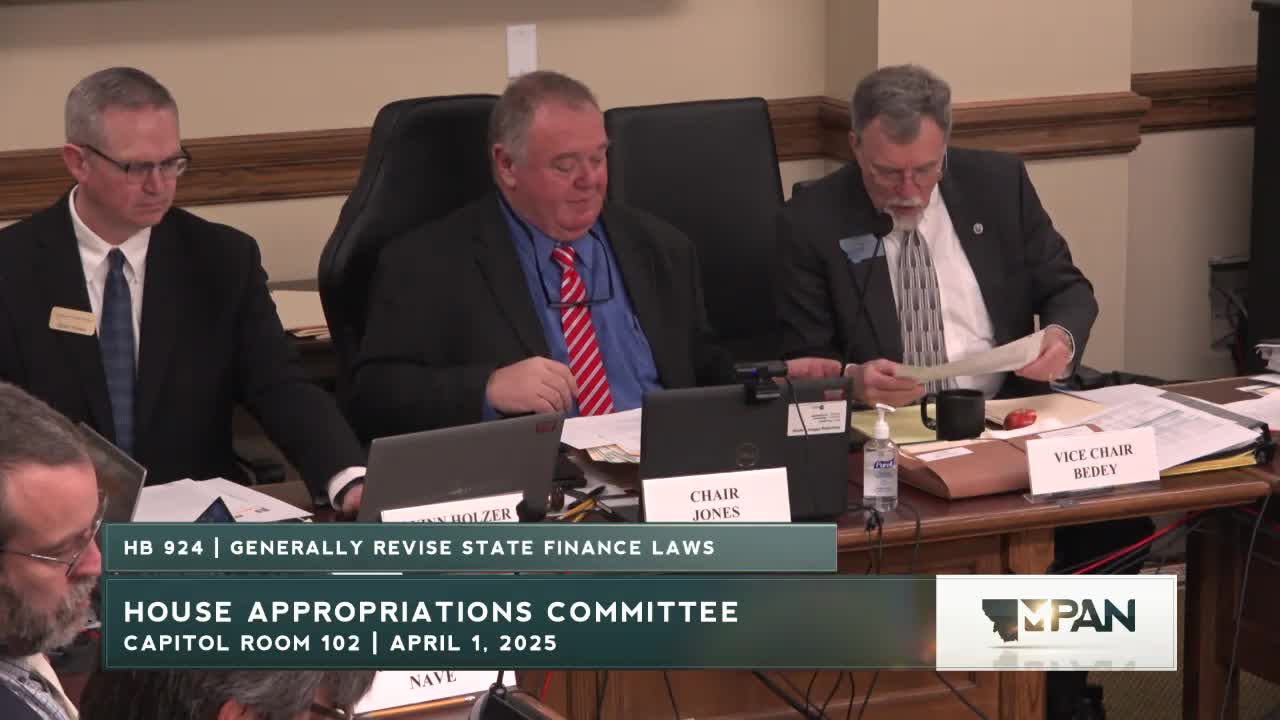
HELENA — Representative Lou Jones introduced House Bill 924 on behalf of the House Appropriations Committee, proposing the Montana Growth and Opportunity Trust, or “Go Trust,” to capture large swings in state revenue and direct interest earnings to several standing priorities.
Jones said the bill “begins with approximately 600,000,000” and showed committee members a handout projecting growth to about $1.8 billion by 2029 if forecasted returns hold. “It’s called the Montana Growth and Opportunity Trust, the Go Trust,” Jones said in opening remarks.
The bill would deposit an initial block of one-time transfers and then, starting in later years, move a defined portion of what the bill calls “volatile” or “risky” revenue into the trust. The sponsor and the legislative fiscal analyst described the proposal as splitting future interest earnings: half is reinvested and half distributed as annual interest to a set of state special funds for uses the bill lists, such as water projects, bridge repair, housing, pension stabilization, tax relief and early-childhood supports.
Why it matters: supporters said the structure is intended to avoid spending large, irregular gains on ongoing programs and to create a predictable stream of interest for targeted priorities. William Hollahan, executive director of the Montana Public Employees Retirement Administration, supported the pension component: under the bill the trust would receive a $300 million seed transfer and make up to $75 million per year available to offset market losses if certified by the retirement board. Hollahan said the contribution pattern and the pension account in the trust would reduce PERS amortization by roughly five years according to actuary projections.
Supporters at the hearing included staff from the Teachers Retirement System, the Montana Association of Counties, conservation groups and water stakeholders. Jim Malizia, chief counsel for TRS, said the bill’s contribution increase would bring the system’s amortization period down “from 21 to 19 years.” Jason Bridal of the Montana Association of Counties and representatives of Trout Unlimited and the Montana Stockgrowers Association testified in favor of water, bridges and disaster resiliency investments.
Concerns and requested changes: Heather O’Loughlin of the Montana Budget and Policy Center described the bill’s intent as “thoughtful” but raised two technical concerns the committee should consider: (1) the bill calculates volatile revenue using HD2 estimates rather than the prior year’s actual revenue and (2) the bill subtracts the 10-year minimum year rather than using a rolling average or compound growth approach used for other funds. She recommended using actual prior-year revenue as the starting point and a rolling average for the floor adjustment to avoid overstating transfers into the trust.
Legislative fiscal analyst Amy Carlson walked the committee through the bill’s flow charts and numbers, explaining that initial “jump start” transfers in FY 2025 and FY 2026 total roughly $679 million and $406 million respectively in the fiscal note the analyst relied on. Carlson said the trust’s interest pool is calculated as total interest on the whole fund and that the bill sets appropriation caps for distributable interest (caps the committee would set at $15 million per distribution pipe in the current draft).
Triggers and reductions: the bill includes two mechanisms to reduce transfers during downturns. Section language allows the budget director to reduce transfers by up to 40% if the general fund ending balance falls toward the operational reserve; a larger statutory trigger already in statute (17-71-40 as cited in testimony) could authorize broader reductions or expenditure cuts by the executive in deeper stress scenarios. Sponsor Jones said he chose the 40% figure to slow transfers in a downturn while avoiding giving the budget office a simple method to halt flows entirely.
Program design and caps: the bill places caps on reinvestment and distribution flows (sponsor said each distribution pipe would have an appropriation cap of $15 million), includes an initial $300 million pension seed, a $50 million initial housing seed, and a $50 million one-time bridge allocation. Sponsor and analyst said the bill is written to revisit caps and sizes in future legislatures and that technical cleanups were expected to follow the hearing.
Next steps: sponsors said technical amendments are coming and that updated fiscal material was expected; Jones asked for the committee to consider the bill after technical fixes that will clarify caps and access rules. No formal committee action or vote was recorded at the hearing.
Ending note: proponents framed HB 924 as a long-term wealth-preservation and targeted-investment tool shaped to limit spending of irregular revenue. Opponents and analysts urged revisions to the volatile-revenue calculation and expressed concern that large transfers during a period of uncertain forecasts could strain the near-term general fund balance.