Get Full Government Meeting Transcripts, Videos, & Alerts Forever!
Get email alerts on the Medicaid Drug Coverage topic
No spam. Unsubscribe anytime.
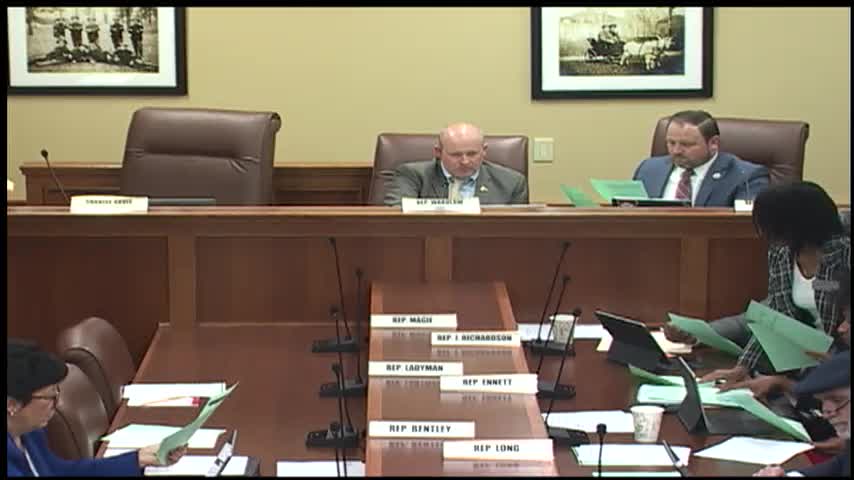
Committee debates covering GLP‑1 weight‑loss drugs under Medicaid; bill fails to reach required threshold
Summary
House members in the Public Health, Welfare and Labor Committee considered House Bill 13‑32, a measure to make Arkansas Medicaid cover GLP‑1 weight‑loss drugs after a final federal rule. DHS warned of immediate state cost and the bill failed to reach the required 11‑vote threshold.
House members in the Public Health, Welfare and Labor Committee considered House Bill 13‑32, a bill by Representative Pilkington that would require the Arkansas Medicaid program to cover GLP‑1 class drugs for weight loss no later than the date a final federal rule is issued based on a proposed federal rule affecting Medicare and Medicaid.
The bill’s sponsor, Representative Pilkington, said the bill simply aligns state coverage with a forthcoming federal rule: “If the federal rule comes down that you can use these to treat weight [loss], then we would expect the state to follow suit,” she said. She emphasized the measure would not take effect until a federal decision and said states such as Mississippi have pursued similar moves to control long‑term Medicaid costs.
Elizabeth Pittman of the Arkansas Department of Human Services told the committee DHS has not budgeted money for an expansion and that the department’s fiscal estimate — which does not include rebates or downstream savings — shows a significant state share. “We do not cover weight‑loss drugs as a class of medication at this time, so that would be an expansion of coverage for us,” Pittman said.
The sponsor and DHS both discussed possible offsets from improved health outcomes. Austin Grinder, who said he brought a University of Mississippi study to the sponsor’s attention, summarized that study’s first‑year findings: pharmacy costs rose by about $61 per beneficiary while medical costs declined by about $59 per beneficiary, a small net increase in year one that the study’s authors said could change over time as medical savings grow.
Committee members pressed DHS and the sponsor on details including whether prior steps (diet, exercise programs) would be required before coverage, how federal changes would trigger state action, and whether the department had modeled rebates and long‑term savings. Pittman noted DHS’s fiscal numbers “are based solely on what we would have to expend on the drug. They don’t account for any return on investment.” Representative Bentley and others said they were reluctant to expand coverage while federal policy and Medicaid funding remain uncertain.
Representative Pilkington made a motion that HB 13‑32 do pass. The committee later called the roll. For the record, the chair said the bill received eight yes votes and therefore did not meet the 11‑vote threshold required; the motion failed on that basis.
The debate combined clinical, budgetary and policy questions: sponsors and advocates framed the bill as a potential cost‑saving, preventive measure tied to a future federal rule; DHS flagged immediate budgetary effects and the absence of set‑aside funds; an outside summary of Mississippi’s experience suggested near‑term pharmacy cost increases largely offset by small medical cost decreases in year one, with uncertainty about longer‑term savings.
With the committee unable to reach the supermajority threshold, HB 13‑32 will not advance at this time.