Get Full Government Meeting Transcripts, Videos, & Alerts Forever!
Get email alerts on the Senior Hunger Grants topic
No spam. Unsubscribe anytime.
Committee adopts special language to create senior-hunger grant; $5 million supplemental request fails
Summary
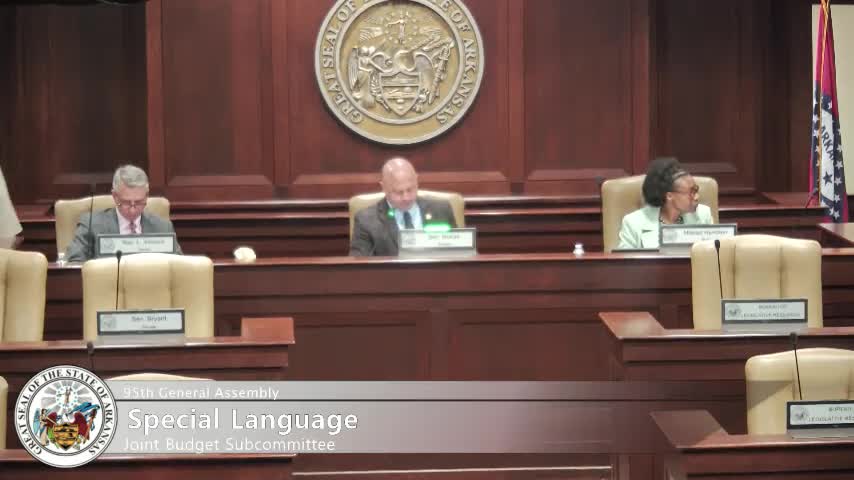
The Joint Budget Committee adopted special-language creating a senior-hunger grant program with set-asides for non-AAA senior centers, and separately rejected a senator’s proposal to transfer $5 million from surplus cash to expand home-delivered meals funding.
The Joint Budget Committee on an unspecified date adopted special-language establishing a grant within the FITE senior-hunger community grant program and set aside funding for senior centers not served by Area Agencies on Aging (AAA). Representative Kavanaugh said the language "sets up a grant" and that "400,000 of it would actually go to non AAA senior citizen centers."
The action came during consideration of amendments and was adopted after a motion and second; no speakers rose in opposition during the floor discussion.
Separately, Senator John Peyton (District 22) proposed a one-time $5 million transfer from the state's cash-flow surplus to address a shortfall in home-delivered meals. Peyton told members the state has a $10 million appropriation but only $5 million funded through RSA, and said the supplemental would pull the additional $5 million from a cited $384,000,000 cash-flow surplus. "This is one time money," Peyton said, adding that food costs have risen and that waiting lists for home-delivered meals exist.
Senators questioned the source and precedent for using reserve or surplus cash for recurring program needs. Senator Hickey argued restricted-reserve allocations are typically used for one-time capital projects and asked whether DHS or other agencies had analyzed the precise shortfall. Jay Hill, representing the Department of Human Services' aging and adult services, told the committee the $5 million "does not have a federal match" and explained that senior centers receive federal Title III funding and a state general revenue allotment. Hill said the extra state funds would count toward maintenance-of-effort requirements but would not generate additional federal matching dollars.
After floor discussion the committee voted and the amendment brought by Senator Peyton failed. The special language introduced by Representative Kavanaugh was adopted earlier in the session.
The committee discussion also included questions about whether the supplemental would become recurring through RSA (restricted reserve account) or remain a one-time appropriation; senators and sponsors noted that RSA adjustments are a separate process. Members also referenced prior restricted reserve allocations and competing demands on surplus cash, including Medicaid trust fund needs.
Members and staff noted operational details: federal Title III rules limit administrative overhead for federal funds (generally to 10 percent), program administrators said they run on tight budgets and expect added dollars to be used for meals rather than overhead. The adopted special language is intended to work in tandem with any future RSA changes or grant programs for non-AAA senior centers.
Looking ahead, sponsors said separate bills and RSA requests are pending to address longer-term funding; those proposals' prospects were described as uncertain during the hearing.
Votes at a glance: Representative Kavanaugh’s special-language amendment — adopted. Senator John Peyton’s $5 million supplemental transfer amendment — failed.