Get Full Government Meeting Transcripts, Videos, & Alerts Forever!
Get email alerts on the Renewable Energy Farmland topic
No spam. Unsubscribe anytime.
Senate panel requires remediation plans for renewable energy on farmland; bill passes
Summary
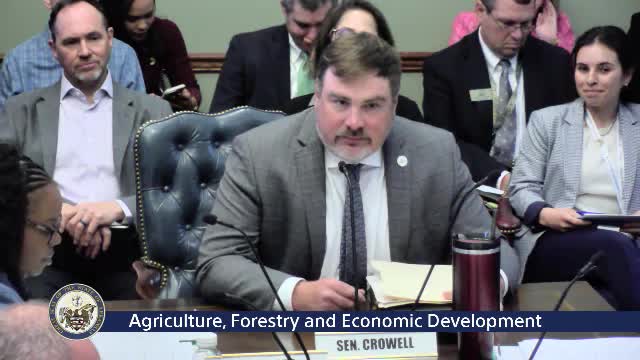
Senate Bill 15 25, amended to require deconstruction and land restoration agreements between renewable-energy developers and agricultural landowners, passed the committee. Sponsors said the measure protects farmland usability after solar or wind facilities retire; industry representatives said many developers already use remediation agreements.
The committee voted to pass Senate Bill 15 25 after a brief presentation and discussion about post-operation land restoration for renewable energy installations on agricultural land.
Sponsor Trey Steinle told the committee the measure requires commercial renewable energy facilities built on farmland to enter remediation agreements with the landowner. "This ensures land use for this energy development remains usable for agriculture once the renewable energy facility is no longer operational," Steinle said.
Nut graf: Supporters said the bill formalizes a practice many "good actors" already follow and prevents future developers from leaving farmland damaged or uncleared after projects cease. The bill exempts small personal-use systems such as grain-bin power and grandfathered facilities already in operation.
Provisions and debate: The bill calls for a remediation plan that includes a deconstruction schedule and restoration to productive agricultural use. Secretary West Ward of the Arkansas Department of Agriculture explained the department would receive copies of remediation agreements and that enforcement would be civil contract matters: "We're gonna have them just like any other contract," Ward said. Industry witnesses told the committee most reputable developers already include restoration plans and supported the bill as a way to keep bad actors from harming farmland.
Vote: Senators passed the bill by voice vote on a motion and second recorded in the transcript. Sponsor Trey Steinle closed and the committee congratulated him after the voice vote.
Ending: Lawmakers said the bill balances support for renewable development with protections for long-term agricultural productivity by requiring written remediation commitments.