Get Full Government Meeting Transcripts, Videos, & Alerts Forever!
Get email alerts on the Housing Development topic
No spam. Unsubscribe anytime.
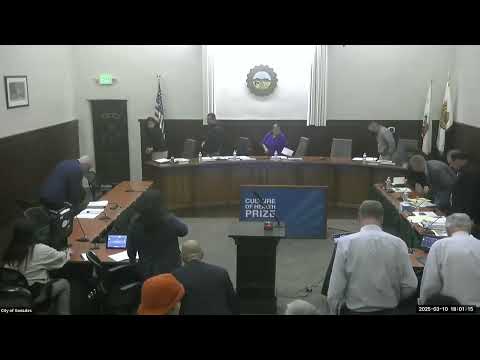
Gonzales planning commission backs Vista Lucia project, sends six recommendations to city council
Summary
The City of Gonzales Planning Commission voted unanimously Tuesday to recommend the City Council certify the final environmental impact report for the Vista Lucia development and to approve the specific plan, pre‑zoning, a development agreement, the first tentative map and initiation of annexation to LAFCO.
The City of Gonzales Planning Commission voted unanimously Tuesday to recommend that the City Council certify the final environmental impact report for the Vista Lucia project and approve the specific plan, pre‑zoning, development agreement, the first tentative map and initiation of annexation to the Monterey County Local Agency Formation Commission (LAFCO).
The action covers six separate Planning Commission resolutions recommending that the City Council: certify the final EIR and adopt a mitigation monitoring and reporting program; amend the Gonzales General Plan and adopt the Vista Lucia specific plan; approve pre‑zoning for the project area; approve a development agreement with Cielo Grande Ranch LLC; approve the first tentative map for 1,247 units; and initiate a 771‑acre annexation request to LAFCO.
The project, commonly called Vista Lucia, would develop about 771 acres east of Gonzales along Feynor (Fano) Road and Associated Lane, and ultimately could contain as many as 3,498 housing units over an anticipated multi‑decade buildout, including parks, three school sites and mixed‑use commercial areas. The Planning Commission vote forwards the actions to the City Council, which would be the final city body to act before the annexation request is submitted to LAFCO.
Why it matters: Vista Lucia would be the largest single development undertaken by the city in decades and would convert productive farmland to urban uses, a change that requires LAFCO approval and drew detailed review in the project EIR. The size, phasing and affordability provisions prompted extensive public comment and debate at the hearing.
Project scope and phasing Brent Slama, the planning consultant on the project, told the commission the plan divides the territory into phases to manage growth. The first tentative map approved by the Planning Commission covers roughly a quarter of the total project and would accommodate 1,247 units, which staff estimated could take about seven years to build under normal market conditions. Slama said the full buildout is envisioned over roughly 30 years and includes 79 acres of parkland, three school sites, a mixed‑use commercial zone and a network of promenades and trails.
Infrastructure, public services and financing Staff explained that the project requires significant infrastructure investments: new wells, water tanks and piping, sewer upgrades and a planned expansion of the city wastewater plant. To reduce impacts on existing residents, the development agreement calls for the developer to pay impact fees at the time building permits are pulled, and for creation of a community facilities/assessment district to pay for ongoing maintenance and new services such as parks and public safety. Slama said Fano Road will be extended and Associated Lane improved to provide a northern route to U.S. 101; those interim road improvements are expected before home construction begins in the first phase.
Affordable housing and donated parcels The developer has proposed several affordable‑housing measures. Glenn Pace, manager of Trenbrook Development (applicant representative), said the developer will donate two blocks (Block 6 and Block 25) to a nonprofit housing provider or to the city for low‑ and very‑low‑income apartments and that the project includes sites and programs for smaller lots, ADUs and a sweat‑equity self‑help program. "I see all families in Gonzales being able to own a home," Pace said, describing a project philosophy that mixes ownership and rental opportunities to broaden access.
CHISPA, a nonprofit housing provider, has a memorandum of understanding with the applicant to pursue development on the donated blocks. Jeffrey Morgan, president of CHISPA, told the commission that the nonprofit supports moving the project forward and urged flexibility on timing and stub‑outs so affordable housing parcels can be served when financing becomes available. "I recommend that we don't — that we have a little bit of freedom in terms of how that timing takes place," Morgan said, noting affordable projects often need different financing and schedules than market‑rate construction.
Public comment and opposition Public comment included both supporters and opponents. Supporters — including longtime Gonzales residents who said the town has not added housing in decades — urged approval to create homes for teachers, firefighters and multigenerational families and to secure donated land for schools and a fire station. Resident Angelica, who identified herself as a teacher, said the project "is not just a housing issue. It's a workforce issue," and urged denser, more affordable choices.
Opponents and affordability advocates said the current specific plan does not guarantee sufficient affordable housing. Laura Davis, deputy director of LandWatch, urged the city to adopt the high‑density Alternative 4 from the final EIR, arguing the project's proposed densities and the plan’s affordability‑by‑design approach will not yield units affordable to most local households. "Most troubling, they do not actually guarantee affordable units in any way," Davis said.
Agency comments and agricultural mitigation LAFCO staff raised a procedural and substantive issue: because the project will require annexation, LAFCO asked the city to apply LAFCO's agricultural‑mitigation guidelines in the EIR rather than the city's municipal farmland ordinance. Darren McBain, a staff member with the Monterey County LAFCO, said LAFCO's letter requested that the EIR mitigation measure be written to meet LAFCO's guidelines so LAFCO could use the city's environmental clearance for its annexation decision. McBain said LAFCO allows, where appropriate, payment of an in‑lieu fee to a qualified land trust if suitable conservation easement sites are not available now.
Planning staff acknowledged the concern and the commission's motion to certify the EIR included an erratum to reflect that the city and the developer will follow LAFCO's agricultural mitigation policy when the matter moves to the council. Staff said the final EIR and the mitigation monitoring and reporting program will be updated to mirror that requirement.
Traffic, schools and other service questions Speakers and commissioners raised questions about traffic impacts at Fifth Street and the U.S. 101 interchanges and about school capacity. Staff and the developer said roadway improvements — including interim connections of Fano Road to Associated Lane and eventual upgrades at the northern interchange — are part of the project's infrastructure program and that specific improvements are triggered as housing counts reach thresholds in the development agreement and conditions of approval. The developer has offered a site for an elementary school; construction of school facilities is the responsibility of the Gonzales Unified School District.
Commission action and next steps The Planning Commission approved each of the six resolutions on unanimous voice votes and recommended the City Council certify the EIR and take the subsequent approvals; the commission also recommended that the City Council adopt an erratum to the EIR to incorporate LAFCO's agricultural mitigation policy. The council will consider the items at a future meeting; if the council acts affirmatively, the city will submit an annexation proposal to LAFCO for final action.
The project team and staff emphasized the long history of the proposal — about 20 years of planning and prior workshops — and said buildout will be phased and contingent on infrastructure and financing. Supporters and developer representatives said the project will create opportunities for both ownership and rental affordable housing if the donated parcels, infrastructure stub‑outs and nonprofit partnerships proceed. Opponents urged higher density and hard guarantees for affordable units.
Votes at a glance The Planning Commission recorded and approved the following resolutions and recommendations to the City Council (all passed on voice vote): PC2025‑01 (certify final EIR and adopt mitigation monitoring program with erratum to follow LAFCO ag mitigation), PC2025‑02 (general plan amendment and specific plan approval), PC2025‑03 (pre‑zoning), PC2025‑04 (development agreement approval), PC2025‑05 (tentative map for 1,247 units), PC2025‑06 (initiation of annexation with LAFCO).
What’s next The City Council will consider the six recommendations. If the council approves them, the city will submit an annexation application to LAFCO; any LAFCO approval would be required before the city could process development permits for land outside the current city limits. The timeline for construction depends on infrastructure funding, school district decisions about school construction and market conditions; staff estimated the first phase could take several years to build once permits and infrastructure are in place.
The Planning Commission record and the final EIR, including the mitigation monitoring program and the erratum addressing LAFCO's agricultural mitigation policy, are available through the City of Gonzales planning office and on the city's website.