Get Full Government Meeting Transcripts, Videos, & Alerts Forever!
Get email alerts on the Property Tax Manufacturing topic
No spam. Unsubscribe anytime.
Sponsor seeks new manufacturing property tax class with 1.47% multiplier
Summary
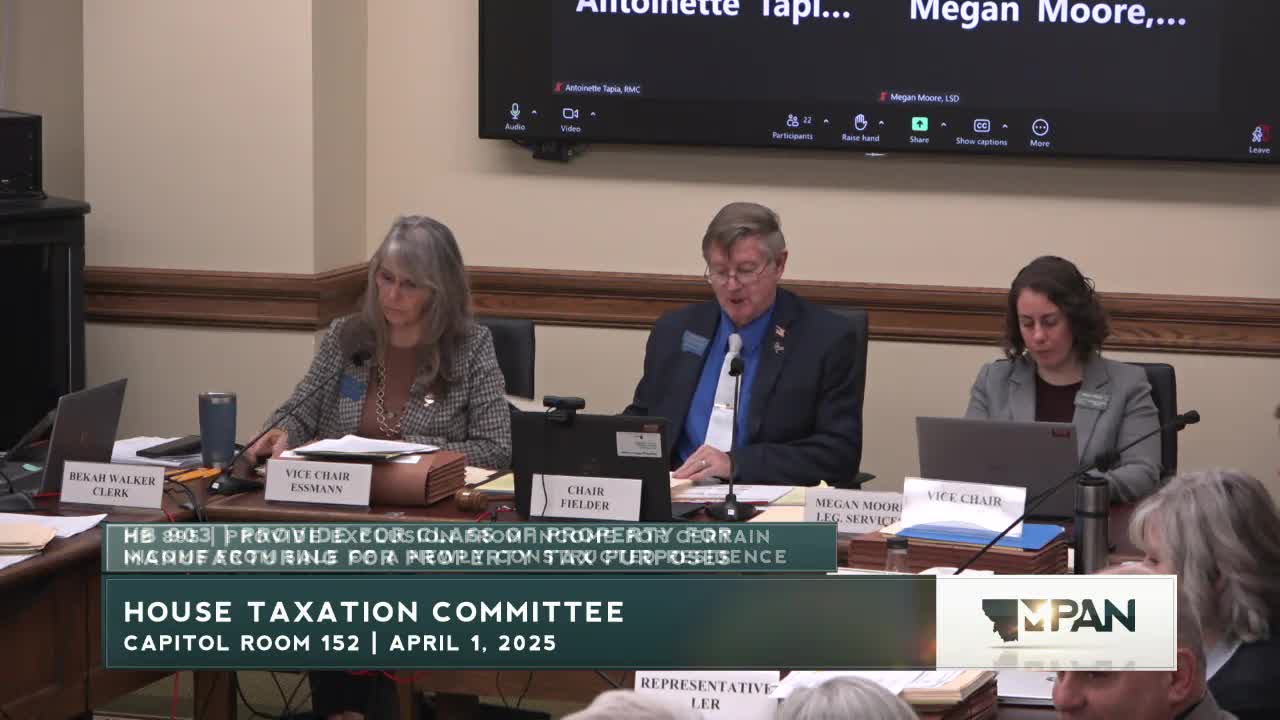
Representative Lukas Schubert told the House Tax Committee that House Bill 903 would create a new property tax class for land and improvements used for manufacturing with a 1.47% multiplier. Opponents cautioned the move could add complexity and may not yield lower rates after broader property tax changes.
Representative Lukas Schubert opened the hearing on House Bill 903 by telling the House Tax Committee the bill would create a new property tax class for manufacturing, setting a multiplier at 1.47% of market value to encourage industry to locate in Montana.
"This bill will create a new property tax class for manufacturing," Schubert said, arguing that tariff policy is returning industry to the U.S. and Montana should compete for jobs. He said the proposal excludes business equipment and targets land and improvements used for manufacturing.
Bob Story of the Montana Taxpayers Association opposed creating another property class, saying, "we don't need another class of property. We already got 16 of them." He also warned that with broader legislation under consideration to reset residential and commercial rates, the proposed 1.47 multiplier might end up close to other commercial rates after adjustments.
Bryce Kautz, Bureau Chief with the Property Assessment Division, answered committee questions about classification rules. He explained how land classification is determined when a parcel contains multiple improvement types: the land is classified according to which improvements occupy the larger share of a parcel. "If the manufacturing was a hundred thousand square feet and the other commercial was 50,000 square feet, the land would be classified as this new class because the manufacturing improvements are the larger share," Kautz said.
Committee members asked about modeling and county‑by‑county impacts; the sponsor said Legislative Fiscal had not provided an immediate estimate at the hearing and that 1.47 was chosen to be lower than some proposals for commercial rates while still not being lower than residential rates. Schubert urged a do‑pass recommendation, saying the state should act while federal policy favors reshoring industry.
No committee action was recorded at the close of the hearing.