Get Full Government Meeting Transcripts, Videos, & Alerts Forever!
Get email alerts on the Wildfire Preparedness topic
No spam. Unsubscribe anytime.
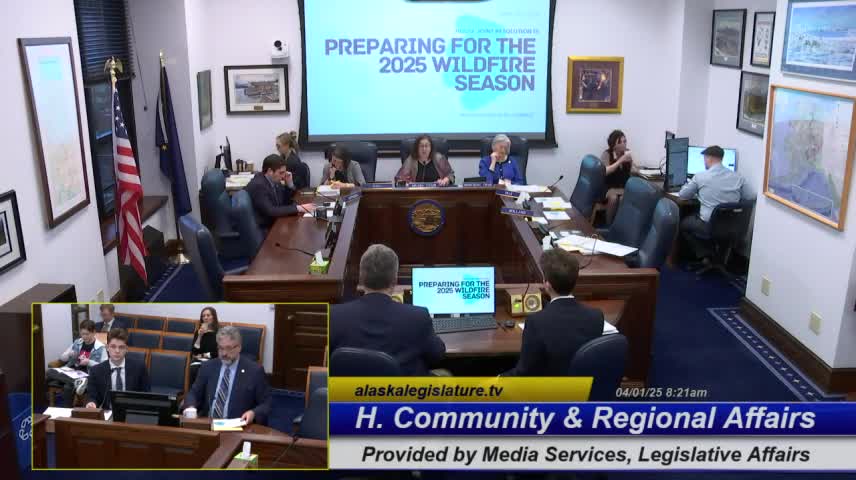
Lawmakers hold introductory hearing on HJR 15, urge early planning and detection for 2025 wildfire season
Summary
The House Community and Regional Affairs Committee held an introductory hearing on HJR 15, a resolution urging stepped-up wildfire preparedness and early detection measures for the 2025 season, with agency witnesses describing pre-season coordination and community outreach.
The House Community and Regional Affairs Committee held an introductory hearing on House Joint Resolution 15, which urges state and local action to strengthen wildfire preparedness ahead of the 2025 season. The hearing included invited testimony from community and agency experts and public comment from a Rabbit Creek Community Council member.
Representative Kai Holland, sponsor of HJR 15, said the resolution grew from community council concern in Rabbit Creek and broader work on the wildland-urban interface (WUI). Holland said the resolution draws attention to dry conditions, higher temperatures and low snowpack and urges state agencies, municipal governments and Alaska’s congressional delegation to take proactive steps to mitigate wildfire risk.
Drew Dembowski, an evacuee from the Eaton fire in Altadena, California, described rapid fire growth driven by extreme winds and urged Alaskans to prioritize preparedness. "Preparation and preparedness are the only solution," he told the committee.
John Glover, wildfire division chief for the Anchorage Fire Department, described unusually early season indicators and said Anchorage faces heightened risk: he cited that more than 86% of Anchorage housing is inside the wildland-urban interface or intermix. Glover said AFD has expanded community messaging (Ready, Set, Go), coordinated preparedness exercises with state partners, and reinstated a woodlot disposal program to accept fuels at no cost for residents. He announced a public town hall on May 19 at the Loussac Library at 6:30 p.m. and said the woodlot will be active six days a week starting May 1 at the Central Transfer Station.
Norm McDonald, deputy director of the Alaska Division of Forestry and Fire Protection, described state detection resources and mitigation efforts, including satellite detection (commercial providers such as Planet), lightning-tracking flight patrols, fuels-reduction programs and interagency planning. He said the division prepositions seven helicopters at bases across the state and maintains two contracted air tankers (Palmer and Fairbanks). Flight time from Palmer to Anchorage is about 25 minutes, McDonald said. He described cooperative resource-sharing under a Northwest compact with Canadian provinces and western U.S. states and said such compacts remain in effect.
Public testimony included Cindy Kynard of the Rabbit Creek Community Council, who urged rapid detection and dedicated suppression assets near high-value, high-risk areas. Committee members asked about the feasibility of the resolution’s timelines — the text encourages tabletop and live evacuation drills before May 1, 2025 — and agency witnesses said smaller, targeted tabletop exercises are low-cost and already scheduled in April and early May; large-scale live exercises take more time and resources.
Members also discussed communication systems (Smart911, RAVE Alert, PulsePoint) and local concerns about consolidated dispatch in some regions; McDonald said the U.S. Forest Service remains the primary suppression agency in parts of Southeast and federal/state support can be provided when needed. Glover said Anchorage’s wildfire division was grant-funded beginning in 2023 through a U.S. Forest Service award that extends into early 2028.
The committee closed the hearing, took no final action, and set the resolution aside for further consideration; staff noted an amendment deadline the next day and plans to continue working on language and coordination with relevant agencies.