Get Full Government Meeting Transcripts, Videos, & Alerts Forever!
Get email alerts on the Money Transmission Crypto topic
No spam. Unsubscribe anytime.
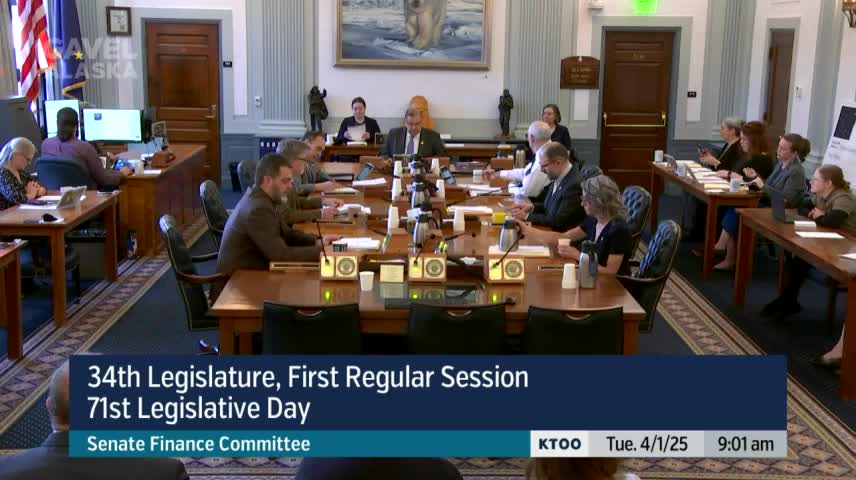
Senate finance committee hears bill to modernize Alaska money-transmission rules for crypto and mobile payments
Summary
Senate Bill 86 would update Alaska's 2007 money-services law to cover cryptocurrencies and modern mobile payment platforms, add consumer protections, and move licensing to a tiered, activity-based fee model; the committee held a first hearing, heard industry and regulator testimony, and set the bill aside pending amendment deadlines.
Sen. Jesse Kiel introduced Senate Bill 86 on April 1, asking the Senate Finance Committee to update Alaska law for cryptocurrency exchanges and modern money-transmission services.
Kiel said the bill would move Alaska away from a 2007 Uniform Money Services Act model to a model developed by the Conference of State Bank Supervisors, adding ‘‘fundamental safety and soundness’’ protections for companies that custody or transmit customer funds, including cryptocurrencies. ‘‘This bill is about making sure the company holding and trading those assets at your direction doesn't divert them, and follows your instructions,’’ Kiel said.
The bill would require background checks, periodic examinations, protections against diversion of customer assets and disclosures and receipts for timely transfers, Kiel told the committee. He said the measure also creates a tiered fee structure keyed to business volume so startups do not pay the same flat license fees as large national firms.
Robert (Rob) Schmidt, director of the Division of Banking and Securities, described the bill as a ‘‘generational update’’ to bring Alaska law into alignment with current technology and other states. The division, Schmidt said, oversees money transmission and related financial services in Alaska and lacks transaction-level personal data in current filings. Schmidt cited 2024 aggregated figures for Alaska: roughly $6.3 billion moved to, from or within the state via licensed money-transmission channels and about $1.496 billion in cryptocurrency flows. He said the division currently licenses roughly 173 money-transmission entities under a flat-fee model and that adopting tiered fees will let the regulator fully fund examinations and investigations without general-fund support.
Industry witnesses — including Adam Atlas of the Money Services Business Association and Adam Fletcher of the Money Services Roundtable — told the committee they support the Conference of State Bank Supervisors model and said uniformity with other states reduces compliance burdens and encourages safe expansion of services into Alaska.
Senators asked clarifying questions about the bill's scope and exemptions. Kiel and Schmidt said the bill exempts entities already regulated by other authorities (for example, federally regulated banks), but that activity such as a cryptocurrency wallet or a nonbank crypto custodian operating in Alaska would fall under the bill. Schmidt stressed the division receives only aggregated quarterly state-level reporting through the Nationwide Multistate Licensing System (NMLS) and has no transaction-level personally identifiable information.
Senator Kiehl summarized the fiscal note presented to the committee: the Department of Commerce, Community and Economic Development reports FY2026 costs of $570,500 and three positions, funded from program receipts. The committee then set the bill aside for further consideration and established an amendment deadline (see actions).
The committee held a first hearing, received invited and public comment, and made no final decisions on policy language. The bill will return to the committee for further work, with amendments due by noon Friday, April 11.