Get Full Government Meeting Transcripts, Videos, & Alerts Forever!
Get email alerts on the Alcohol Regulation topic
No spam. Unsubscribe anytime.
Committee advances bill letting officers cite people who refuse ID and shortens complaint window for liquor retailers
Summary
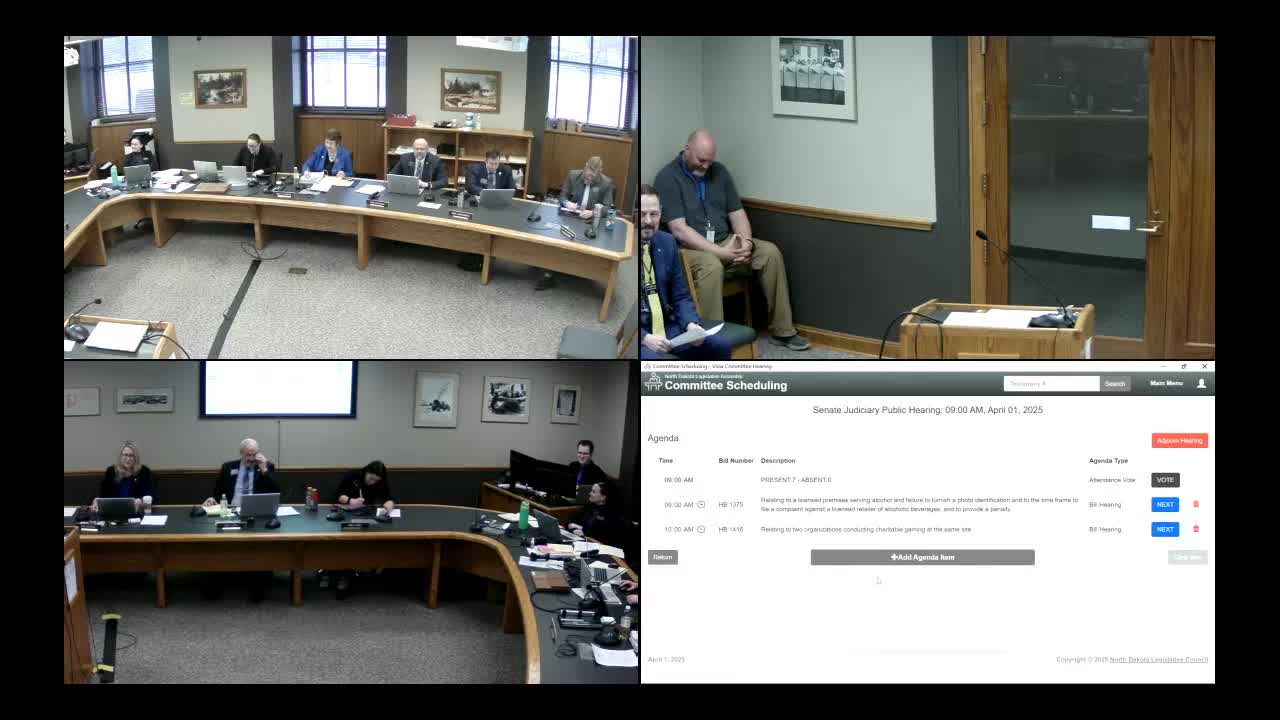
The Senate Judiciary Committee advanced House Bill 1375 after testimony that fake IDs and delayed complaints are hampering liquor-license enforcement and leaving bars vulnerable. The committee adopted a technical amendment replacing "fails" with "refuses."
The Senate Judiciary Committee on March 12 advanced House Bill 1375, a proposal that would allow a peace officer who has "reasonable and articulable suspicion" that a person on licensed premises is under 21 to request a photo identification and cite the person if they refuse, and would narrow the time window for filing complaints against licensed retailers to help preserve video evidence.
Representative Ben Koppelman, R-West Fargo, the bill sponsor, told the committee the measure grew from problems raised by a downtown Fargo bar owner who said fake identifications and late complaints left the establishment unable to defend itself in licensing proceedings. "These new fake IDs are very, very, very good," Representative Koppelman said, adding that owners often cannot produce video proof after 30 days because routine surveillance overwrites older files.
The bill contains two main provisions: a new on-premises requirement that people asked by an officer to show a non-driver photo ID or operator's license be subject to an infraction (with an option for the committee to elevate the penalty to a Class B misdemeanor), and a procedural change requiring complaints against licensed retailers to be filed within 14 days of the alleged violation so businesses can preserve evidence. Koppelman described the 14-day window as "a reasonable time frame" to allow law enforcement and city attorneys to assemble evidence before routine video is overwritten.
Supporters from law enforcement said the change fills a gap. Stephanie Ingebretson of the Chiefs of Police Association of North Dakota told the committee the association "felt like this does fill that gap in the law," and said local agencies, particularly near universities, are seeing more fake IDs and refusals to show identification when officers investigate potential underage drinking.
Captain Jason Craft of the Ward County (Minot) Sheriff's Office told the panel his department's evidence room holdings of fake IDs rose from three items in 2022 to 21 by 2024. "You can go online and buy one of these for $120," he said, describing the ready availability of convincing counterfeit licenses. Craft said the bill would create a process similar to other civil infractions (for example, proof-of-insurance citations) where a person issued a citation can later present valid ID to the prosecutor and have the charge dismissed.
Committee members questioned technical points the bill leaves open, including whether an ID must be unexpired or otherwise "valid," and whether the statutory language should say someone "refuses" rather than "fails" to provide identification. Several senators argued for clarifying language; the committee adopted an amendment to replace the word "fails" with "refuses." Senator Mehrdal moved the wording change and Senator Brownberger seconded; the voice vote passed.
After discussion, Senator Myrtle moved a do-pass recommendation on House Bill 1375 as amended; the motion was seconded by Senator Castaneda and carried in roll call. Recorded ayes included Senators Cory, Merrill, Castaneda, Brownberger, Lueck, Paulson and Chair Larson. No recorded no votes were entered at roll call.
The committee record includes testimony urging local incentives for ID scanners as a prevention tool, but witnesses said scanners are costly and that the bill provides an additional enforcement mechanism rather than a technology mandate.
With action taken, the bill now moves to the next stage in the legislative process; committee minutes show sponsors and law-enforcement stakeholders will continue to discuss penalty language and drafting details.