Lifetime Citizen Portal Access — AI Briefings, Alerts & Unlimited Follows
Senate Judiciary Committee hears bill to consolidate civil protection orders into a single chapter
Loading...
Summary
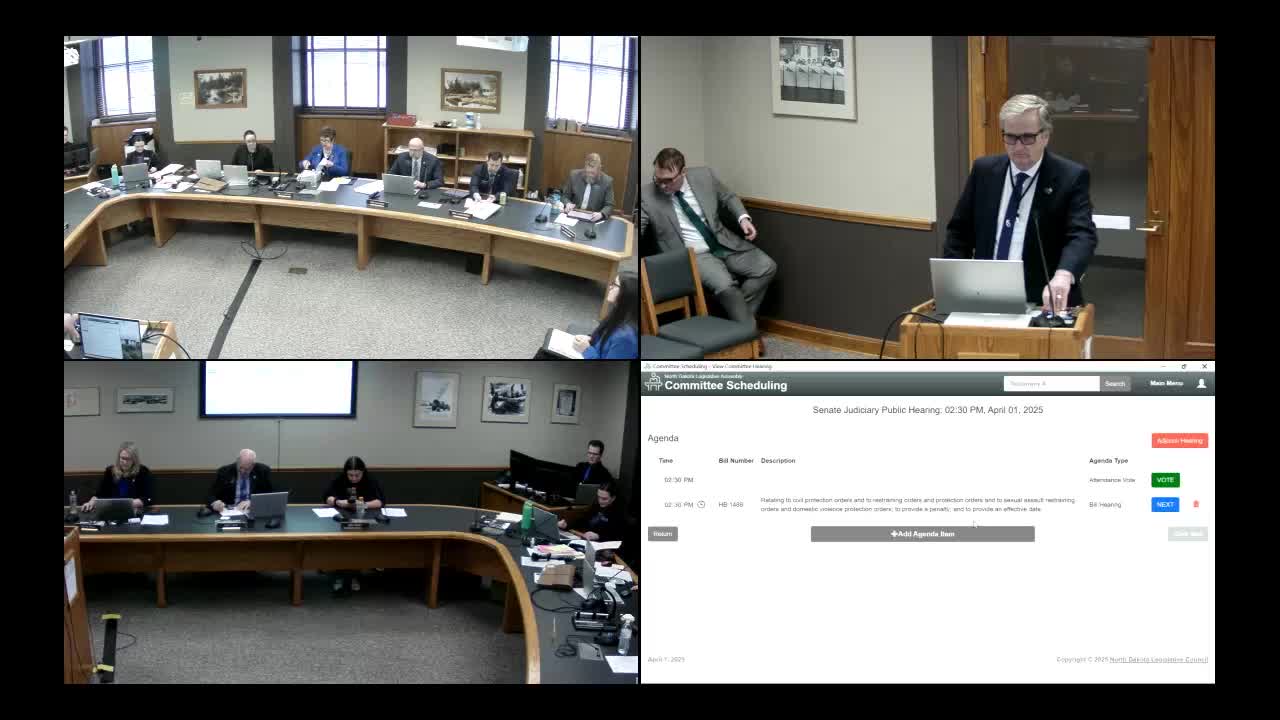
At a Senate Judiciary Committee hearing, Representative Bernie Satrim introduced House Bill 1489, a Supreme Court–sponsored measure that would consolidate three separate restraining- and protection-order statutes into a single new chapter titled "civil protection orders."
At a Senate Judiciary Committee hearing, Representative Bernie Satrim introduced House Bill 1489, a Supreme Court–sponsored measure that would consolidate three separate restraining- and protection-order statutes into a single new chapter titled "civil protection orders." Representative Bernie Satrim said the bill "puts all civil protection orders...into 1 single chapter."
The bill would gather disorderly conduct restraining orders (DCROs), domestic violence protection orders (DVPOs) and sexual assault restraining orders (SAROs) in one place, standardize petition requirements and remedies, remove filing and service fees for all three order types, establish uniform service by sheriffs with no service fee, require transmission of orders to the Bureau of Criminal Investigation (BCI), and set an effective date of Jan. 1, 2026 to allow Judicial IT and the self-help center time to update forms and systems. "Section 18 provides for an effective date of 01/01/2026," Sarah Behrens, staff attorney for the State Court Administrator’s Office, told the committee.
Why it matters: Supporters said consolidation reduces confusion for petitioners, clerks and law enforcement by centralizing definitions and procedures that are currently scattered across multiple code sections. Behrens described differences in current practice that create problems for petitioners and court staff: "Disorderly Conduct Restraining Orders...do not require there be a relationship of some type between the petitioner and the respondent," while a DVPO "requires a particular relationship such as family members, dating relationship, or roommate." She said the change will let courts correct a misfiled case type rather than dismiss and force a petitioner to start over.
What the bill would change: The draft moves existing statutory provisions into a new chapter (proposed 14-07.7), adds definitions drawn from current law, clarifies procedures for temporary and permanent orders for each type, specifies what must be included in petitions and when a guardian ad litem may be appointed for minors, and standardizes penalties for violations (a class A misdemeanor for a first violation, and a class C felony for a second or subsequent violation). Behrens summarized that the bill "flushes out the procedure for all types" and noted additional clarifying timeframes for law enforcement and expanded relief language allowing judges to exclude a respondent from places necessary to protect the protected individual.
Stakeholder positions and suggested amendments: Seth O'Neil of the North Dakota Domestic and Sexual Violence Coalition supported consolidation as clarifying and practical, but urged an amendment to include former dating relationships in the definition of family or household member so recent ex-partners could qualify for DVPOs. "I would hate to see that in practice" — referring to a judge replacing a DVPO with a DCRO in a way that would reduce protections — O'Neil told the committee. The Legislative Council, represented by Victoria Christian, proposed amendments folding language from two other senate bills (SB 2289 and SB 2326) into HB 1489 to prevent changes made elsewhere in the session from being lost when the old sections are repealed. Christian explained the package would preserve prior chamber changes and could be narrowed if the committee prefers confidentiality rules to apply only to particular order types.
Confidentiality and courtroom closures: The committee discussed whether hearings should be closed to the public. Behrens recommended keeping DCRO hearings open and limiting closed hearings to DVPOs and SAROs because the latter often involve highly sensitive personal information such as medical records. "I would suggest having DCROs remain open," she said, adding that DVPOs and SAROs frequently discuss "very private information that's discussed, which often is not in DCROs." The Legislative Council indicated it could narrow proposed confidentiality language to apply only to the DVPO and SARO provisions.
Fees and federal funding: Committee testimony said removing fees for all three order types protects federal funding tied to fee-free DVPOs; O'Neil said the state receives about $900,000 in federal funding that could be jeopardized if counties charge fees for DVPOs. The bill would eliminate filing and service fees for civil protection orders to provide uniformity.
Process and implementation notes: Witnesses described a subcommittee that drafted recommendations, listing judges, clerks, law enforcement, BCI staff and Judicial IT among participants. Legislative Council counsel said amendments are necessary to reconcile HB 1489 with changes made in other bills and asked the committee to authorize a consolidated draft for committee work. Committee leadership left the public hearing open and scheduled committee work on the bill for the following afternoon to consider the technical amendments and stakeholder changes. Chairwoman Larson asked legislative counsel to produce a single revised draft incorporating the requested changes; Victoria Christian agreed to prepare it.
Outcome: The committee left the hearing open for further committee work and did not take a final vote. Committee staff and stakeholders were asked to draft and review amendments and to reconvene for committee work the next day.