Get Full Government Meeting Transcripts, Videos, & Alerts Forever!
Get email alerts on the Property Crime Security Devices topic
No spam. Unsubscribe anytime.
House approves statewide standards for battery‑charged security devices powered by solar
Summary
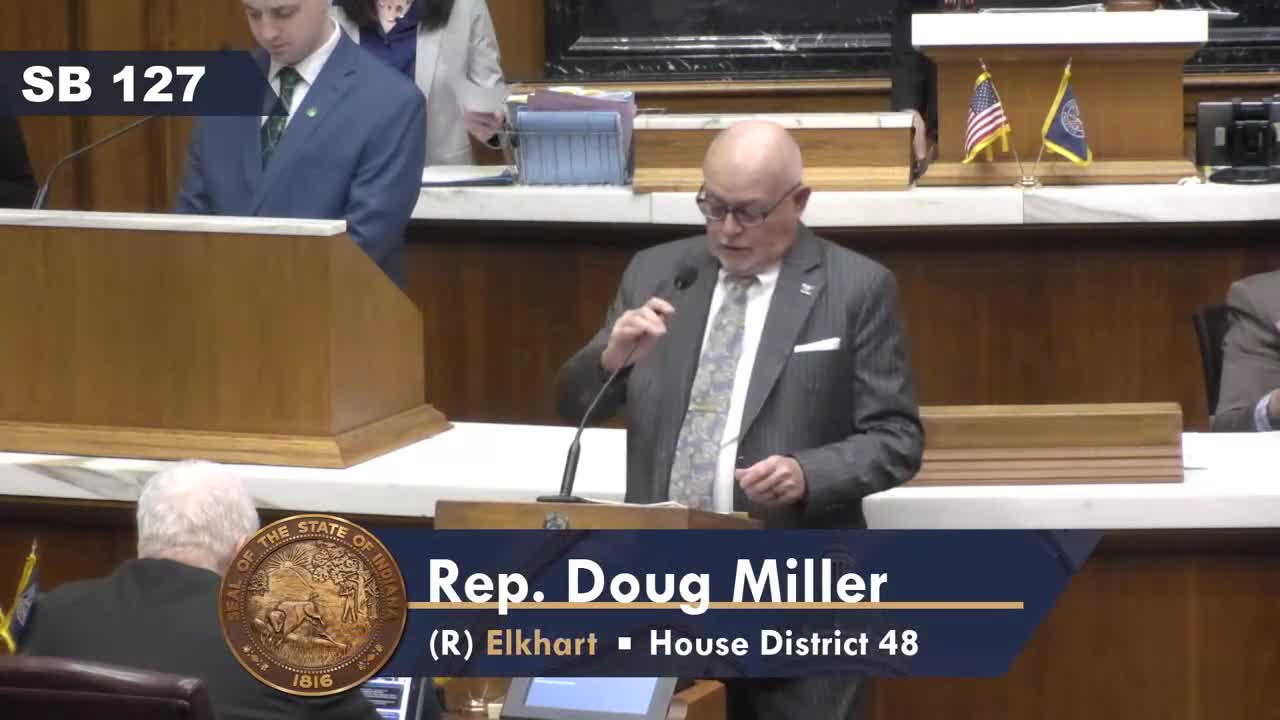
Senate Bill 127 passed on March 26, 2025, creating a statewide definition and permitting framework for battery‑charged security devices, including compliance with safety standards, signage, height and perimeter rules; the sponsor said businesses would receive relief from commercial property crime.
The Indiana House approved Senate Bill 127 on March 26, 2025, to establish a statewide definition and permitting framework for battery‑charged security devices — including those powered by solar‑charged batteries — that are used to secure manufacturing, industrial and commercial properties.
Representative Miller, who presented the measure on the floor, said the bill "authorizes the statewide use of battery charged security devices powered by solar charged batteries to secure manufacturing industrial and commercial properties." The bill defines a battery‑charged security device in state statute as an alarm system and sets conditions for deployment, including adherence to international safety standards, required warning signage, height restrictions and perimeter barrier requirements.
Representative Miller told colleagues that the bill would provide "immediate necessary relief from commercial property crime" by clarifying that these devices are permitted like other alarm systems. He added local governments would retain authority to prohibit installations that do not meet state law requirements and could charge a fee for an alarm system permit.
A brief question period followed on whether some communities had been prohibiting such systems and whether concerns involved system reliability. The House recorded final passage; the floor transcript recorded the roll call outcome as "9 4 ayes. 1 no," and the presiding officer announced the bill had passed.
What the bill does: it adds a statutory definition for battery‑charged security devices, requires compliance with safety and signage rules, preserves local authority over noncompliant installations, and allows local permit fees for alarm systems.
Next steps: The bill will be transmitted to the Senate for notification of House action and any subsequent steps toward enactment.