Get Full Government Meeting Transcripts, Videos, & Alerts Forever!
Get email alerts on the World Cup 2026 topic
No spam. Unsubscribe anytime.
City and local organizers outline World Cup planning: fan zones, transit, security and small-business efforts
Summary
City and Local Organizing Committee officials briefed council on planning for the 2026 FIFA World Cup, including a Seattle fan celebration at Seattle Center, neighborhood microgrants for community events, small-business assistance, public-safety planning and federal and state funding requests.
Seattle officials and representatives of the local World Cup organizing committee updated council members March 31 on preparations for the 2026 FIFA World Cup, including neighborhood outreach, transportation planning and safety and security funding requests.
Deputy Mayor Greg Wong introduced the panel and Kylie Ralph, director of World Cup operations in the mayor's office, told the council, "We are 436 days away" from hosting matches, framing the briefing as a point-in-time overview of planning across city departments and the local organizing committee.
April Putney, chief strategy officer for the Seattle FIFA Local Organizing Committee, described roles: FIFA handles stadium operations and international coordination, the local organizing committee manages events outside the stadium footprint, and city departments will continue to provide enhanced government services. "We wanted to make sure that we are doing that in light of and consistent with our region's values," Putney said, describing the LOC's six legacy pillars: human rights, accessibility, sustainability, children, culture and community.
Key details presented:
- Match and attendance: Seattle is scheduled to host six matches (four in the group stage and two in the knockout stage). The LOC projected up to 750,000 visitors to the city during the three-week tournament window and estimated large cross-border movement with Vancouver, B.C., as a nearby host.
- Economic impact and jobs: Early modeling by Visit Seattle with Tourism Economics estimates nearly $1 billion in economic impact in King County, more than $100 million in direct state and local tax revenue and nearly 21,000 local jobs supported between planning and the event.
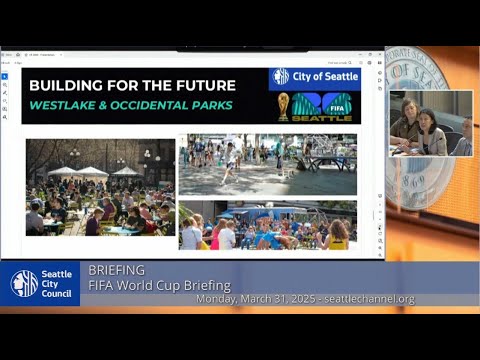
- Fan celebrations and neighborhood outreach: The city and LOC plan an official fan celebration at Seattle Center, expecting 15,000 to 30,000 people daily, and a network of nine statewide fan zones to extend access. The city said it will provide microgrants (funded in the 2025 city budget at about $500,000) to neighborhood groups; the goal is at least one community celebration in each council district.
- Small-business support: The LOC and Visit Seattle will provide toolkits and technical assistance; King County-funded programs will deliver localized technical assistance and the city will fund neighborhood liaisons in the stadium-adjacent neighborhoods of the Chinatown-International District, Pioneer Square and SoDo to offer one-on-one support.
- Labor and human-rights commitments: The LOC said it has signed a labor-standards agreement with MLK Labor for work at Seattle Center fan activities and highlighted collaboration with trafficking-prevention nonprofits and federal partners to provide training and outreach.
- Safety, security and funding: The LOC and city said all 16 host cities are coordinating federal asks. Locally, the LOC said it supports a collective federal request of $625 million for host-city security; the Seattle-specific ask is $33 million. The OIR noted a $5.5 million item for safety and security in the Senate budget and city staff said they are working to preserve that funding during negotiations.
- Transportation goals: The city aims for 80% of ticket holders to arrive without a personal car, citing expanded transit service, a planned circulator bus connecting Lumen Field, Seattle Center, Chinatown-International District and the waterfront, and permanent walking/bike connections such as the Elliott Bay connector.
Council members pressed officials on neighborhood selection for microgrants, mitigation for trash and restroom needs, transit safety and staffing, and whether federal and state funding requests will cover the security and transportation gaps the city anticipates. April Putney said the three prioritized neighborhoods were chosen because they are the closest to the stadium and likely to bear the largest impacts; LOC and city staff said they will expand outreach and create office hours for neighbors and businesses to ask questions.
Why it matters: The World Cup will bring substantial short-term visitor demand and permanent infrastructure and neighborhood changes; city staff said they are aiming to maximize local economic benefit while mitigating burdens on stadium-area neighborhoods.
Next steps: The LOC and city plan further briefings as the tournament draw (expected in December) determines which teams and fan populations will come to Seattle; the LOC expects to launch volunteer recruitment and ticket sales in the months after the draw.