Get Full Government Meeting Transcripts, Videos, & Alerts Forever!
Get email alerts on the Early Literacy topic
No spam. Unsubscribe anytime.
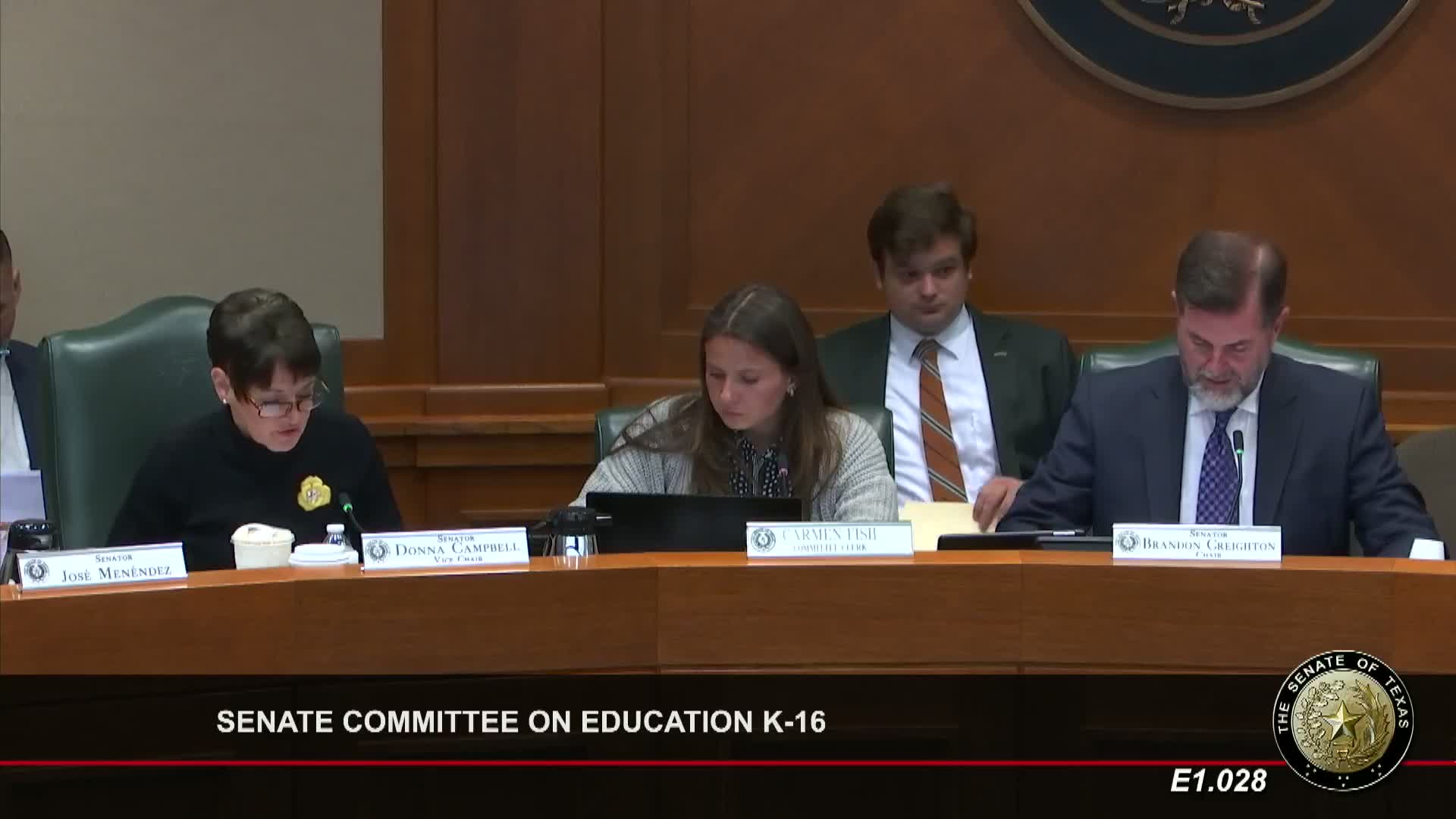
Committee adopts substitute for early‑literacy bill to expand screeners, teacher supports and pre‑K funding
Summary
The Senate Committee on Education K‑16 adopted the committee substitute for Senate Bill 2,252, a multi‑part early‑education bill by Sen. Brandon Creighton to expand screening, teacher support and funding for high‑quality pre‑K programs and to strengthen kindergarten‑through‑third‑grade literacy and numeracy work.
The Senate Committee on Education K‑16 adopted the committee substitute for Senate Bill 2,252, a comprehensive early‑learning bill sponsored by Sen. Brandon Creighton that seeks to strengthen kindergarten through third‑grade literacy and math instruction, expand screening and progress monitoring, fund teacher stipends for literacy and math academies, and increase support for eligible pre‑K students.
Creighton told the committee the bill builds on prior legislation and committee interim work to improve tier‑1 instruction and give teachers “the tools and training they need to close learning gaps.” He cited national assessment results as context: “69 percent of Texas fourth graders scored below proficient on the 2024 NAEP reading exam,” and framed the bill as a combined education and workforce measure to improve foundational skills.
The committee substitute preserves stipends for teachers who complete literacy and math academies, clarifies how early literacy and numeracy screening instruments are administered and reported, adds screening options (moving from one alternative to two additional alternatives for a total of three), labels an adaptive vocabulary screener as a pilot rather than a statewide mandate, and requires superintendent reporting of screener results to school boards. The substitute also includes full‑day funding for eligible four‑year‑old pre‑K students who attend high‑quality programs and confirms that the early education allotment applies to early learners with added supports for educationally disadvantaged children.
Invited witnesses described classroom and program results. Stephanie Augenbaugh, managing director at Uplift Education, described a district and charter experience using brief diagnostic screeners and intensive small‑group tutoring: “Our early literacy support program is 1 on 1 or 1 on 2 brief reading tutoring sessions with a live tutor, not an AI.” Augenbaugh said targeted tutoring generated outsized gains for the students furthest behind and cited results from randomized evaluation work showing measurable growth.
An invited special‑education expert testified that districts have long used instruments in special education and that the bill aligns statutory dyslexia‑screening requirements with universal screening and clearer data‑review and intervention directives. “At any time, a disability is suspected… the requirements in this bill would not supersede a district’s responsibility to refer a student for special education evaluation,” the witness said, while urging alignment between dyslexia screening and the bill’s instruments.
Amber Shields of the Commit Partnership stressed that early identification and high‑quality pre‑K matter to later outcomes and urged the committee to scale proven interventions statewide. “Only 46 percent of Texas third graders are currently reading on grade level,” she said, arguing that earlier, consistent screening tied to evidence‑based intervention helps districts catch students before gaps widen.
Committee members asked technical questions about how the short diagnostic screeners differ from high‑stakes testing and how gains from targeted tutoring are quantified. In one exchange Sen. Paxton asked about a referenced “seven‑month” gain; Augenbaugh explained that rigorous small‑group tutoring programs can accelerate growth substantially, citing estimates of about “1.7” years of academic growth in a year for students receiving intensive intervention.
Sen. Paxton moved adoption of the committee substitute; there was no objection and the substitute was adopted. The bill will proceed through the legislative process with the committee’s staff and TEA to finalize operational details and reporting timelines.