Get Full Government Meeting Transcripts, Videos, & Alerts Forever!
Get email alerts on the School Safety topic
No spam. Unsubscribe anytime.
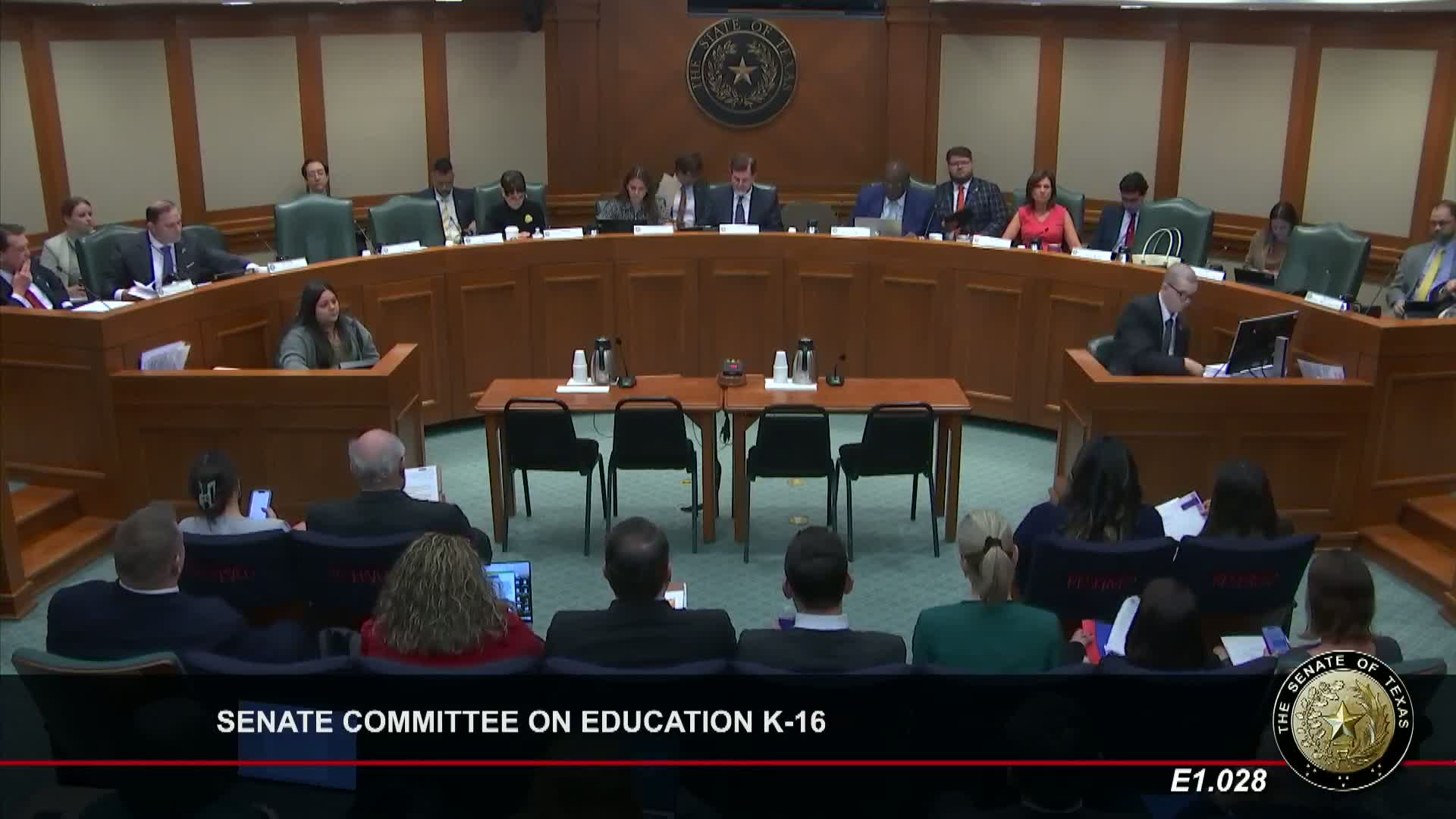
Committee adopts substitute for school‑safety cleanup bill; TEA commissioning, special‑education safeguards and drone vendors draw testimony
Summary
The Senate Committee on Education K‑16 adopted the committee substitute for Senate Bill 12 62, a school‑safety cleanup bill by Sen. Nichols, and heard resource and public testimony on TEA‑commissioned peace officers, new special‑education safeguards in threat assessments and a private vendor’s proposal to use remotely piloted less‑lethal drones in active‑shooter responses.
The Senate Committee on Education K‑16 adopted the committee substitute for Senate Bill 12 62, a school‑safety “cleanup” bill from Sen. Charles Nichols, and heard extended testimony from state safety officials, a TEA resource witness, district safety staff and private vendors including a company proposing remotely piloted less‑lethal drones to confront active shooters.
The substitute, sent up by Sen. Paxton and adopted without objection, would allow the Texas Education Agency to commission peace officers for school‑safety purposes so those officers could support local law enforcement during emergencies; require that a “good cause” exception to the armed‑guard requirement be renewed on an annual basis; create a report based on intruder‑detection audits and vulnerability assessments; and require that behavioral threat‑assessment teams handling cases involving students with disabilities include a person knowledgeable about the student’s disability.
The provisions are framed as technical follow‑ups to House Bill 3 and other recent school‑safety work. Sen. Nichols said the bill “follows up on the good work that was done” and that the substitute reflects requests from the Texas School Safety Center.
TEA and safety‑center witnesses described how the commissioning would operate. Shane Sexton, the TEA resource witness, said the licensing authority (TCOLE) certifies officers but that the agency employing an officer is where the officer is commissioned, and that a TEA commission would facilitate interagency communications during incidents. Kathy Martinez Prather, director of the Texas School Safety Center at Texas State University, answered procedural questions and supported the bill’s clarifications.
Resource and public testimony highlighted two fault lines in the debate: how much authority a TEA‑commissioned officer would have in practice, and whether private, remotely piloted less‑lethal systems should be authorized as an alternative where districts cannot station armed officers.
Justin Marston, CEO and founder of Campus Guardian Angel, described a commercial managed service that places charging boxes of small drones on campuses and pilots them remotely from an Austin operation center. “If a shooter walks into a school that we’re defending, our goals are to respond in 5 seconds, confront the shooter in 15 seconds, then degrade or incapacitate the shooter in 60 seconds,” Marston testified. Co‑founder Bill King, a retired Navy special‑operations leader, said the system had been exercised in multiple joint drills and that remote operators can provide rapid targeting and situational awareness: “I know this will work because I’ve already done it hundreds of times in missions with the SEAL teams.”
Rick Goodrich, chief of safety and security for Boerne Independent School District, supported the bill and the idea of flexible options where districts cannot staff officers. “Silent panic alarm technology, the hardening of facilities and the placement of armed officers in our schools are a game changer,” Goodrich said, adding that shortages of officers leave some campuses exposed.
Disability Rights Texas supported the provision strengthening special‑education input for threat assessments. Maya Volk testified that including professionals who understand a child’s disability “would enhance threat assessment accuracy by helping teams distinguish between genuine threats and manifestations of a disability,” and cited data that students with disabilities are disproportionately involved in reported threats.
Committee members pressed witnesses for operational details. Sen. West asked whether TEA‑commissioned officers would be certified through the Texas Commission on Law Enforcement (TCOLE) and whether commissioning would allow law enforcement to share sensitive information with TEA officers; Sexton said commissioning would allow interagency cooperation and facilitate access to law‑enforcement information during incidents. Senators asked whether commissioning would create a broader authority beyond buildings and grounds; witnesses said the intent is to limit the role to the school‑safety functions described in the bill.
Campus Guardian Angel witnesses described pricing and pilots’ operations: the company testified its managed service runs about $4 per student per month, charges $15,000 for a box of six drones, and that remote pilots would operate from an Austin command center. Testimony and questioning addressed remote pilot staffing, how many tactical teams would be needed to cover statewide contracts, and how the system identifies a shooter in a classroom before applying less‑lethal effects. Witnesses emphasized they had exercised the system in district drills and in multi‑agency exercises.
Public testimony closed after several witnesses and the committee left Senate Bill 12 62 pending for further consideration.