Get Full Government Meeting Transcripts, Videos, & Alerts Forever!
Get email alerts on the Renewable Energy Solar topic
No spam. Unsubscribe anytime.
Invenergy outlines 200‑MW "Olympus" solar project, answers county questions
Summary
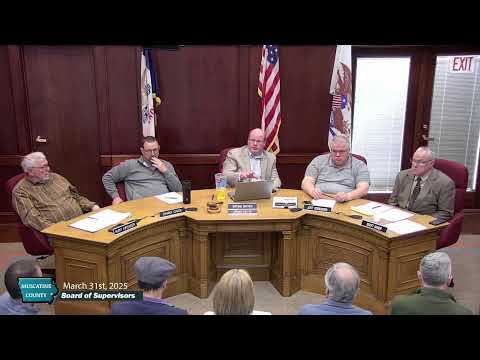
Invenergy representatives described the proposed 200‑megawatt Olympus Solar project and a 50‑megawatt battery component to the Muscatine County Board of Supervisors, reviewed permitting and timeline, and took public questions and comments for roughly an hour and a half on March 31.
Steve Morris, a developer with Invenergy, told the Muscatine County Board of Supervisors on March 31 that the company plans to seek local permits this year for the Olympus Solar project, a proposed 200‑megawatt solar facility with a 50‑megawatt battery storage component. Morris said the project currently would occupy roughly 1,100 acres and that Invenergy has easements signed on about 5,500 acres in the broader study area.
The presentation came during the board’s regular meeting. Morris said the project has a generator interconnection agreement with the Midcontinent Independent System Operator, or MISO, and would connect at the Sub‑92 substation between West Liberty and Atalissa. He said Invenergy expects to apply for the county special‑use permit and a floodplain development permit in June and to seek an Iowa Utilities Commission permit (required for projects above 25 MW). If permitting proceeds as planned, Morris said construction could begin in late 2026 with a target operation date in December 2028.
“The project is gonna be roughly 40 years in operation,” Morris said, describing signed easements (32 agreements to date) and a typical contract structure with an initial 25‑year term and an option for another 25 years. He said Invenergy expects roughly 200 construction jobs for the build and three to five permanent operations positions. Morris estimated landowner payments on the project at about $2,000,000 annually during operation.
Why it matters: project size and location, local tax treatment and permitting pathway will determine how the development affects county revenue, roads, floodplain management, and neighbors’ uses of land. Invenergy said the company aims to reduce the final site footprint as engineering, environmental and wetland studies proceed.
Technical, environmental and design details offered by Invenergy included single‑axis trackers with bifacial polycrystalline silicon panels and steel racking; Morris said the panels used by Invenergy do not contain PFAS. The company described recent geotechnical and site‑characterization work and said wetland delineations and other environmental studies are ongoing. Morris said the battery storage will occupy about 3.5 acres and would sit adjacent to the project substation.
Counsel and operations: Samantha Morris of Brown Winnick, legal counsel on the project, described how renewable generation bids into the MISO market and said, “renewable energy should bring your energy prices down” by displacing higher‑cost bidders in dispatch. Invenergy representatives also said they have an internal setback of roughly 340 feet to the nearest residence for equipment and that the county setbacks are less restrictive than Invenergy’s internal standard.
Safety and decommissioning: Invenergy described several mitigation measures they plan to use and to require by contract, including a road‑use agreement, a financial security for decommissioning and a vegetative management plan. On batteries, Morris said the company uses lithium iron phosphate battery chemistry, monitors temperature remotely, trains local operations staff and coordinates training with local fire and emergency services. He characterized a severe battery incident as “mostly a let it burn kind of situation” while emphasizing monitoring and cooling systems to reduce the risk of thermal runaway.
Public comments and concerns: More than a dozen Muscatine County residents spoke during public comment after the presentation. Supporters including Mark Patton (Muscatine County Clean Energy Board; farmer) and David Shield (farmer) argued the project provides steady lease income for landowners, local tax revenue, and wider renewable generation benefits. Patton summarized economic benefits, saying solar rent can be a stable revenue source for landowners and that properly sited utility solar does not impose ongoing service burdens.
Opponents and concerned residents raised questions about noise from inverters and transformers, decommissioning and end‑of‑life disposal, potential storm or tornado damage, effects on property values and water runoff, and whether county zoning and ordinances are current to address utility‑scale solar. Diane Glenny and Rhonda Meredith urged more detailed local ordinance review and stronger decommissioning and setback rules; Tom Dalsing and others expressed skepticism about claimed benefits and long‑term land impacts.
Next steps: County staff explained that Invenergy will need to apply for a special‑use permit through the Board of Adjustment for utility‑scale solar in the A‑1 Agricultural District, with mailed notice to adjacent property owners within 500 feet of affected parcels and a public hearing process. County Community Development Director Eric Furnace explained the separate floodplain, building‑permit and electrical permitting steps that would follow, and emphasized that the Board of Adjustment (not the Board of Supervisors) issues the special‑use permit decision under current county ordinance.
What the board did: The March 31 meeting included the presentation and a public Q&A; supervisors took no formal action on the project that day. Multiple residents were told Invenergy staff would remain to take follow‑up questions after the meeting.
Ending: Invenergy representatives left contact information and said they will continue community outreach as permitting progresses. The county’s next formal opportunities for public input on a siting application would come if and when Invenergy files a special‑use permit application with the Board of Adjustment.