Get Full Government Meeting Transcripts, Videos, & Alerts Forever!
Get email alerts on the Pensions topic
No spam. Unsubscribe anytime.
Nebraska Investment Council reports $42.7 billion in assets; defined-benefit plans return 11.2% in 2024
Summary
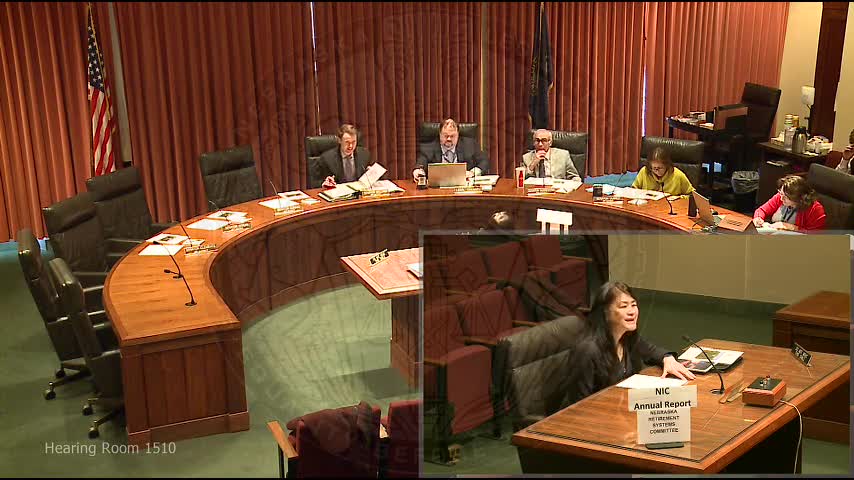
State Investment Officer Ellen Hung told the Nebraska Retirement Systems Committee the Nebraska Investment Council had $42.7 billion in assets across 32 programs as of Dec. 31, 2024; defined-benefit plans returned 11.2% for the year and the council approved hiring a private-markets consultant subject to budget approval.
State Investment Officer Ellen Hung told the Nebraska Retirement Systems Committee that the Nebraska Investment Council managed $42.7 billion across 32 investment programs as of Dec. 31, 2024, and that the council’s defined‑benefit plans returned 11.2% for 2024.
The annual report Hung presented to the committee said the council’s assets rose from $40.8 billion at the end of 2023. Hung said the defined‑benefit plans account for about 42.7% of total assets and the council’s operating investment pool makes up about 21.5% of assets, with the latter managed internally by council staff.
The details: the council reported $18.2 billion in defined‑benefit plan assets, a 11.2% 2024 return for those plans (slightly below their benchmark but in the top quartile versus peers), and a 9.4% return for the Omaha Employees Retirement System in 2024. Hung said the council is still working through holdings it inherited from the Omaha system in 2017, which helps explain the lower recent returns for that plan. She also confirmed the general endowment returned 6.2% in 2024 and noted the permanent school fund within the general endowment is about $1 billion; the report lists a 7% total return since inception for the general endowment as calculated by the custodian and confirmed by the council’s general consultant.
Hung described operational changes in 2024: the council completed a custodial‑bank transition to Northern Trust and switched securities‑lending services to Mitsubishi, which Hung said increased expected annual securities‑lending revenue by about $2.6 million. She said staff realignment reduced administrative roles and the council’s investment staff totals nine people.
On portfolio construction, Hung said the council has begun a new asset‑liability study with its general consultant to reassess expected returns and funding assumptions; she told senators the study will be presented to the council at its June meeting. Hung said the board has selected and approved hiring a specialty consultant for private markets, subject to budget approval.
Committee members asked for clarifications. Senator Tony Sorrentino asked why some small state trust accounts show low target returns; Hung said those accounts are invested in fixed income for liquidity because the funds are typically “money in, money out.” Senators asked about the Omaha retirement system’s funded status; Hung said she believes the funding ratio is “in the fifties” but did not provide a precise figure during the hearing and offered to follow up.
Hung and senators also discussed asset allocation. Hung pointed to the defined‑benefit plan allocation shown in the report: roughly 24% U.S. equity, 22% global equity and 11.5% non‑U.S. equity (with the three components summing to the plan’s public‑equity allocation). She emphasized the council’s long‑term investment horizon and said the asset‑liability study may recommend modest de‑risking of the portfolio depending on liabilities and expected returns.
Hung closed by inviting committee members to the council’s annual education retreat, which she said will likely be held in August or October and will include a macroeconomic overview and equity‑market discussion. That concluded her report to the committee.