Get Full Government Meeting Transcripts, Videos, & Alerts Forever!
Get email alerts on the Minimum Wage Policy topic
No spam. Unsubscribe anytime.
Heated floor debate over minimum-wage carve-outs; motion to indefinitely postpone filed
Summary
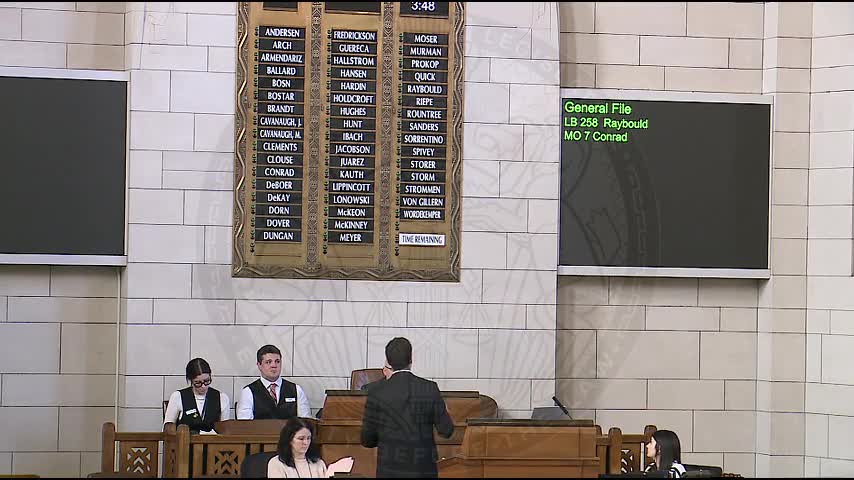
Senator Raybould introduced LB258 proposing caps and carve-outs to the voter-approved minimum-wage increases (including a 1.5% CPI cap, a youth wage and a higher training wage). Senator Conrad filed a motion to indefinitely postpone the bill; senators debated whether the Legislature should alter voter-approved initiative language.
Senator Raybould opened discussion of LB258 with a three-part proposal she described as a balance between the voter-approved minimum-wage increase and small-business concerns. Raybould said the bill proposes a CPI cap (fixed at 1.5% annual adjustment), a youth wage set at $13.50 for 14–15-year-olds with a 1.5% increase every five years, and a training wage raised to $13.50 for 90 days (90% of state minimum) before moving to full minimum wage. “This is a fair-minded attempt to craft some centrist legislation,” Raybould said, and she cited letters from small-business owners, grocers and child-care providers urging flexibility.
Senator Conrad moved to indefinitely postpone LB258 (IPP motion), arguing the motion would protect the will of the voters and preserve indexing to the Consumer Price Index for All Urban Consumers (CPI-U) in the Midwest region as the ballot authors intended. "The will of the voters said we're going to have modest yet meaningful increases in the minimum wage to keep pace with inflation," Conrad said; she and other opponents argued an IPP would stop what they described as a rollback.
Supporters of Raybould’s measure — including several small-business representatives and franchisees whose written testimony was read into the record — said the proposed carve-outs would preserve entry-level opportunities for teenagers, help small employers (notably grocery stores and child-care centers) that cited lost teen hires and families priced out of care, and give predictability to businesses. Raybould and supporters repeatedly cited local business letters describing lost teen hires and day-care families who could not afford higher fees.
Opponents said the people had already acted via Initiative 433 (2022) to raise the minimum wage to $15 by 2026 and index future increases to CPI-U, and that changing the formula now would undercut the ballot initiative and low-wage workers. Several senators urged honoring the ballot language and noted the state constitution requires a higher legislative threshold to alter voter-initiated statutes.
Senators debated multiple details on the floor: the current statutory rate ($13.50 at the time of debate), the initiative schedule to $15 in 2026, the existing federal training-wage baseline (75% of federal minimum or $5.44 under current federal standards), and the interplay of indexing versus a fixed 1.5% growth rate. The IPP motion was fully briefed and debated on the floor but no final disposition of the IPP motion appears in the record excerpt; debate continued for multiple hours with many senators weighing constituent contacts, small-business concerns and worker protections.