Get Full Government Meeting Transcripts, Videos, & Alerts Forever!
Get email alerts on the Small Business Regulation Procurement topic
No spam. Unsubscribe anytime.
Women’s entrepreneurial group urges inclusion of small businesses in regulatory rollbacks and offers procurement training
Summary
Antoinette Ball and colleagues from the Women’s Entrepreneurial Opportunity Project told a House committee that small businesses need clearer regulatory engagement, procurement training and certification guidance as state and federal contracting priorities shift.
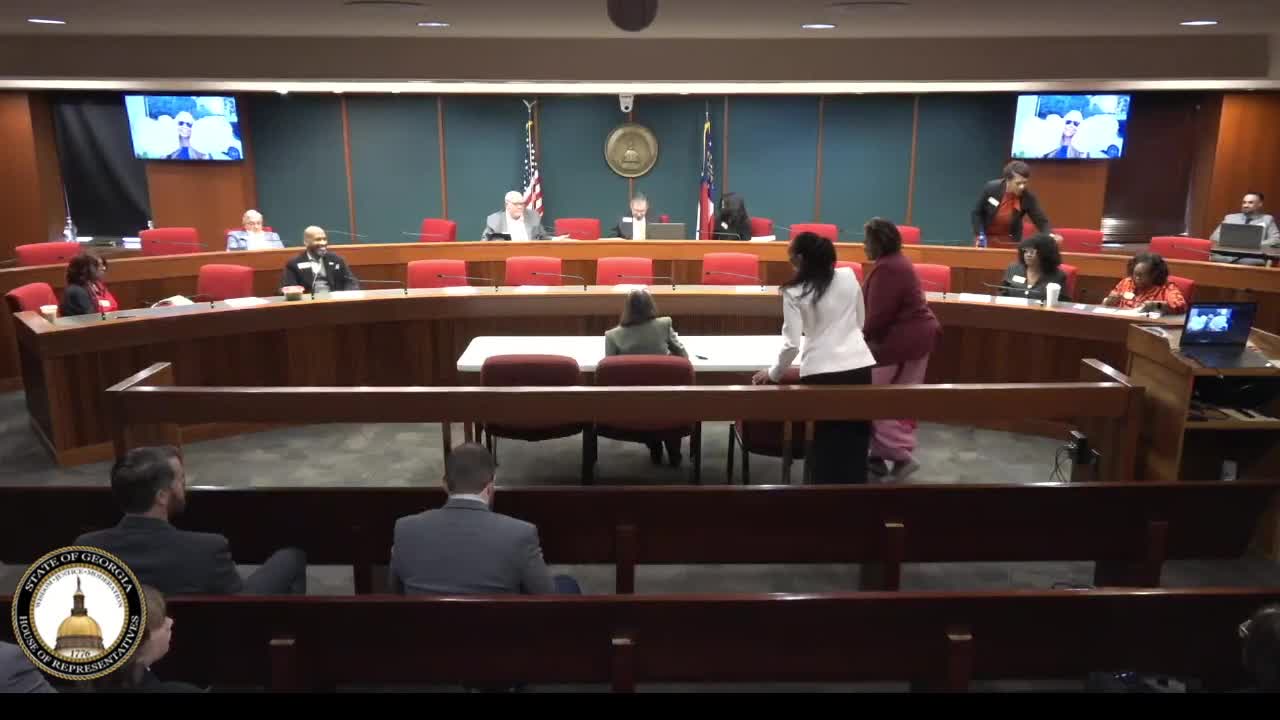
Antoinette Ball and colleagues from the Women’s Entrepreneurial Opportunity Project (WEAP) told the House Small Business Development Committee that their long-running nonprofit provides training, networking and procurement support to women entrepreneurs and urged that small businesses be included in regulatory-review processes tied to the so-called Red Tape Rollback Act of 2025 (SB 28).
“Entrepreneurship is more than just a career choice,” Ball said, describing WEAP as a nonprofit based in Grant Park that focuses on civic engagement, leadership development and small-business support. She said the group has provided classes, forums and mentoring for more than two decades.
Shanae Commodore (identified in testimony as a WEAP leader) told the committee her work centers on helping small businesses navigate federal procurement and federal contracting vehicles such as GSA schedules. She said Georgia has “over 9,000 federal defense contractors, totaling over a billion dollars in revenue” and argued that state-level policy should help firms retool and scale into new contracting opportunities as federal procurements and agency priorities shift.
Montez Diamond, who described himself as founder of the Endow Group and an adviser on regulatory engagement, urged that SB 28 include stronger opportunities for small-business participation in economic-impact assessments and that legislators consider mechanisms — for example, task forces or formal advisory roles — that increase small-business input while agencies draft major regulatory changes. “Can a solution be created to allow them to be a part of the actual written legislation process?” Diamond asked.
Panelists recommended several policy and program steps the committee could consider or track: clearer public-notice and comment procedures tailored to small businesses, educational materials that explain how a proposed rule would affect specific firms, and legislative recognition of equivalencies between federal certifications (for example, GSA schedule holders) and state certifications such as DBE/MBE where technical qualifications substantially overlap.
Speakers also emphasized leadership succession and workforce development as a policy priority, noting that many experienced federal contractors and procurement experts are nearing retirement and that capturing institutional knowledge could support both entrepreneurship and state competitiveness.
Committee members asked about overregulation, the practical differences between federal and state certification requirements, and workforce development; presenters offered to provide additional outreach materials and to coordinate local workshops and “road-show” sessions for small-business owners.
The presenters said they host events and maintain an outreach network (they reported an online membership of roughly 900) and asked the committee to consider how statute and administrative process could be structured to give small businesses earlier, clearer and more actionable input on rulemaking and major regulatory changes.
The testimony referenced SB 28 (described in testimony as the Red Tape Rollback Act of 2025) and urged that the statute’s implementation include small-business impact analyses and formal engagement pathways.