Get Full Government Meeting Transcripts, Videos, & Alerts Forever!
Get email alerts on the Abuse Registry topic
No spam. Unsubscribe anytime.
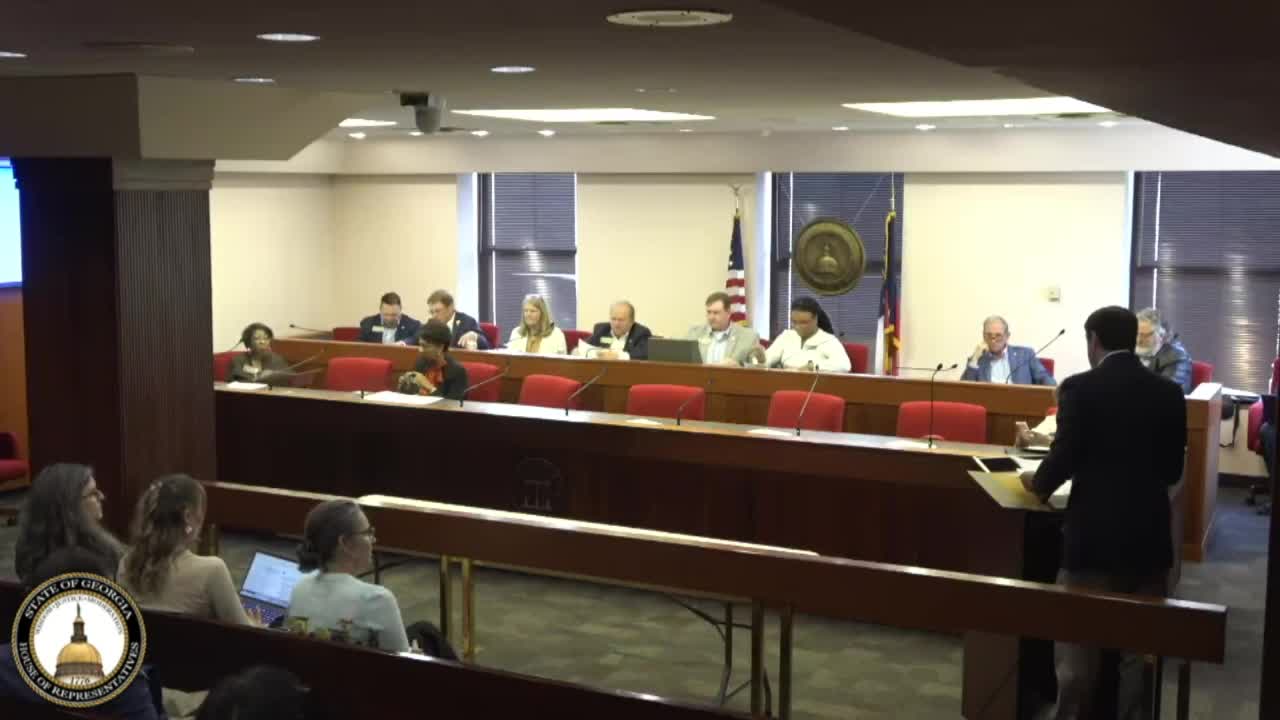
Georgia House committee advances resolution to study at-risk populations and abuse registry
Summary
The committee voted to advance House Resolution 816 as amended to create a study committee to examine abuse registries and state service delivery for at‑risk populations, with changes reducing membership and removing nonmember compensation.
Representative Hilton introduced House Resolution 8 16 to create a House study committee on at‑risk populations and an abuse registry, saying the proposal would let lawmakers examine models used in Tennessee, Kentucky and Texas and ‘‘look at folks in cases where there has been substantiated abuse, but not criminal action taken.’’
The committee adopted amendments that shrink the proposed study committee from 11 members to eight, reduce the number of House members on the panel from five to three, reduce nonlegislative members from six to five, strike a provision authorizing compensation for nonmembers, and combine two listed nonmember slots. Representative Frey moved to accept the amendments as described by general counsel and the bill author; the motion was seconded and approved. The committee then advanced House Resolution 8 16 as amended by voice vote with no opposition announced.
The resolution would direct a study of whether a centralized registry could help employers and providers identify individuals with substantiated abuse findings when criminal charges were not pursued, and to examine how similar registries operate in other states. Hilton told the committee that, under some existing state practice, a substantiation that does not result in criminal charges can allow a person to move to a different facility and continue working, creating a known gap the study would examine.
Members and stakeholders discussed procedural and operational issues the study should address. Committee members and witnesses flagged two recurring concerns: (1) due‑process protections for people listed where there is no criminal conviction, and (2) timeliness and data access for providers who must hire quickly. Representative Frey and other members emphasized the need for an appeal process for individuals listed without a criminal record. The committee also discussed involving the Georgia Bureau of Investigation (GBI) and the Department of Behavioral Health and Developmental Disabilities (DBHDD) in conversations about data management; staff and witnesses noted that the GBI currently manages the database many providers use and that providers need timely responses so caregiving positions do not go unfilled.
Hilton said one meeting of the study committee should focus ‘‘holistically how we deliver services to our disability community’’ to address stakeholders’ difficulty navigating state programs. Witnesses introduced by Hilton included Rena Harris of the Georgia Advocacy Office, Nancy Pietra of the Alzheimer’s Association, and Charlotte Densmore of the Georgia Council on Developmental Disabilities; the record shows those organizations were invited to participate in the discussion although the transcript records only a portion of direct testimony.
The committee instructed staff to include GBI in follow‑up conversations about the registry and legislative counsel confirmed technical edits needed in the bill language (for example, converting some numbered items to Roman numerals and adjusting subsection labels) as the amendments were adopted. No funding amounts, statutory citations, or a timetable for the study were specified in committee testimony or the amendment language recorded in the transcript.
Votes at a glance: House Resolution 8 16 (as amended) — advanced by committee; outcome: approved (voice vote; no opposition announced).