Get Full Government Meeting Transcripts, Videos, & Alerts Forever!
Get email alerts on the Food Labeling And Safety Hbh17 topic
No spam. Unsubscribe anytime.
House committee hears bill to tighten labeling and testing rules for large-scale meat and poultry producers
Summary
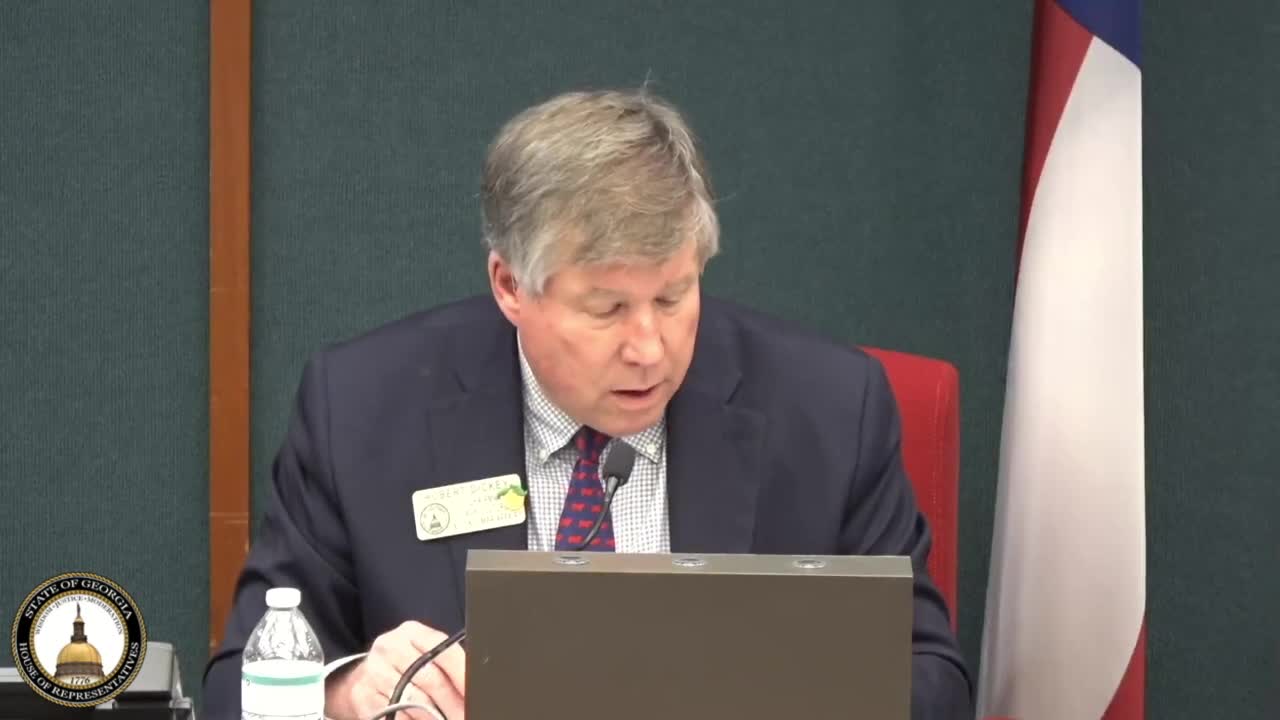
On April 1 the House Agriculture Committee held a hearing on HBH 17 (LC600163S), a bill that would require disclosures about production methods for large-scale meat and poultry and would set testing and penalty provisions; the measure received a hearing only and no vote.
The Georgia House Agriculture Committee on April 1 held a hearing on HBH 17 (LC600163S), a bill the author described as intended to improve transparency and fairness in labeling for large-scale meat and poultry producers. The committee did not take a vote; the item was presented for discussion and further refinement.
The bill, as described to the committee, would require producers and marketers that meet proposed “large-scale” thresholds to include conspicuous written disclosures about where and how livestock were raised. The draft defines large-scale grass-fed meat production as roughly 1,000,000 animals per year and large-scale pasture-raised poultry at about 250,000 birds per year (figures described in the bill text as a “ballpark” and subject to adjustment). The author said the measure aims to protect consumers who pay price premiums for labels such as “grass finished,” “pasture raised,” “grain finished” or “certified organic.” Small-scale producers were described in the hearing as outside the bill’s scope.
HBH 17 also includes a disease-testing provision for large-scale pasture-raised poultry. The draft language discussed in committee would require a minimum 3% of a live poultry flock to be tested weekly for highly pathogenic avian influenza (HPAI). Several committee members who identified themselves as poultry or cattle producers questioned how that testing requirement would be implemented and noted existing biosecurity practices for enclosed poultry houses. One member said integrated poultry operations typically test flocks before moving birds to slaughter; others said free-range flocks face different migratory-bird exposure risks that could make testing and biosecurity more complex.
Penalties for noncompliance are included in later sections of the draft; the presenter described them as “pretty stiff,” but the bill text reviewed in committee did not specify an exact schedule of fines during the hearing discussion. Committee members asked for clearer definitions — for example, what constitutes “pasture-raised” versus “grain-finished” — and for additional detail about who would carry out and pay for testing, how frequently, and how traceability would be documented.
Members who spoke generally supported the goal of protecting consumers and producers from misleading labels but urged more work on implementation. Representative Huddleston, who identified himself as a cattle and poultry producer, described current industry biosecurity measures and noted the role migratory birds play in transmitting avian influenza. Representative Dawson called the bill “innovative” and said the issue affects a growing national market. Representative Osteen asked specifically how difficult weekly testing of 3% of live flocks would be to implement and who would perform that testing. Representative Donahue raised examples of animals marketed as “grass fed” after brief grain finishing and said that kind of practice is what the bill seeks to clarify with definitions.
The sponsor told the committee the measure is intended as a consumer-protection and market-fairness bill and said the committee could refine definitions and thresholds before further action. He and other members said the committee plans additional off-season work, including hearing from producers and other stakeholders, and possibly coordinating a joint session with the Senate or a committee-of-the-whole to develop clearer definitions and implementation details.
Because the hearing was informational only, no formal action or vote was recorded on HBH 17 at this meeting. The committee presenter asked staff and members to provide input during the off season so the bill can be revised and returned for further consideration.