Get Full Government Meeting Transcripts, Videos, & Alerts Forever!
Get email alerts on the Roadway Infrastructure topic
No spam. Unsubscribe anytime.
City staff outline Cedar Lane extension plan and bridge cost challenges; TIF and bond options discussed
Summary
City engineers briefed the Community Planning and Transportation Committee on March 27 on a long‑discussed plan to extend Cedar Lane to Jenkins Avenue, including the need for a bridge over Bishop Creek, right‑of‑way needs, and potential funding paths such as a tax increment financing district and future bond cycles.
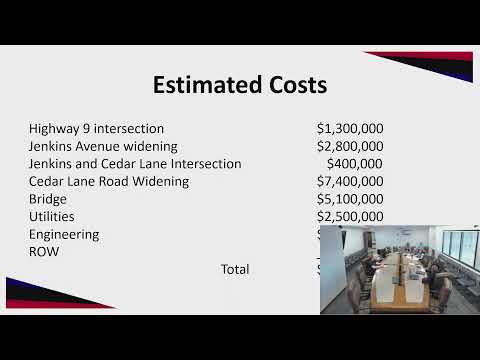
City of Norman staff presented details on March 27 about a proposed extension of Cedar Lane from its current end north to Jenkins Avenue and on to Highway 9, saying the project’s required bridge over Bishop Creek and additional right‑of‑way make costs substantial.
Tim Miles, City Engineer, said the “big challenge is, we need a bridge over Bishop Creek,” and explained that the bridge would need to meet the city’s hundred‑year flood standard. Miles estimated a crossing length of roughly 70 feet and a 50‑foot roadway width to accommodate the planned typical section.
Staff described differing typical roadway sections: a three‑lane section with bike facilities for Cedar Lane and a four‑lane section recommended for Jenkins Avenue because of heavy truck and commercial use. The plan also anticipates multimodal paths where appropriate rather than on‑street bike lanes.
Cost estimates discussed by staff for planning purposes included about $7,000,000 for Cedar Lane construction (exclusive of separate right‑of‑way costs) and a multi‑million dollar bridge component; staff mentioned the bridge alone could be in the range of about $5.1 million depending on scope. Councilors and staff noted those are planning numbers and would require detailed design to refine.
Funding options discussed included a tax increment financing (TIF) district tied to nearby commercial and residential development, piecing the work into the city’s street/bridge bond program, and pursuing federal or state grants. Staff said developer contributions for the Sooner Village preliminary plat might cover only a portion of Jenkins widening estimated at roughly $250,000–$300,000 as a developer deferral, and the city would likely need to advance most costs.
Committee members asked about relocation risk for a nearby active oil well and pipeline, coordination with the Oklahoma Department of Transportation for Highway 9 improvements, and whether federal emergency or mitigation funds (FEMA or OWRB) might be available because the road provides alternate storm evacuation routes. Staff said those are potential avenues to investigate but have not been secured.
Councilors discussed timing for another street/bridge bond. Staff said the current bond is a 10‑year program (2019) and that the next major bonding opportunity would likely fall in 2029; they also noted higher construction inflation and supply‑cost volatility have raised engineering estimates since 2019 and complicate competitive grant scoring.
No formal action or vote was taken; staff recommended continuing planning and pursuing funding opportunities, and council members asked staff to keep the project in planning for future bond packages and to pursue grants and developer coordination as possible.