Get Full Government Meeting Transcripts, Videos, & Alerts Forever!
Get email alerts on the Affordable Housing Rezoning topic
No spam. Unsubscribe anytime.
Clemson holds public hearing on rezoning request for 68-unit Mercy Housing affordable complex
Summary
City council heard public comment on a request to rezone seven parcels on Old Greenville Highway to allow a 68-unit affordable housing development targeted at households at or below 60% of area median income; Planning Commission recommended the rezoning and council has scheduled first and second readings in April.
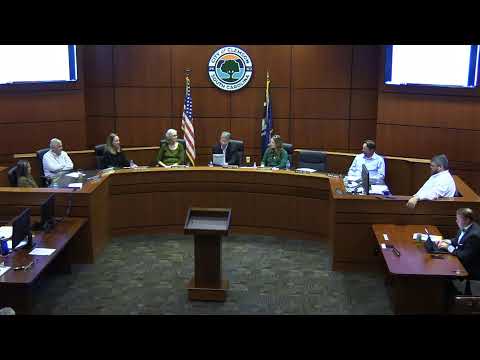
Clemson City Council on Monday held a public hearing on a rezoning request that would allow Mercy Housing Southeast to build a 68-unit multifamily affordable housing development on about 11 acres near 579 Old Greenville Highway.
The proposal would rezone seven parcels now zoned RM‑1 and RM‑2 (two‑family residential districts) to RM‑4 (multifamily residential). Planning Commission Chair Herb Tyler said the commission unanimously recommended the rezoning at its March 10 meeting.
The rezoning would be financed with federal low‑income housing tax credits and tax‑exempt bonds, the applicant said. The developer must complete the funding cycle before May, so Council set April 7 for the first reading and April 21 for the second reading of the rezoning ordinance.
Why it matters: The change would allow higher‑density housing targeted to households at or below 60% of area median income (AMI), a federally defined threshold used by the Low‑Income Housing Tax Credit (LIHTC) program. Supporters told council the project would add workforce housing without directly costing city funds; opponents raised traffic and density concerns.
Discussion and clarifications
Herb Tyler, Planning Commission chair, told council the commission asked the developer about several common public concerns and received answers the commission found satisfactory. “This is an opportunity that does not cost the city dollars,” Tyler said, describing the project as a private solution that would deliver units the city could not provide on its own.
Representatives of Mercy Housing Southeast described the organization as a national nonprofit that acquires and manages affordable housing long term. A Mercy Housing senior developer said projects under the federal tax credit program carry affordability restrictions (covenants) for at least 30 years and that Mercy typically remains the long‑term owner and manager of its properties. The developer said units will target households earning 60% AMI or below and that property management will determine individual eligibility.
Council and members of the public asked whether units could become student housing. Planning Commission members and Mercy Housing representatives said students would generally have to qualify as independent taxpayers to be eligible and that the 30‑year covenants (and the LIHTC program rules) make a conversion to conventional student housing unlikely. The developer said it bids construction work and may use preferred builders but would follow procurement rules tied to its funding sources.
Numbers and site details (as presented)
- Parcels: 7 parcels totaling approximately 11 acres near 579 Old Greenville Highway. - Units: 68 multifamily units targeted to households at or below 60% AMI. - AMI reference: Council discussion cited HUD figures; an example cited in the meeting was $88,600 as HUD AMI for a family of four for the Greenville‑Spartanburg MSA and other HUD tables used to calculate income bands and maximum tax‑credit rents. - Affordability term: developer stated a minimum 30‑year restricted covenant would apply under the LIHTC program.
What happened next
Council closed the public hearing at the end of its comment period. No rezoning vote was taken on March 17. Councilors scheduled the first reading of the rezoning ordinance for April 7 and a second reading for April 21 to meet the developer’s funding timeline.
Public comments included written submissions urging denial citing traffic and density, and in‑person speakers who expressed both support for bringing more affordable workforce housing and concern about potential student occupancy and added congestion. Planning Commission members emphasized the commission’s unanimous recommendation and asked the city to retain oversight if funding or site control issues arise.
Ending
The council’s next formal steps are the April readings. If council adopts the rezoning ordinance on second reading (or later), conditions of financing and recorded covenants required by the LIHTC program will govern occupancy and affordability; those technical conditions will be reviewed as the project proceeds through permitting and financing.